A few years ago Becky wrote a lovely post about finding treasures tucked into books, or that ARE certain books, and a treasure hunt that followed one find. That happened to me this week, so Becky's words, and our shared love of mystery and history, have been on my mind.
The other night, while talking to a friend on the phone, I began idly leafing through a big book on my nightstand, a 1929 edition of English Poetry and Prose of the Romantic Movement. I'd bought it at the flea market decades ago, but to be frank, I'd read little of it. It doesn't leap off the shelf calling "pick me, pick me!" like some books do. It's a dark green, imposing 1400-page tome with Bible-thin pages, penciled here and there with faint, studious notes— someone's textbook, too austere to curl up with, though I've reached or it now and then to look something up.
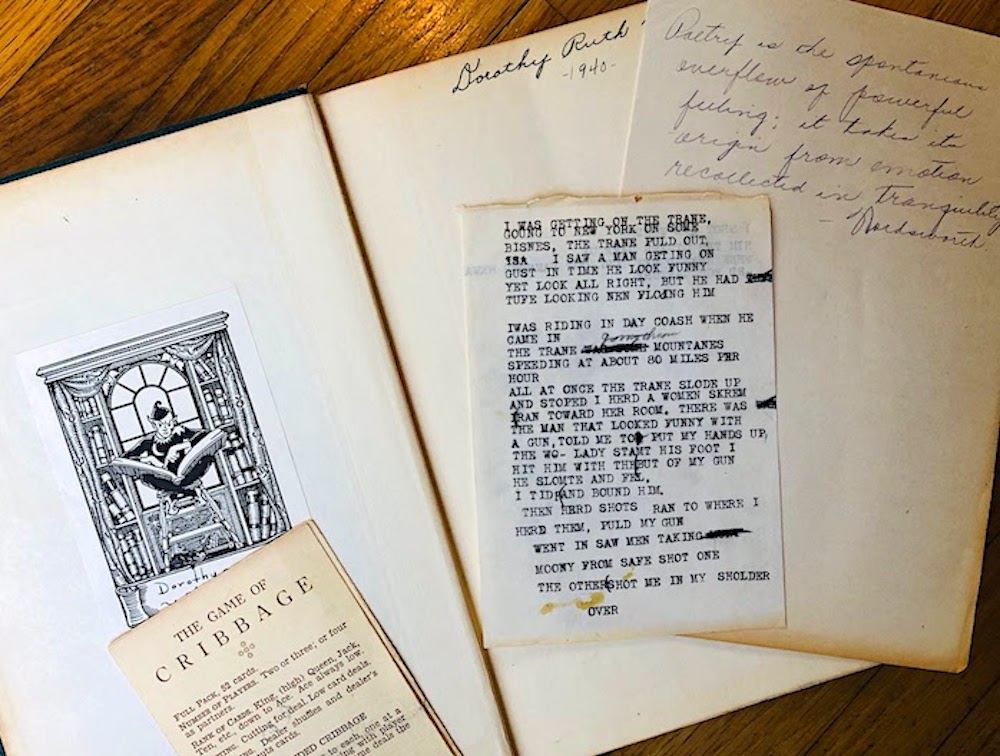
As I flipped through the volume, out fell a quote, pencil-written in a feminine script:
Poetry is the spontaneous overflow of powerful feeling; it takes its origin from emotions recollected in tranquility. - Wordsworth
That lovely definition, from the Preface to the poet's Lyrical Ballads, resonated with me, as it clearly had with the unknown student. Now I was more curious about who she had been. A few pages farther on I found a three-by-four aged ivory pamphlet in brown ink titled "The Game of Cribbage," and knew the owner of my book might have played, or wanted to play. I had an immediate image of a woman in early 20th-century dress, at a card table in someone's parlor, laughing with friends. Intrigued, I turned to the front and found her bookplate and name, along with the year, 1940. For privacy reasons, I'll hold back her surname here, but her first name was Dorothy, like Wordsworth's dear sister, and her middle name was Ruth, like mine.
I told my friend what I'd found, and he, as curious as I, typed her full name into his browser. Within seconds he'd found her obituary and photo, and soon we found several connections between her and me. Besides sharing a middle name, I learned she'd been born in 1918, like my grandma; that she'd studied English in college, like me; that she'd lived in Pasadena, like my parents; that her husband had been in the Army during World War II, like my dad; and that she died on my mother's birthday in 2015.
And that she'd always loved reading great books, like Becky and me—like our mom and our siblings, too. I picked up the book again, and saw her early love of literature speaking in its margins, could even hear her reading this book to her kids sometime in the 1950s.
The family hadn't lived near me, but when I inevitably went down the rabbit hole of looking up her kds, each named in the obituary, I found out one of her twin daughters had ended up on my old street the year her mother died. Except for the off-set of three decades, we would have lived six houses apart, neither of us knowing I had her mom's college textbook on my shelf. Her other daughter, now in her seventies, had become a special education teacher. The "six degrees of separation" between the world and me seemed more like just two or three.
As if this exploration weren't thrilling enough—for me, at least!—I found another intriguing note tucked between the book's pages: a typed, first-person account of someone stopping a train robbery. YES! The account is hard to read, because, ironically, of the writer's poor command of English skills. It may be a true account by a semi-literate adult; I'm guessing it's more likely one of her children's creative inventions. Either way, it's not what one expects to find in English Poetry and Prose of the Romantic Movement.
I read more online, about her son and grandchildren, awed by how easy it was to find out so much, and how much we had had in common. I went to sleep with the thought that the world is so full of people just like us—or at least similar enough that we could have an afternoon's worth of interesting, good conversation—that we're always surrounded by friends we haven't yet met. Friends we may never meet, except through someone or something that brings us together posthumously— like a book found at a flea market, holding poems that further bind us together.
Though nothing can bring back the hour Of splendor in the grass, of glory in the flower; We will grieve not, rather find Strength in what remains behind
- William Wordsworth, "Ode: Intimations of Immortality"
* * *
Have you, too, found a treasure in an old book—besides what was published there?