Charlie Bucket and his family are so poor they’re weak, but their love for each other is strong. They all want Charlie to find one of five golden tickets hidden in a Wonka bar—a ticket that would admit him to inventor Willy Wonka’s magnificent chocolate factory. When Charlie miraculously finds one, he and Grandpa Joe join four awful children on the promised tour, but as it proceeds, the nasty kids get what they deserve. We’re delighted that Charlie, who is honest and good and kind, is the last man standing. In Charlie and the Chocolate Factory, we have the satisfaction of seeing that the meek do inherit the earth, or at least the chocolate!
Read reviews / buy the book We make a small commission on anything you buy through our Amazon affiliate links.
Teaching options
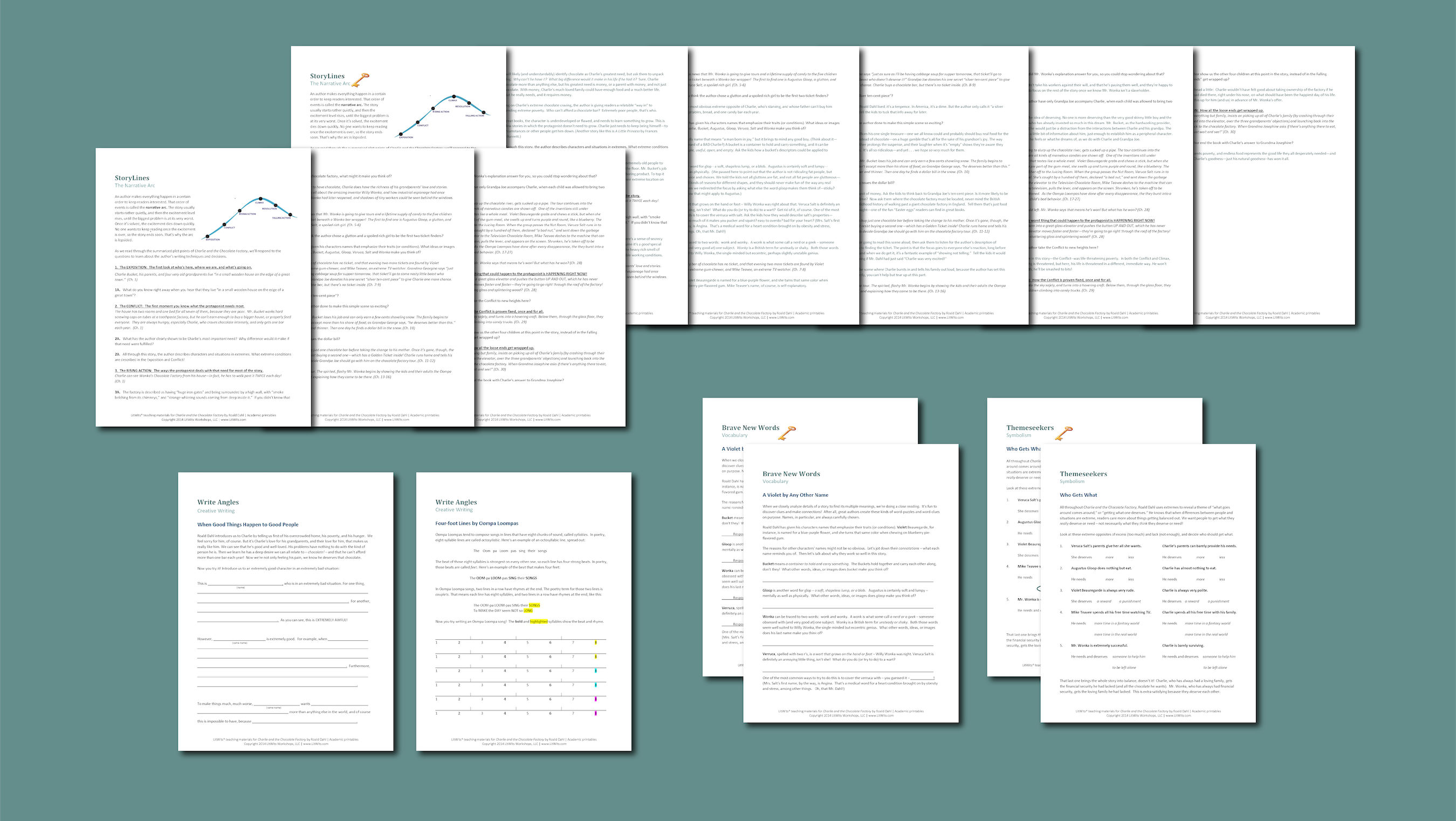
This page shares all the fun we had in our live workshops on Charlie and the Chocolate Factory. We hope it inspires you! If you'd like to teach this book yourself, you might want to buy the printables you'll see throughout.
On the other hand, if you'd like US to teach your kids, check out our video workshop!
There are many ideas in this Hands-on Fun section—don't feel you have to do them all! Go with whatever works best for you and your kids. If you want to focus on a particular teaching point, our Takeaway Topics section can help you narrow down the activity options. And you can enhance discussions during any activity with audiovisual aids from Learning Links or story objects from Prop Ideas.
In our workshops, we do all the activities on this page, in order of the story's narrative arc. You might find our narrative arc discussion guide helpful for sequencing your activities, teaching the important concept of the arc, and helping kids learn how Roald Dahl assembled Charlie and the Chocolate Factory.
BookBites is the part of our literary experience when we get to “taste the story.” We choose a food right out of the book, and it has to meet at least one criterion:
it’s important to a plot point
it has thematic significance
it’s unfamiliar for reasons of culture, era, or location
Of course the kids were expecting candy – buckets of it – but we told them this story of extreme opposites required an opposite taste. As it turned out, this wholesome soup of cabbage and potatoes, well-seasoned, was absolutely delicious.
INSPIRATION
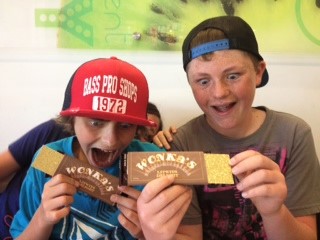
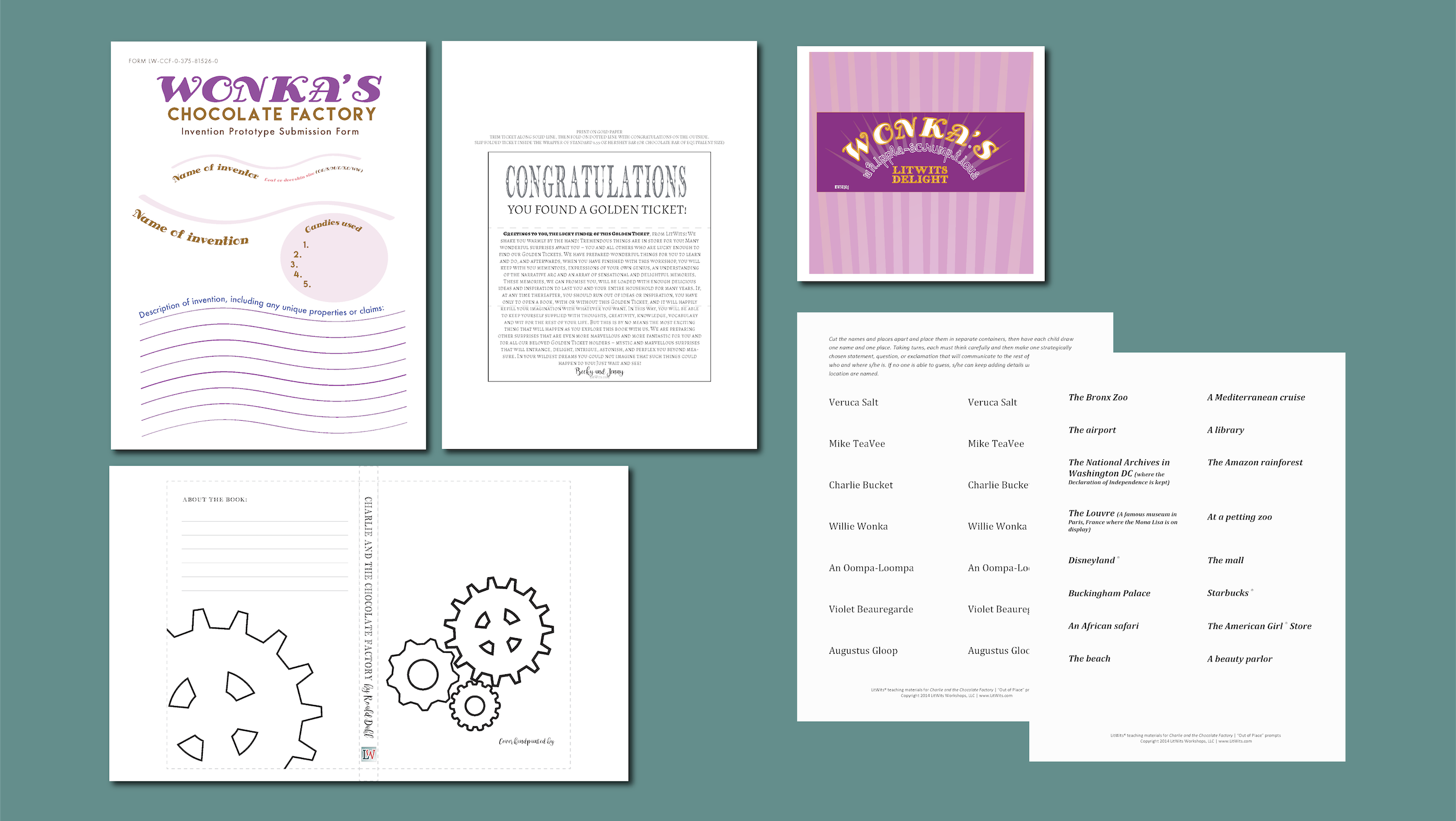
The only meals they could afford were bread and margarine for breakfast, boiled potatoes and cabbage for lunch, and cabbage soup for supper. - Ch. 1 Of course the kids did get some candy, too . . . but not before “dinner.” (We customized chocolate bars with our “Wonka” wrappers, included in our printables.)
While they ate we talked about Roald Dahl’s excellent use of extremes, and did the worksheet on characterizing by extremes (included in printables). We also went through our Learning Links, below, to learn more about this gifted author, and indulged in a couple of 1971 movie clips. We all agreed the book and our imaginations had done a better job than Hollywood.
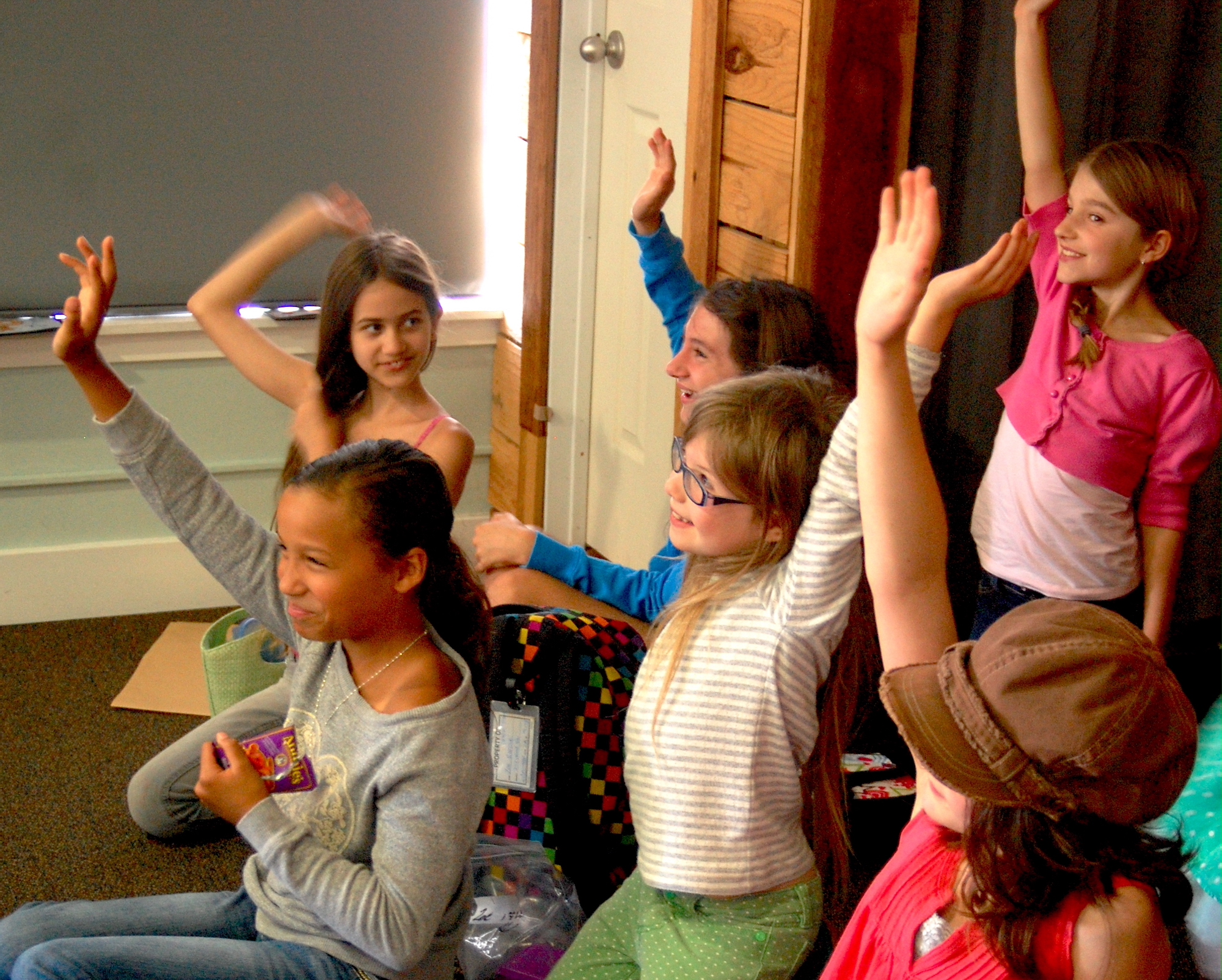
We had so much fun grabbing Dahl’s iconically awful (and sweet) characters and depositing them in contexts far removed from Mr. Wonka’s factory!
What might Veruca Salt say in the middle of an American Girl® store?
How might Charlie react to seeing the Mona Lisa for the first time?
What would Mike TeeVee be most likely to exclaim while looking at a lion in the zoo?
There’s only one way to find out – randomly pair your kids with names and destinations (included in printables) and see what happens! It always surprises us how many shy kids volunteer for this kind of thing--something about "being someone else" must feel freeing for some. :) FOR DISCUSSION
This activity gets kids considering what makes each character tick — who’d do what where and when, and why. As in life, when we see characters act a certain way in the story's situations, we know what they'd be likely to do in ANY situation. So without realizing it (until you point it out later), kids are thinking about the writing craft of characterization. More importantly, they're grasping that in real life, too, our choices teach others what to expect of us.
You might want to define the actual problem each of the other four children in the story has--that it's the degree of their indulgence, and of their self-centeredness, that makes those kids so unappealing.
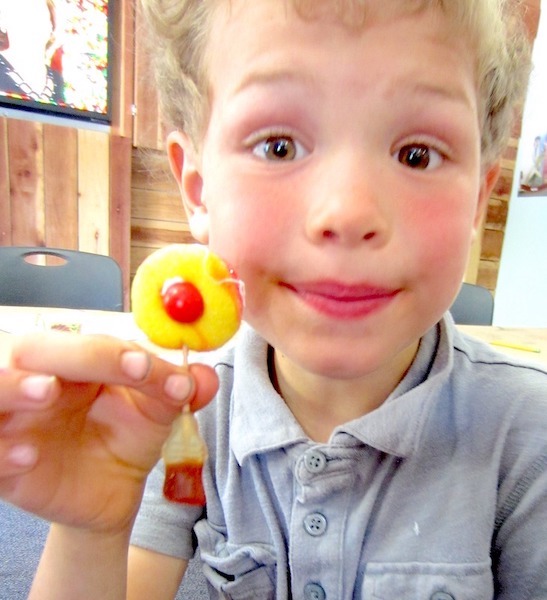
Willy Wonka’s creativity gets us all thinking like candy inventors — and Wonka’s always looking for new ideas, right? So we gave our kids some raw materials he’d already made, and told them to come up with a candy creation that’s as fantastic and marvelous, as delicious and mind-blowing as anything else he’s produced.
This project gets kids in the spirit of invention, and into a character’s shoes. It lets them practice imagining, creative problem-solving, and marketing, too!
SUPPLIES
assorted unwrapped candies, including marshmallows to be torn apart and used as “glue”
scratch paper and pencils for invention packaging design
invention prototype submission form (included in printables)
DIRECTIONS
Tell the kids their challenge is to use 3-4 ready-made candies to construct a whole new candy prototype of magical proportions, worthy to be mass produced by the Oompa Loompas and machines of Mr. Wonka’s factory. (Tell them that the prefix proto- comes from Greek and basically means “the first one” – a model for more to come.)
First, have kids spend a few moments brainstorming about special properties their candy invention might claim. Have them think about the problems, needs, wants and wishes of themselves and people they know. Habits that ought to be broken or formed, powers heretofore unattainable, fixes for life’s little wrinkles and inconveniences.
Then have them go (in pairs or groups) to the supply table, where they’ll choose three or four candies to create a brand new invention. You might also remind them how Willy Wonka feels about snitching… NOT a good idea, remember?
But what IS a good idea? One that’s packed with creativity. imagination, thought, and attention to detail, of course! Tell them that when they’re done inventing, and are satisfied their invention is Wonka-worthy, they need to complete the Invention Submission Form (included in printables) and design some packaging.
When everyone’s finished, Willy Wonka himself will come in to place his order! (You can put on the top hat and jacket and be the man! Don’t forget to skip.)
FOR DISCUSSION
That's a U.S. dollar Charlie finds on the ground, not a pound note--so this story seems set in America, and perhaps is, in part, a tribute to American ingenuity. In our workshop we talked about what ingenuity means, and its connection to industry, and went over some famous examples of American inventions that have done extremely well.
Roald Dahl might also have had in mind the flip side of American awesomeness. We hate to say it, but the vices exemplified in this book seem notoriously American--especially in the book's publication year of 1964, when the number of TV-obsessed, gum-chewing, over-indulged American kids was on the rise. And it's just possible Mr. Dahl might be saying something not-so-sweet about Willy Wonka (and American business geniuses in general). The inventor is not without his weaknesses and defects. And neither is the author. Depending on your educational goals and your kids, there could be an awful lot to talk about.
Teamwork, innovation, design, industry and creativity – and oh yes, chocolate! Throughout this workshop our kids reveled in the things that make Willy Wonka skip for joy--especially projects as sweet as this one.
The premise here is that Willy Wonka has read Roald Dahl’s book about his factory and Charlie, and he likes it – in fact, he’s decided to publish it on his own in-house printing press. He’s not crazy, though, about any of the covers that have been designed so far. He's had his Oompa Loompas come up with a new one, and is inviting students to help him embellish it.
This delightfully aromatic painting project gets kids right into the factory, and gives them a role to relish!
(NOTE: The artwork shown above is done on silver paper. We've since turned this project into an actual dust jacket, and included the template in our printables.)
SUPPLIES
book jacket template (included in printables) printed on plain paper
Compare different covers of this book that you have on hand (or online) and talk about why Mr. Wonka might not have cared for the artwork, colors, depiction of him, etc.
Tell the kids he’s decided to improve the design, and has asked his Oompa Loompa creative team to come up with a basic template that communicates teamwork, industry and innovation. Being a velvet-jacket-and-top-hat-wearing man of some style, he’s also requested a steampunk vibe. The faithful Oompa Loompas have gone eagerly to work, and this morning their simple yet elegant design was approved.
Show your kids what the Oompa Loompas have come up with (the book cover template shown here is included in our printables) and ask if they can see how the gear-motif communicates these concepts.
Explain that in typical Wonka fashion, Mr. Wonka would like each cover to be individually hand titled and painted. Besides having the name of the book written artistically on each cover, he would also like the gear design filled in. Hmmmm…. what could they use as paint that would be Wonka-worthy – and smell delicious?
Chocolate, of course! Kids get SO happy when they find out they get to paint with REAL chocolate! And yes they can taste it (unless it’s been mixed with glue)! Ask them if they think unsweetened chocolate actually does taste more like paint than candy.
FOR DISCUSSION
While the kids are painting you might want to talk about the way Roald Dahl made us feel for Charlie. It's not just that the boy loves chocolate extremely; it's that he's too extremely poor to have it, and to make matters extremely worse, there's an extremely famous enormous chocolate factory extremely close to his house. The other characters, too, “are who they are and do what they do” to an extreme.
You might ask the kids how else the author goes to extremes in this story, and point out that sometimes hyperbole (exaggeration) is used to make the opposite point:
Is Willy Wonka as extremely rich, successful, and happy as he seems to be? What's at least one important thing he's missing?
Is Charlie as extremely poor as he seems to be? What's at least one important thing he has?
How does the ending make both Willy and Charlie extremely, permanently, completely happy?
A LitWits Kit is a bag or box of supplies you pack up and give to each child right before you begin your "field trip" through the story. You might be doing one-off projects as you read through the book together, or you might do everything in this guide from top to bottom after the book has been read. However you explore this book in LitWitty ways, kids love the anticipation of opening their kit.
If you'd like to build LitWits Kits for your child/ren, you could easily arrange the items in a bag, basket, or story-relevant container. Honestly, it's just as much fun to create a kit as it is to open one!
To make it all the more fun, our printables for many books include special "story packaging" for certain activity supplies, including BookBites. Click the button below for a specific list of contents for this book.
Why did we choose this book? Well, first of all, there's the obvious . . . we just can't get enough of the sweet stuff. But beyond that, we love that there's so much deep stuff here too, about love and character and personal values. This sugary story is packed with nutrient-rich "takeaway topics," which we're sharing below.
So we chose it for one of our experiential workshops, where we made these teaching points tangible, meaningful, and memorable in the kids' hands. It's amazing how much kids can learn while they're "just" having fun!
Happy teaching! (Or, if you'd like US to teach your kids, check out our video workshop!) Becky & Jenny
Takeaway 1
Secret messages
The setting is a little ambiguous, and Roald Dahl was British, so it’s easy to assume his story is set in England. But the money Charlie finds on the ground, enabling him to buy the winning chocolate bar, isn't a pound note. Nope, it’s a dollar! So... is Willy Wonka an American industrial genius? We love that kind of nonchalant little Easter-egg stuff great authors do, and we love figuring out what it means.
Hands-on connections in this guide: “Cocoalicious Cover” project; “Sweet Innovations” project; props that convey the essence of Wonka’s work (and of American vices!)
Roald Dahl paints such an extremely drab picture of the Buckets’ poverty, we can’t help but feel extremely sorry for them–or do we? The extremely successful and splendorous Willy Wonka has all the riches in the world—or does he? All the "extremelys" in this book have us questioning some obvious assumptions, and provide lots to talk about.
Hands-on connections in this guide: “Out of Place” activity; props that convey contrasts between Bucket and Wonka lives; BookBites activity; vocabulary, characterization, and creative writing (“good things”) worksheets
Not too far into the story, we know this little boy deserves a lot more than chocolate, or even a golden ticket. Charlie's choices keep proving his worth, his inherent goodness. We love that simply by being himself in the midst of hardships, good fortune comes to him. What a great message in this impatient, over-competitive world!
Hands-on connections in this guide: “Out of Place” activity; props that convey before-and-after circumstances; characterization and creative writing worksheets
This book is chock-full of other subjects to explore, too--from the from the origins of chocolate to gluttony to post-war American factories and more. Scroll down to see our curated Learning Links for more tangential teaching opportunities, and to see how we brought this book and its ideas to life.
Learning Links
Explore these links to supplement your reading experience, research points of interest, and prompt tangential learning opportunities.
When choosing props for our live workshops, we always try to focus on two important categories: props that are unique to the setting, because they help kids understand “what that was like,” and props that are symbolic of themes, because they make big ideas visual and tangible. Both kinds of props generate those wide-eyed, “aha!” moments.
Below is an overview of the display we put together for our live workshop, and under that we've shown the individual props up close. You could easily have your kids contribute items to a table over time, as the book is being read.
Sometimes we create a printable prop; click the button to check the list for this book.
"All the most wonderful smells in the world seemed to be mixed up in the air around them -- the smell of roasting coffee and burnt sugar and melting chocolate and mint and violets and crushed hazelnuts and apple blossom and caramel and lemon peel . . ."
Candy
A giant jar of mixed small candies, which we also used in our Sweet Innovations activity.
Wonka bars
All the kids got their own Wonka bar (with a golden ticket) during BookBites. (The wrapper is in our printables.)
Willy wear
Willy’s top hat and plum-colored coat
Charlie wear
In sharp contrast to Willy Wonka's plum velvet coat, bright green pants, and showy fashion.
Toothpaste tube
We had kids do 20 times what Mr. Bucket had to do all day – screw the cap on and off, to get how that was for him.
Bucket
A symbolic bucket – names are always intentional!
Potatoes & cabbage
The diet of good buys--and inventive geniuses.
Stale bread
Breakfast of champions, apparently!
Squirrel
"Hey, Mummy... I've decided I want a squirrel! Get me one of those squirrels!" Nope, they got HER.
...all four of them would suddenly sit up, and their old wrinkled faces would light up with smiles of pleasure-and the talking would begin. For they loved this little boy. He was the only bright thing in their lives, and his evening visits were something that they looked forward to all day long. Often, Charlie's mother and father would come in as well, and stand by the door, listening to the stories that the old people told; and thus, for perhaps half an hour every night, this room would become a happy place, and the whole family would forget that it was hungry and poor. * Then at last, when he could stand it no longer, he would peel back a tiny bit of the paper wrapping at one corner to expose a tiny bit of chocolate, and then he would take a tiny nibble – just enough to allow the lovely sweet taste to spread out slowly over his tongue. The next day, he would take another tiny nibble, and so on, and so on. And in this way, Charlie would make his sixpenny bar of birthday chocolate last him for more than a month. * "Mr Willy Wonka can make marshmallows that taste of violets, and rich caramels that change colour every ten seconds as you suck them, and little feathery sweets that melt away deliciously the moment you put them between your lips. He can make chewing-gum that never loses its taste, and sugar balloons that you can blow up to enormous sizes before you pop them with a pin and gobble them up." * However small the chance might be of striking lucky, the chance was there. * “You'll never get anywhere if you go about what-iffing like that." * “So shines a good deed in a weary world.” * "Don’t forget what happened to the man who suddenly got everything he wanted." "What happened?" "He lived happily ever after.” *
“You should never, never doubt something that no one is sure of.” * “I've heard tell that what you imagine sometimes comes true." * "So please, oh please, we beg, we pray, Go throw your TV set away, And in its place you can install A lovely bookshelf on the wall. Then fill the shelves with lots of books." * “Mr. Wonka knows exactly what he’s doing.”
You're literally on our page about inspiring kids to love great books. YAY! We're eager to share our passion for LitWitting and the work we've done for over a decade.
We're also eager to keep doing it! :) So if you find this guide-page inspiring* and useful, please share it with your social world. And if you buy our printables for this book, thank you. We appreciate you helping us keep the lights on at LitWits!
Happy teaching, Becky and Jenny Sisters, best friends, and partners
*We hope we've inspired you! If you're feeling a little overwhelmed (we hear that sometimes), remember, you're LitWitting whether you do a lot or a little. You can't go wrong! The learning is happening, trust us. Just take the pressure off and do what works for your kids, time, and budget. (On the other hand, if you'd really like us to teach your kids, we can do that right here. ) It's all about inspiring kids to read for fun, so they want to read more—because kids who read more great books learn more great things.
Now get ready for a bunch of wide-eyed kids having “aha!” moments—and you, grinning ear to ear because your kids are happily engaged with a great book.
Terms of Use
The Becky & Jenny version: Feel free to print pages for teaching use, and make copies of printables for your students. Please don’t use our name, ideas, or materials commercially or share our printables, though we'd love for you to share these free pages with your fellow educators.
The blah legal version: You are granted exclusive use of our products in download or print version as follows: You have the right of reproduction that is limited to your use only in whatever quantity is necessary to meet your needs and those of your student participants. This right is unlimited and extends for as long as you need the materials during which time they cannot be given to or shared with any other person(s) through any means of delivery, materially or digitally via the Internet. As such you have the right to store the product(s) on the hard drive of your computer or as hard copy in your resource file. Any misuse of these rights is in violation of copyright law.
LitWits® is a registered trademark of LitWits Workshops, LLC.
LitWits teaching ideas and materials for Charlie and the Chocolate Factory by Roald Dahl Copyright 2014 by LitWits Workshops, LLC. All Rights Reserved.
.jpg)
.JPG)
.JPG)
.JPG)


.JPG)
%20banner%20copy.jpg)
