Creative Teaching Ideas for

THE TRUMPET OF THE SWAN

by E.B. White (1970)


ON THIS PAGE: LitWits hands-on activity ideas and instructions, teaching topics, learning links, and more. Scroll on!

About the story

The Trumpet of the Swan is a beautiful story, not only of swans, but of embracing differences, exceeding expectations, and excelling despite (even because of) difficulties. Louis is a trumpeter swan who can’t make any sound. As observed by a thoughtful child, Sam, Louis does everything he can to win the lovely swan Serena, without success. When his father steals a trumpet for him, Louis shares his feelings through the power of music–and finally finds his voice.

Read reviews / buy the book here
We make a small commission on anything you buy through our Amazon affiliate links. 

Teaching options

This page shares all the fun we had in our live workshops on The Trumpet of the Swan. We hope it inspires you! If you'd like to teach this book yourself, you might want to buy the printables you'll see throughout.

On the other hand, if you'd like US to teach your kids, check out our video workshop!

Hands-on Fun

Making a plan . . .


There are many ideas in this Hands-on Fun section—don't feel you have to do them all! Go with whatever works best for you and your kids. If you want to focus on a particular teaching point, our Takeaway Topics section can help you narrow down the activity options. And you can enhance discussions during any activity with audiovisual aids from Learning Links or story objects from Prop Ideas.

In our workshops, we do all the activities on this page, in order of the story's narrative arc. You might find our narrative arc worksheet helpful for sequencing your activities, teaching the important concept of the arc, and helping kids learn how E.B. White put The Trumpet of the Swan together.

Sam's Daybook

A LitWits activity from the Exposition
This story opens with Sam making notes in his diary, a “daybook” where he records his daily observations, thoughts, actions, and a question, often about nature.  A journal is such an important tool for personal growth, not to mention the acquisition of knowledge — so we had the kids make one of their own. 

Even though all of the kids already owned notebooks, something about making a Sam-ish journal, and referring to it as a daybook, inspired them to start writing immediately.

SUPPLIES


Each child needs “just a cheap notebook,” like Sam had, and a place to store specimens. We added a 6 x 9 envelope to the front of a composition book (both from a dollar store). See our printables previews for nature images to add to the cover.

While the kids worked we told them that E.B. White, too, was shy and quiet, and found it easier to write in his journal than for publication. That's in spite of the fact that he was well known for his regular contributions to The New Yorker and the revered writer’s handbook The Elements of Style.  He wrote essays, poems, and sketches, and won many prestigious awards, including a Pulitzer, but he avoided publicity whenever he could. (You might want to share this rare recording of him reading for five minutes from The Trumpet of the Swan.)

Like Louis, it wasn’t always easy for him to communicate–but his determination paid off for himself and for his readers. In fact, some of his best ideas for books came from his "half a million words" of journaling. We suggested the kids  consider their own daybooks as “someday story starters,” and that they use it to hold their dreams, including daydreams. 

What If?

A LitWits activity from the Exposition

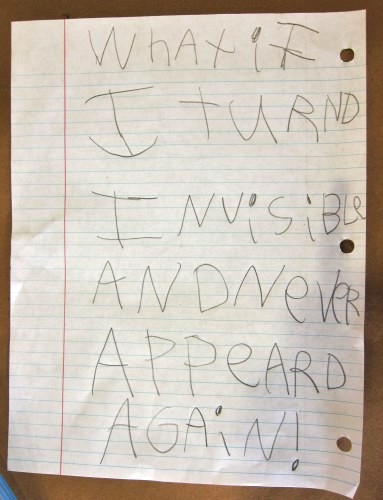
Sam’s diary entries always end with a question, to leave him with something to think about. One of OUR favorite questions is What if ?  Isn’t that an excellent question? What if a writer were to ask “What if a swan was born without a voice?” What if that writer were to answer that question by imagining a beautiful story?

What if anyone could imagine an answer to a what if  question?

But of course anyone can!

Have the kids write “What if…” at the top of a piece of paper, then give them five minutes to write a sequence of “what if” events as fast as they can. (This can just as easily be done verbally instead of in writing, if that works best for your kids.) Tell them not to overthink it — just go with what comes to mind first. The point is to wonder, not analyze.
 

This activity revs up imaginations and gets kids thinking creatively.  Anyone can come up with at least one event — and that one event might lead to a whole story someday!

Speechless Swan

A LitWits activity from the Conflict

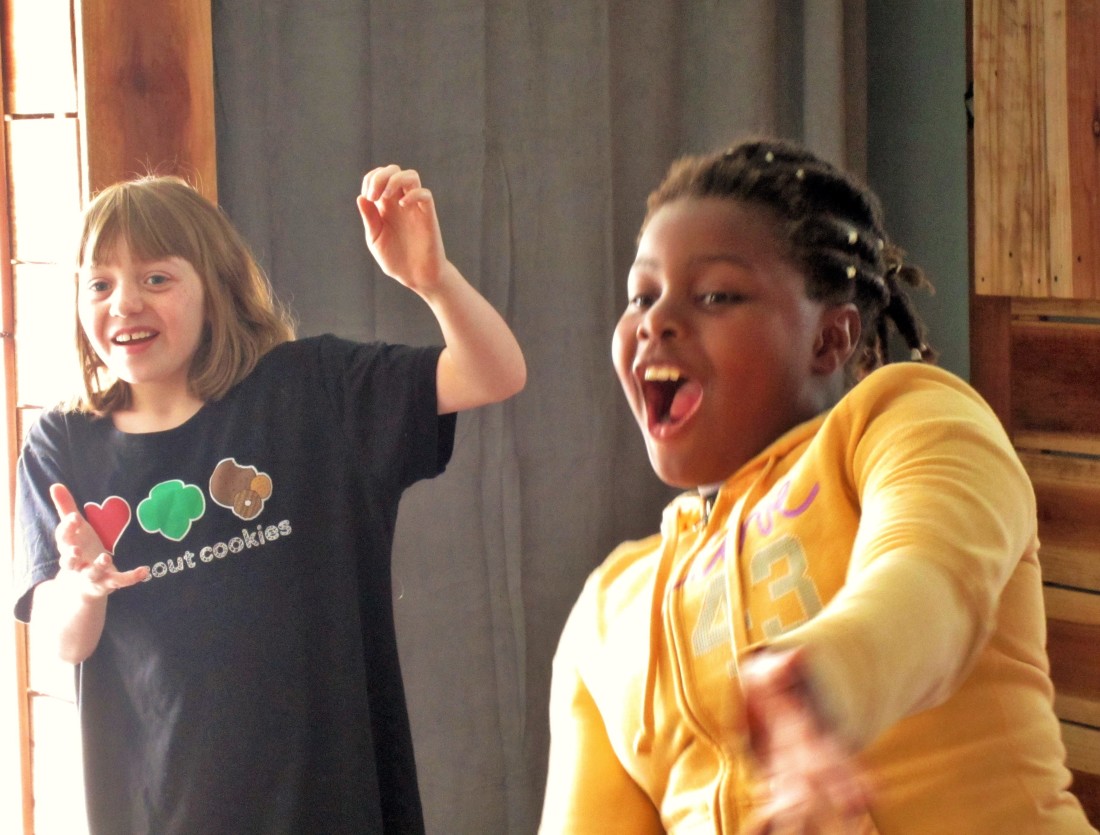
Pretend to be a mute swan who must communicate something of vital importance to the flock! (We've included some funny prompts in our printables.)  Tell the kids they can’t use words, or  even “Koh-oh!” — or slates! They must use only gestures and facial expressions to get the general idea across. A partner, or the entire “flock,” must guess what’s being shared.

Camp K Tee

A LitWits activity from the Rising Action

Who doesn’t want a Camp Kookooskoos t-shirt of their own?  This souvenir is symbolic of Louis's first gig, where he gained skills and confidence. Besides, kids LOVE being campers “right out of the book,” and this project lets us get into Sam's shirt as well as his shoes. :)

DIRECTIONS & SUPPLIES

Have the kids create a camp design on paper, then transfer the design to large inexpensive t-shirts with markers or paint-pens. (Slip a magazine or a piece of heavy paper inside the t-shirt first, so the pens don’t bleed through to the other side.) 

Our printables include a front-and-back template for sketching out a design ahead of time.

Of course, you’ll be an extra popular counselor if you pass out large marshmallows as a project-related snack.

BookBites

Ritzy Nibbles & Campy Treats

A LitWits activity from the Rising Action

BookBites is the part of our literary experience when we get to “taste the story.”  We choose a food right out of the book, and it has to meet at least one criterion:

  • it’s important to a plot point
  • it has thematic significance
  • it’s unfamiliar for reasons of culture, era, or location
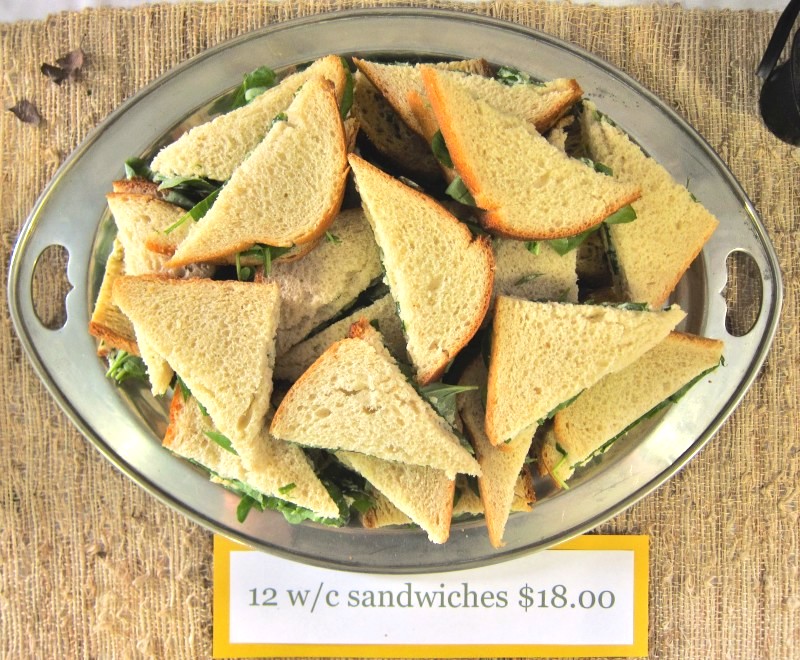
For our bite of this book, we had a couple of options. In one workshop we served some Ritzy watercress sandwiches like those Louis and Serena enjoyed. (You can slip your kids a room service bill with their order, and ask them to fill it in--we've included that "straight from the story" form in our printables.)

While they ate we talked about the magnificent Louis Armstrong and heard him sing "Summer Song."  This was a great opportunity to talk about the many different ways of expressing yourself, through art and actions, with or without words.

In a different workshop on this book, we focused on the other end of the fine dining experience, representing Louis's first trumpet gig. We've made you a S'Mores label to turn any S'mores-flavored treat (like these) into Camp Kookooskoos fare.

You'll find this fun label in our printables for this book.

SCORE!

A LitWits activity from the Rising Action

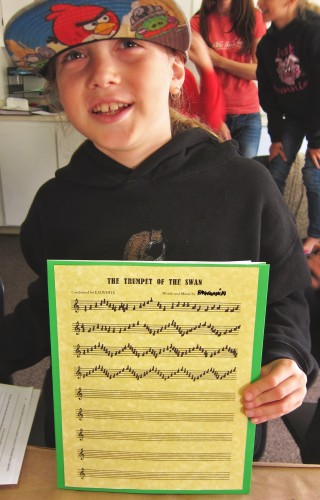
What an impression Louis made on Serena with that sweet serenade he wrote! Reading about that made us want to compose our own, so we knew the kids would love that idea too.

We simply told them that musical notes read from left to right, like words, and that notes would sound higher or lower depending on where they were on the staff.  No musical knowledge or skill necessary — it’s impossible to do it “wrong”!  As Louis shows us through this story, it’s best not to focus on can’t but instead on will.


While the kids are composing their own music, point out the connection between Serena’s name and the word serenade.  You might ask them why a song is such an effective expression of love, and talk about other musicians who overcame difficulties and touched hearts, like Roy Orbison, who sings “Beautiful Dreamer.”

SUPPLIES

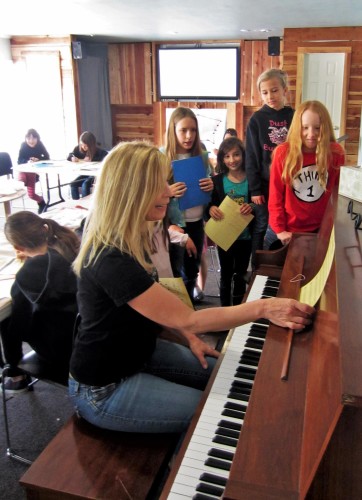
All you’ll need are markers and copies of the staff paper (included in our Printables).  If an instrument is available and you or a student can play, let the kids hear their compositions! Our kids were thrilled to hear their music go from mind to paper to ears.
 

Louis's Load

A LitWits activity from the Falling Action

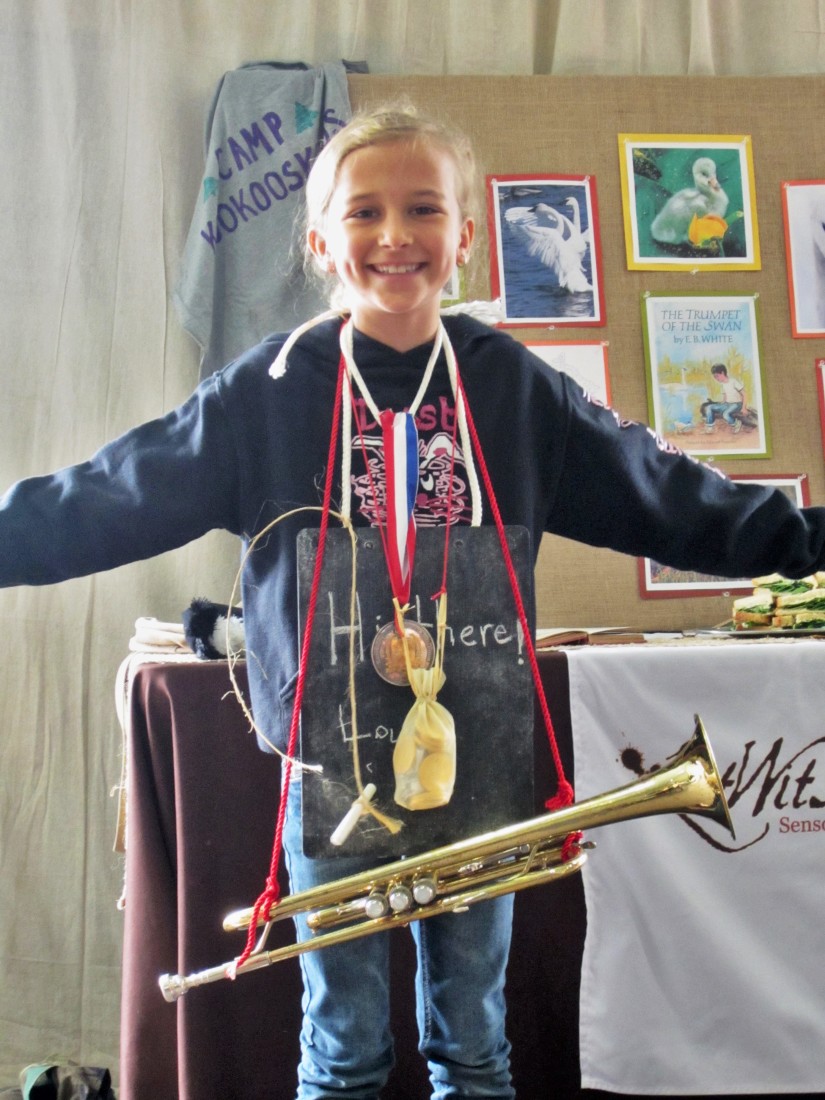
Every reader wonders how Louis manages to carry such a great load, and over such a great distance! (He wonders himself, along with worrying about looking like a hippie.) We let the kids take on his objects to feel how that would feel. As they took turns adding each cumbersome object, we asked them to describe what that item meant to Louis — how it helped him fulfill his own needs.


This activity naturally leads to talking about themes, as everything Louis carries is symbolic of the universal quest for independence, self-expression, and self-esteem. His dad knows how important those are; that's why he risks his neck to get Louis the trumpet. The cob's  long fancy speeches might be a little obnoxious, but there's real wisdom in them, and lots of love, and a sincere desire to help his son get what he needs.

Here's a chance to teach some natural science, too.  Ask the kids to imagine a real swan holding this stuff.  How tall and heavy is a Trumpeter Swan? (5’, 30 lb.)  Measure each child’s armspan and compare it to the 7-8’ wingspan of a Cygnus buccinator.  Talk about the sounds, flight patterns, and colors that differentiate Trumpeters from other swans and similar-looking geese. You can get swan facts galore on The Trumpeter Swan Society web site, including an identification brochure.

SUPPLIES

You’ll need the props pictured under our Prop Ideas — the slate and chalk, trumpet, moneybag, and medal. (You can also use mini party-favor trumpets or mini-kazoo trumpets and mini-slates, if that option better suits your needs.) Our printables also include some mini songsheets to put in the moneybag, to represent the real reward of his playing.

Journey Mapping

A LitWits activity from the Falling Action

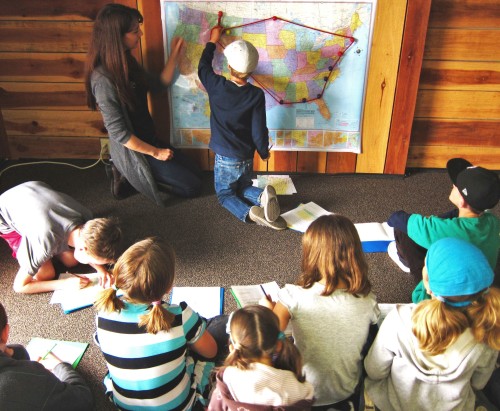
Louis is definitely a frequent flyer! And by the end of this story, he's made a complete round trip. Travel stories always make us reach for maps, so we had the kids help us plot out the protagonist’s journeys.

Have volunteers follow compass-based directions to plot Louis’s journeys on a wall map. Sure, you could  just track it point to point on a screen, but the kids really love taking turns plotting Louis’s flights themselves. Besides, this activity makes the trip (and geography lesson) both visual and tactile.

SUPPLIES

All you’ll need are a big wall map of North America, giant pushpins or magnets, and yarn. The journey guide and map worksheet (and key) are included with our printables.

Printables Previews

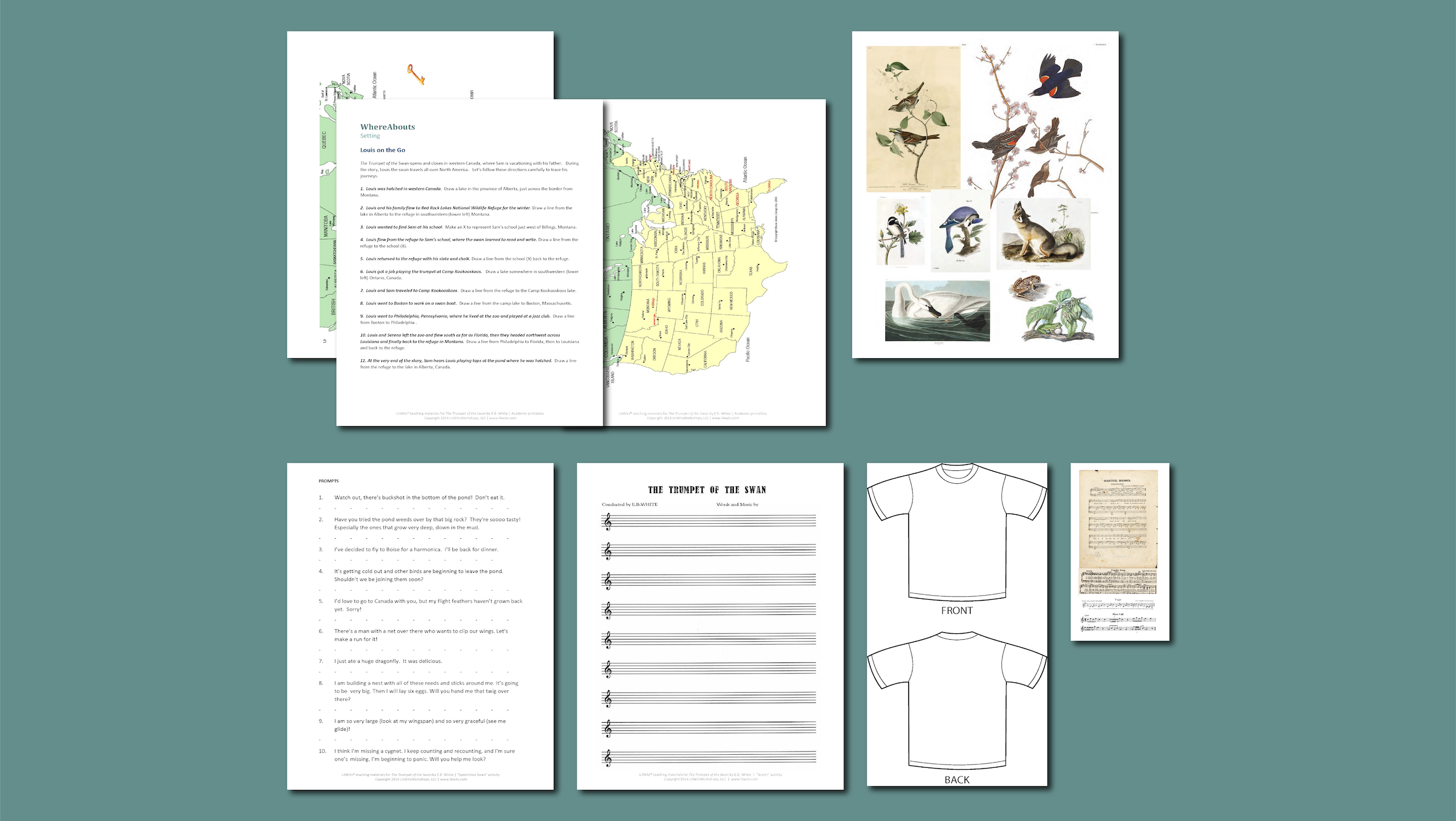
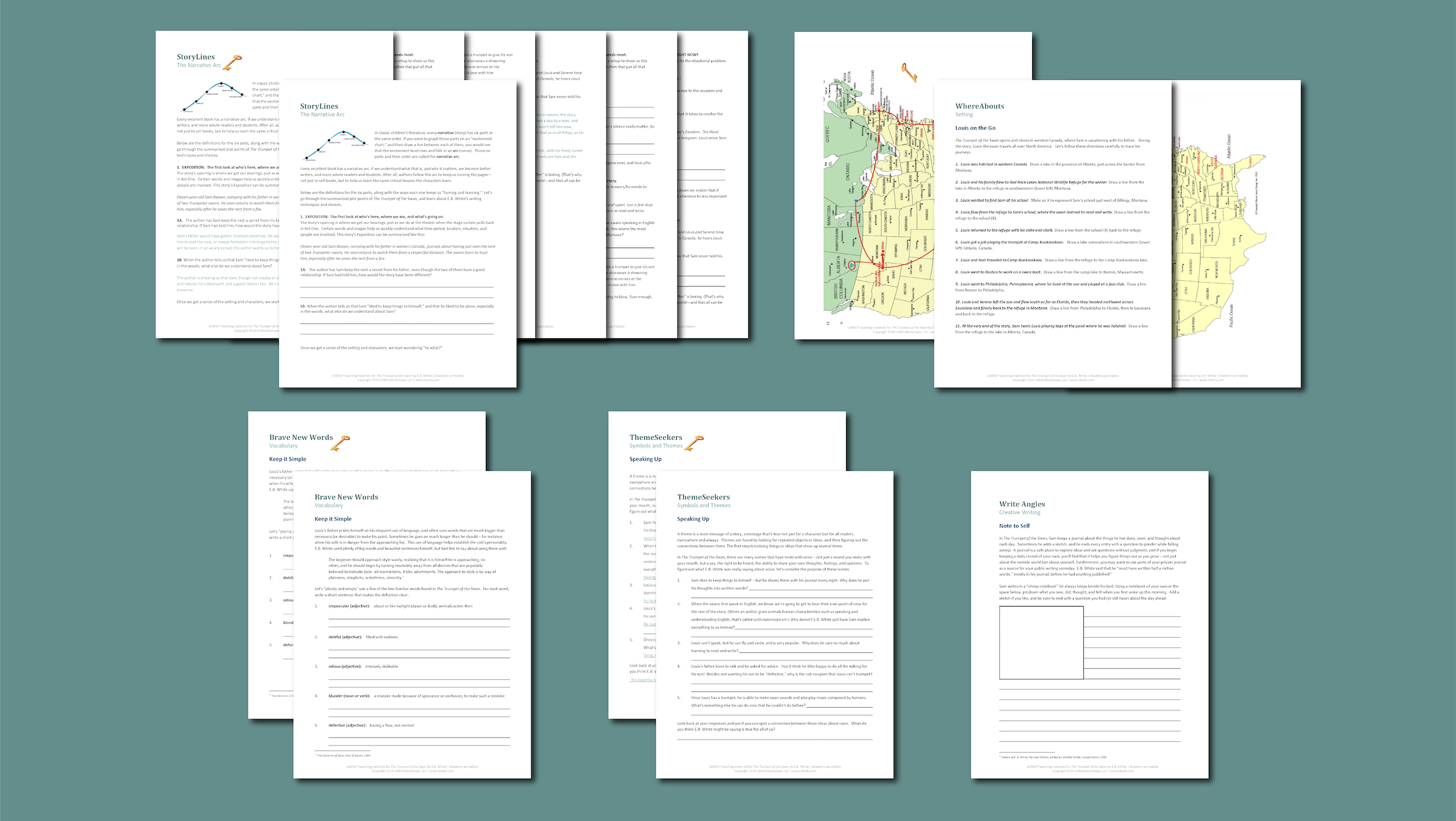
The worksheets and printables used for our activities are sold as a complete set. (If you buy our video workshop, the printables needed are included.)

Common Core State Standards Alignment for the comprehensive use of our teaching ideas and materials is also included for grades 3, 4, 5 and 6.

The LitWits Kit

Pack up for the field trip!

A LitWits Kit is a bag or box of supplies you pack up and give to each child right before you begin your "field trip" through the story.  You might be doing one-off projects as you read through the book together, or you might do everything in this guide from top to bottom after the book has been read. However you explore this book in LitWitty ways, kids love the anticipation of opening their kit.

If you'd like to build LitWits Kits for your kids, you could easily arrange the items in a bag, basket, or story-relevant container.  Honestly, it's just as much fun to create a kit as it is to open one!

To make it all the more fun, our printables for many books include special "story packaging" for certain activity supplies, including BookBites.  Click the button for a specific list of contents for this book. 

Takeaway Topics

Why we chose this book for a "field trip"
We sort of have a crush on E.B. White. Such a great model of a human being AND a writer! We love his wry wit, his quiet shy ways, his understanding of animals and kids--and we want kids to know he's not "just" the guy who wrote Charlotte’s Web. And we love everything about The Trumpet of the Swan! Seriously, it's worth reading if only for the magnificent cob's magnificent soliloquies. And it's packed with great takeaway topics, which we're sharing below.

In our workshops, we did our best to make these teaching points tangible, meaningful, and memorable in the kids' hands. It's amazing how much kids can learn while they're "just" having fun!
 
Happy teaching!
(Or, if you'd like US to teach your kids, check out our video workshop!)
Becky and Jenny

Takeaway 1

The Lost Art of Wondering

In the very first chapter, Sam reminds us that to wonder is to let a question simmer, instead of Googling it (and quickly forgetting the answer). That he writes his wondering in a journal  sets another beautiful example for all of us.

Hands-on connections in this guide:  "Sam's Daybook" project, creative writing worksheet, "What If" activity

Takeaway 2

Self-Expression

This story's all about finding your voice! Whether in journals, pictures, music, or long fancy speeches, there's always a way to speak up for yourself--and for others.

Hands-on connections in this guide: “Sam’s Daybook” project, “Score!” activity, “Speechless Swan” activity, “Louis’s Load” activity, props that connote expression (slate, trumpet, camera, music book), theme worksheet

Takeaway 3

Trumpeter Swan Facts

Did you know a real Trumpeter swan can be 5' tall, weigh 30 pounds, and have an 8' wingspan? That's the kind of jaw-dropping data kids like to learn, and we love expanding their knowledge of the natural world.

Hands-on connections in this guide:  “Louis’s Load” activity, BookBites snack (watercress), “Sam’s Daybook” project for recording facts, props that connote research (field guide, binoculars, camera), audiovisual support

Takeaway 4

The Legacy of E.B. White (1899-1985)

E.B. White is just as well known for his regular contributions to The New Yorker and the revered writer’s handbook The Elements of Style as he is for his children's books. He also wrote essays and poems, and did sketches, and won many prestigious awards, including a Pulitzer. Like Louis, it wasn’t always easy for him to communicate –but his determination paid off for himself and for his readers. We heartily recommend Melissa Sweet's gorgeously artsy scrapbook-bio Some Writer! for you and your kiddos. (Photo credit: White Literary LLC, EB White and his dog Minnie, CC BY-SA 3.0)

Hands-on connections in this guide:
“What If” activity, “Sam’s Daybook” project, “Camp K Tee” project, vocabulary and creative writing worksheets, audiovisuals and research in Learning Links

The Trumpet of the Swan is chock-full of other subjects to explore, too--from ornithology and botany to social skills at the Ritz.  Scroll down to see our curated Learning Links for more tangential teaching opportunities, and to see how we brought this book and its ideas to life. 

Learning Links

Prop Ideas

When choosing props for our live workshops, we always try to focus on two important categories: props that are unique to the setting, because they help kids understand “what that was like,” and props that are symbolic of themes, because they make big ideas visual and tangible. Both kinds of props generate those wide-eyed, “aha!” moments.

Below is an overview of the display we put together for our live workshop, and under that we've shown the individual props up close. You could easily have your kids contribute items to a table over time, as the book is being read. 

Sometimes we create a printable prop; click the button to check the list for this book.

A stuck skunk

A tame skunk (okay, a plush toy) with its head in a can, along with a vintage pack from the army surplus store, filled with pencils and pads of paper.

Field tools & book

A vintage camera, field glasses, and Peterson's A Field Guide to the Birds

Bugle calls

Old book of army bugle calls, found on Ebay

Cattails & feathers

It's as if Louis and Serena were JUST HERE! We found these at a local pond, but you can get feathers and cattails on Etsy and in craft stores that sell floral supplies.

Louis's luggage

A vintage trumpet found on eBay, an old (soccer) medal, and a small bag of well-earned (Monopoly) money. All that PLUS the slate and chalk!

Camp K Tee

Our model for the Camp Kookooskoos t-shirt activity (and a conversation starter at the grocery store). Design template included with printables.

Slate & chalk

THE slate and chalk that Louis used to "speak," once he learned to read and write. 

Tennies

These timeless tennies represent Sam's wanderings (so essential to his wonderings).

LitWitty Shareables

Great Quotes

“The world is full of talkers, but it is rare to find anyone who listens. And I assure you that you can pick up more information when you are listening than when you are talking.” 
*
Every night, before he turned in, he would write in the book. He wrote about things he had done, things he had seen, and thoughts he had had. Sometimes he drew a picture. He always ended by asking himself a question so he would have something to think about while falling asleep.
*
“It's a catastrophe to be without a voice.” 
*
“The sky," he wrote on his slate, "is my living room. The woods are my parlor. The lonely lake is my bath. I can't remain behind a fence all my life.” 
*
“Tonight I heard Louis's horn. My father heard it, too. The wind was right, and I could hear the notes of taps, just as darkness fell. There is nothing in all the world I like better than the trumpet of the swan.” 
*
“Safety is all well and good: I prefer freedom.” 
We're glad you're here!

You're literally on our page about inspiring kids to love great books.  YAY! We're eager to share our passion for LitWitting and the work we've done for over a decade.

We're also eager to keep doing it! :)  So if you found this guide-page inspiring and useful,* please share it with your social world. And if you buy our printables for this book, thank you!  We appreciate you helping us keep the lights on at LitWits! 

Happy teaching,
Becky and Jenny
Sisters, best friends, and partners
*We hope we've inspired you!  If you're feeling a little overwhelmed (we hear that sometimes), remember, you're LitWitting whether you do a lot or a little. You can't go wrong!  The learning is happening, trust us. Just take the pressure off and do what works for your kids, time, and budget. (On the other hand, if you'd really like us to teach your kids, we can do that right here.) It's all about inspiring kids to read for fun, so they want to read more—because kids who read more great books learn more great things.

Now get ready for a bunch of wide-eyed kids having “aha!” moments . . . and you, grinning ear to ear because your kids are happily engaged with a great book.

Terms of Use

The Becky & Jenny version:  Feel free to print pages for teaching use, and make copies of printables for your students. Please don’t use our name, ideas, or materials commercially or share our printables, though we'd love for you to share this free web page with your fellow educators.

The blah legal version: You are granted noncommercial use of our products in download or print version as follows: You have the right of reproduction that is limited to your use only in whatever quantity is necessary to meet your needs and those of your student participants. This right is unlimited and extends for as long as you need the materials during which time they cannot be given to or shared with any other person(s) through any means of delivery, materially or digitally via the Internet. As such you have the right to store the product(s) on the hard drive of your computer or as hard copy in your resource file.  Any misuse of these rights is in violation of copyright law.

LitWits® is a registered trademark of LitWits Workshops, LLC.

LitWits teaching ideas and materials for The Trumpet of the Swan by E.B. White 
Copyright 2014 by LitWits Workshops, LLC.  All Rights Reserved.

Want ideas for more great books?