Creative Teaching Resources for

A WRINKLE IN TIME

by Madeleine L'Engle (1962)

Fun, hands-on ways to teach this great book!

Plus: Takeaway Topics, Learning Links, and Prop Ideas

By the time a bizarre old woman named Mrs. Whatsit mysteriously shows up in misfit Meg’s back yard, Meg’s father, a prominent physicist, has been missing two years—people in town say he’s left his brilliant scientist wife. As it turns out he’s actually a prisoner on a planet controlled by IT, a mind-controlling brain. With Mrs. Whatsit’s help, Meg and her brother, along with their new friend Calvin, set off to rescue him by “tessering” (shortcutting) through time and space. They soon learn that the whole cosmos is at risk!

Danger and disillusionment abound throughout  A Wrinkle in Time, but so does love. Meg’s adventures and actions show us the necessity of mind-heart balance, and of being true to who you really are.

LitWits makes a small commission on anything you buy through our Amazon affiliate links.

Teaching Options

This page shares all the fun we had in our live workshops on A Wrinkle in Time. We hope it inspires you to teach this book yourself! On the other hand, if you'd like US to teach your kids, check out our video workshop!

Explore this book with your kids, LitWits style!

Dress Mrs. Whatsit

A LitWits activity

No one better exemplifies nonconformity than the lovably weird and brilliant Mrs. Whatsit. Our kids drew straws (as the kids in the story did), and the winner got to “get in her shoes” — and socks and more! This activity lets kids enacts the idea of differentness, in a positive way.

Before starting, we asked the kids to name a famous person, then asked if that person is “just like everyone else.”  Of course the answer was a chorus of NOOOOOOs!! The people who make differences are often people who are different — like Madeleine L’Engle. We also talked about some of the  “different people” quoted in this book. (There's a list, with photos, in our printables.)

INSPIRATION

After a few moments that seemed like forever to Meg, Mrs. Murry came back in, holding the door open for—was it the tramp? It seemed small for Meg’s idea of a tramp. The age or sex was impossible to tell, for it was completely bundled up in clothes. Several scarves of assorted colors were tied about the head, and a man’s felt hat perched atop. A shocking pink stole was knotted about a rough overcoat, and black rubber boots covered the feet.. . . Mrs Whatsit untied a blue and green paisley scarf, a red and yellow flowered print, a gold Liberty print, a red and black bandanna. Under all this a sparse quantity of grayish hair was tied in a small but tidy knot on top of her head. 

SUPPLIES & DIRECTIONS

Provide the items described in the above description of Mrs. Whatsit (from closets or thrift stores), and read the excerpt aloud. Then have the non-Whatsits help transform her.  

You go, Mrs. W.!  It’s GREAT to be off in your own world, doing your own thing!

Scale the Solar System

A LitWits activity

This activity gives kids a sense of just how grand our solar system is – let alone the galaxy, or universe! We placed the sun at one end of the room, then gave each kid an object that represented “their” planet, and asked them to place it by the given measurement in turn.

Ask the kids if they know how far Earth is from the sun, and how many planets there are. (As of this writing, Pluto is being counted as a “dwarf planet.”)  By using mnemonics, it’s fairly easy to learn their names and order; by creating the scale model, kids can grasp Earth’s insignificance — not to us, of course, but in relation to the solar system.
OBJECTS NEEDED AND HOW TO LAY THEM OUT ON THE FLOOR

While the model is laid out, and the kids are in awe at how “short” 93 million miles is from the sun, point out that our vast solar system is just one of billions in our galaxy, and that our galaxy is just one of at least a hundred billion!  Explain that we measure such huge distances in light years, the number of miles that light (at 186,000 miles per second, or 671 million miles per hour) travels in one Earth year. The nearest sun to ours is Proxima Centauri, which is “only” 4.24 light years away.

When the kids are done scaling the solar system, have them come up with fun ways to remember the names of the planets in order, like My Very Educated Mother Just Served Us Noodles.  A helpful guide to this activity, along with a fill-in-the-blank diagram, is included in our printables.
Tesser to Planet X

A LitWits activity

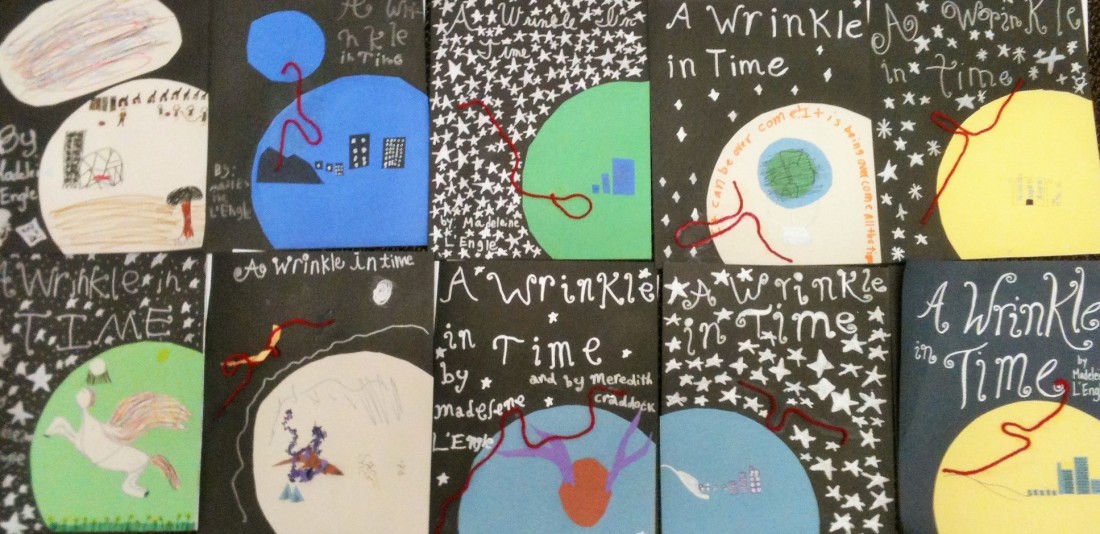
According to Mrs. Whatsit, to tesser  is to shortcut through time by wrinkling it, bringing two divergent “time-places” closer together. For a tangible expression of that idea, we had the kids design any of the story’s planets in colored paper, and “tesser” between the title and planet with yarn.

SUPPLIES

 You’ll just need metallic silver pens, colored construction paper, yarn, scissors, and glue. For the background, we used a black folder that held kids' worksheets, but you could just use black cardstock instead. We have a template in our printables, or you can just use a plate.

Interplanetary Peekabo

A LitWits activity

The notion of dimensions isn’t easy to get across — but it makes more sense when you’ve crossed three dimensions yourself!  For this project, our kids folded two-dimensional paper into a three-dimensional cube to view a 3-D scene from the story. We suggest making a model ahead of time, so it’s easier to demonstrate and explain to the kids. But how much you show ahead of time is up to you. It's fun to see the kids really surprised when they peek inside their inflated globe and see the world they've created!

SUPPLIES

  • any paper trimmed to 8.5 x 8.5; must be white on at least one side
  • felt-tip pens for drawing

DIRECTIONS
Read this description of the planet Uriel together with the kids. Ask them to notice what is seen in the foreground, sky, and distance. If they were standing there, what might they see to the right, and to the left?

She looked around rather wildly. They were standing in a sunlit field, and the air about them was moving with the delicious fragrance that comes only on the rarest of spring days when the sun’s touch is gentle and the apple blossoms are just beginning to unfold. She pushed her glasses up on her nose to reassure herself that what she was seeing was real.

They had left the silver glint of a biting autumn evening; and now around them everything was golden with light. The grasses of the field were a tender new green, and scattered about were tiny, multicolored flowers. Meg turned slowly to face a mountain reaching so high into the sky that its peak was lost in a crown of puffy white clouds. From the trees at the base of the mountain came a sudden singing of birds. There was an air of such ineffable peace and joy all around her that her heart’s wild thumping slowed. -- Chapter 4

After talking about what it would be like to stand in that meadow, explain to the kids that they are going to illustrate this landscape themselves in a three-dimensional way. Here's how it works. Kids will:

1. Fold most of the shape
2. Unfold it and draw their landscape in the space indicated by the folded lines
3. Fold the shape back up
4. Inflate it and peep inside the world of Planet Uriel.

The video below shows how it's done!
For a pretty darn good explanation of the fourth dimension, here's a 5-minute video of physicist David Morgan called "Tesseracts and Madeleine L'Engle," made in her memory.

BookBites

Dining Blind

A LitWits activity

BookBites is the part of our literary experience when we get to “taste the story.”  We choose a food right out of the book, and it has to meet at least one criterion:

  • it’s important to a plot point
  • it has thematic significance
  • it’s unfamiliar for reasons of culture, era, or location
For this book, our “taste” met all three criteria, and also served as an exercise in trust!  We drew from Meg’s experience of being fed in the dark by Aunt Beast:

Something completely and indescribably and incredibly delicious was put to Meg’s lips, and she swallowed gratefully. With each swallow she felt strength returning to her body . . .  (Ch. 11.)


To serve this mystery food, we turned off the lights, put on soothing spacey music, and in mesmerizing tones we told the kids to close their eyes — that their Auntie Beasties were going to feed them something incredibly, indescribably delicious and nourishing.  NO PEEKING! 

After placing watermelon balls in their mouths and asking them to identify this marvelous food, we let them know we’d just fed them our planet’s greatest delicacy: alien eyeballs.

That was fun.

(You could also use any number of other squishy or globular foods, like squash, peeled grapes... you get the idea). 

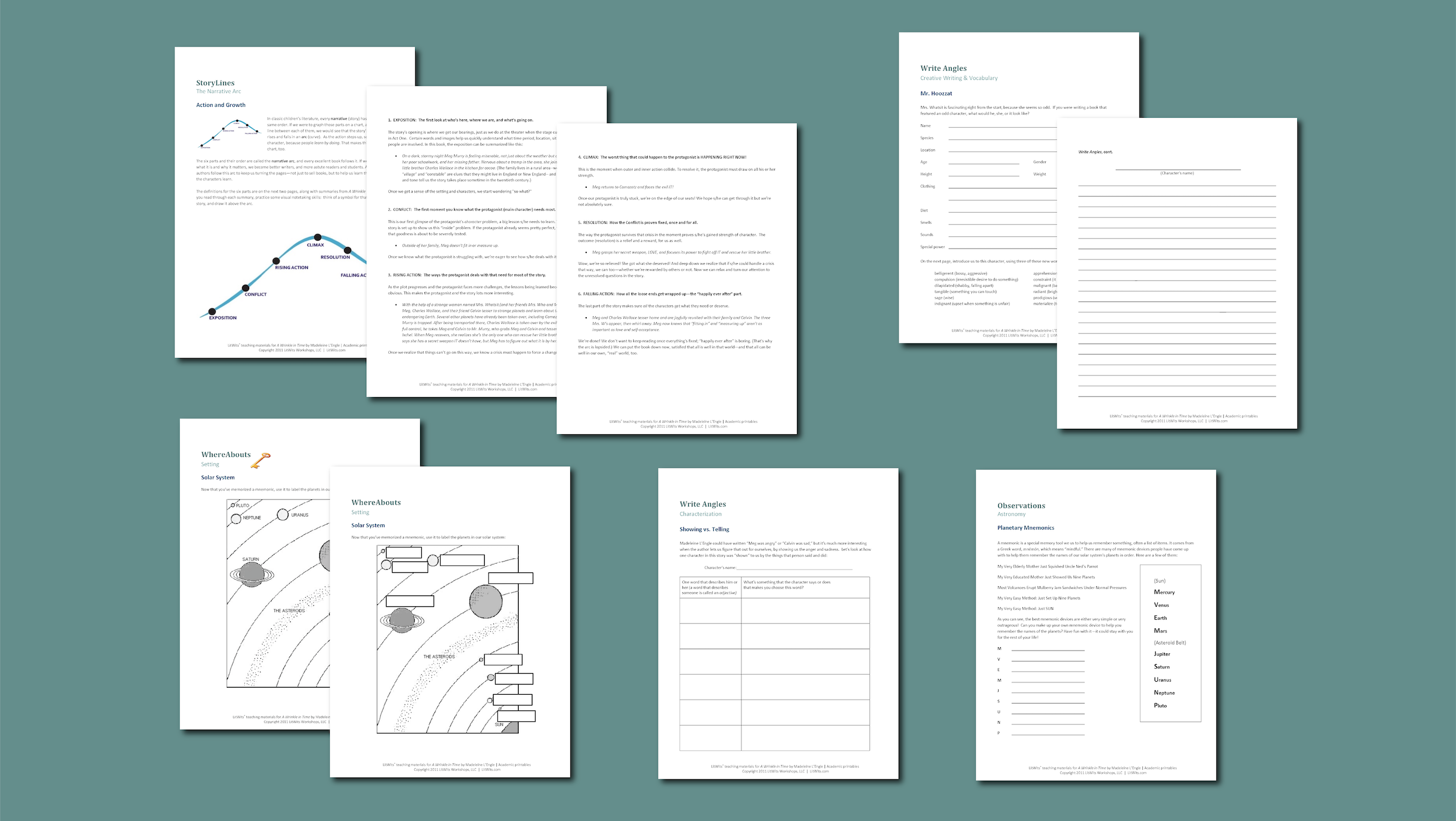
Printables Previews

The worksheets and printables used for our activities are sold as a complete set. (If you buy our video workshop, all the printables needed are included.)

Common Core State Standards Alignment for the comprehensive use of our teaching ideas and materials is also included for grades 3, 4, 5 and 6. 

Takeaway Topics

Why we chose this book for a "field trip"

A Wrinkle in Time  was read to us by our classroom teachers when we were kids; it was one of our first introductions to the fantastic possibilities of science fiction and we can still feel the wonder of traveling to all those strange planets hand-in-hand with Mrs. Whatsit. And when we find ourselves caught in the midst of a particularly dramatic rainstorm, one of us will sometimes exclaim to the other, "Wild nights are my glory!"   So  of course we wanted to share this story with our LitWitters as one of our experiential workshops. Not only is it an action-packed tale with a sympathetic main character and lots of suspenseful moments, but it's also packed with great takeaway topics, which we're sharing below.

In our workshops, we did our best to make these teaching points tangible, meaningful, and memorable in the kids' hands. It's amazing how much kids can learn while they're "just" having fun!  

Takeaway 1

Our Solar System

It’s hard to get our heads around the enormity of our solar system, let alone the grander universe beyond.  This book gives us plenty of opportunity to throw in some basic astronomy facts, along with some brain-bending points about dimensions.  We could see our kids' imaginations soaring--in fact, tessering!  For more fascinating facts about time and space, we recommend the “Solar System and Beyond” page on the NASA website.

Hands-on connections in this guide: “Scale the Solar System” activity, “Tesser to Planet X” project, "Interplanetary Peekaboo" project, mnemonics and solar system worksheets

Takeaway 2

Nonconformity

Even kids who seem confident can feel like a misfit sometimes. Meg's pretty down on herself at the start of the story, and the author once felt that way, too. There are actually quite a few "not normal" folks in this book--but what does “normal” mean, anyway? This book helps us teach the importance of honoring people for who they are, and of BEING who we are, ourselves--without disregard for other people's needs or feelings. in our workshop, while the kids were dressing Mrs. Whatsit or creating their own “weirdo” on paper, we made sure they understood that we weren't making fun of weirdness: we were celebrating it.

Hands-on connections in this guide:  “Dress Mrs. Whatsit” activity, creative writing and vocabulary worksheets

Takeaway 3

Love and Learning

From Meg saving her little brother with an intense dose of love, to learning how to love herself, this story is very love-focused. Many of the "difference-makers" quoted in this book are also known for their love, or the balance of heart and brain. The heart alone can have poor judgment, and the mind by itself will fixate on self-interests-- Madeline L’Engle once called this book’s antagonist, a “naked brain,” evil because It was devoid of feelings. This story shows us we need both learning AND love. As Aristotle said, “Educating the mind without educating the heart is no education at all.”  

Hands-on connections in this guide:   Brain prop/discussion, "Dress Mrs. Whatsit" discussion aid (difference-makers), BookBites snack (trust, love)
A Wrinkle in Time is chock-full of wonderful topics to explore, from astrophysics to philosophy to bullying and more.  Scroll down to see our curated learning links for more tangential learning opportunities, and see how we brought this book and its ideas to life.

Learning Links

Story Supplements

Origin of the opening phrase, “It was a dark and stormy night" - Phrases
Difference between hot chocolate and hot cocoa
Mrs. Murry's liverwurst and cream cheese sandwich - Good Food Stories
About tessaracts - Wikipedia
The PinWheel Galaxy (M101) - NASA
Image of the spiral nebula Messier 101 - where Uriel was - NASA
All about absolute zero, the lowest possible temperature - Science Daily
Interesting article about conformity - PsyBlog
History of IQ tests - IQ Test Center
Video: Carl Sagan explains tesseracts using apples (9:30)
Two kinds of time: Chronos and Kairos - M. Valentine blog
Video: easy explanation of the theory of relativity (16:18)
Video: shorter explanation of the theory of relativity (8:30)
How time travel works
About black holes - NASA
Origin of the phrase IT (Information Technology) in 1958 - Harvard Business Review
Image of a brain - Nat Geo
Shakespeare’s The Tempest in full - MIT
Thomas Jefferson’s Declaration of Independence - National Archives
The Periodic Table of Elements - Web Elements
About Irrational Numbers - Math is Fun

Some of the warriors against the Black Thing:

(All necessary printables are already included with the video workshop.)

Prop Ideas

When choosing props for our live workshops, we always try to focus on two important categories: props that are unique to the setting, because they help kids understand “what that was like,” and props that are symbolic of themes, because they make big ideas visual and tangible. Both kinds of props generate those wide-eyed, “aha!” moments.  Sometimes we create a printable prop; check the list for this book.

Below is an overview of the display we put together for our live workshop, and under that we've given more details. You could easily have your kids contribute items to a table over time, as the book is being read. 

Space dust

Sparkly space dust from the fourth dimension and a quote that embodies key themes of faith and nonconformity. 

Mrs. Who's spectacles

Mrs Who's spectacles shone out at them triumphantly, "And the light shineth in darkness; and the darkness comprehended it not."  

It Itself

If we only had a brain -- a pulsing mesmerizing brain like the one that "took" Charles Wallace!  Good thing we found this gelatin brain mold (eew!) and the color-changing glow-ring we embedded inside it. 

This prop gave us a squishy way in to talking about the brain-heart balance we all need.  We asked the kids if they’d ever acted without thinking — or without feeling for someone else first. How did that turn out?  What did they learn?  It’s in our nature to put ourselves first — but it’s also in our nature to put others first.  Which characters in the story put other people first, and when, and why? We talked about what happened to sweet Charles Wallace when IT had control over him — and how Meg got her little brother back.

Crystal gazing ball

A crystal ball like the Happy Medium's, along with the observation it provided and some random space dust. 

LitWitty Shareables


Great Quotes

"Life, with its rules, its obligations, and its freedoms, is like a sonnet: You're given the form, but you have to write the sonnet yourself."  - Mrs. Whatsit
*
The only way to cope with something deadly serious is to try to treat it a little lightly.
*
“Like and equal are not the same thing at all.” 
*
“People are more than just the way they look.” 
*
“If you aren't unhappy sometimes you don't know how to be happy.” 
*
“A straight line is not the shortest distance between two points.” 
*
“Only a fool is not afraid.” 
*
“Thinking I'm a moron gives people something to feel smug about," Charles Wallace said. "Why should I disillusion them?” 
*
“I don't understand it any more than you do, but one thing I've learned is that you don't have to understand things for them to be.” 
*
"We do not know what things look like. We know what things are like. It must be a very limiting thing,this seeing." 
*
“A book, too, can be a star, “explosive material, capable of stirring up fresh life endlessly,” a living fire to lighten the darkness, leading out into the expanding universe.” 
*
It seemed to travel with her, to sweep her aloft in the power of song, so that she was moving in glory among the stars, and for a moment she, too, felt that the words Darkness and Light had no meaning, and only this melody was real.
*
“Wild nights are my glory!” - Mrs. Whatsit
*
“Meg, don't you think you'd make a better adjustment to life if you faced facts?" 

"I do face facts," Meg said. "They're lots easier to face than people, I can tell you."
*
Love. That was what she had that IT did not have.

We're glad you're here!

You're literally on our page about inspiring kids to love great books.  YAY! We're eager to share our passion for LitWitting and the work we've done for over a decade.

We're also eager to keep doing it! :)  So if you find this guide-page inspiring* and useful, please share it with your social world. And if you buy our printables for this book, thank you. We appreciate you helping us keep the lights on at LitWits! 

Happy teaching,
Becky and Jenny
Sisters, best friends, and partners

Terms of Use

The Becky & Jenny version:  Feel free to print pages for teaching use, and make copies of printables for your students. Please don’t use our name, ideas, or materials commercially or share our printables, though we'd love for you to share these free pages with your fellow educators.

The blah legal version: You are granted exclusive use of our products in download or print version as follows: You have the right of reproduction that is limited to your use only in whatever quantity is necessary to meet your needs and those of your student participants. This right is unlimited and extends for as long as you need the materials during which time they cannot be given to or shared with any other person(s) through any means of delivery, materially or digitally via the Internet. As such you have the right to store the product(s) on the hard drive of your computer or as hard copy in your resource file.  Any misuse of these rights is in violation of copyright law.

LitWits® is a registered trademark of LitWits Workshops, LLC.

LitWits teaching ideas and materials for A Wrinkle in Time by Madeleine L'Engle
Copyright 2014 by LitWits Workshops, LLC.  All Rights Reserved.

Want ideas for more great books?