Creative teaching ideas for Alice's Adventures in Wonderland by Lewis Carroll

Creative Teaching Ideas for

ALICE'S ADVENTURES IN WONDERLAND

by Lewis Carroll (1865)


ON THIS PAGE: LitWits hands-on activity ideas and instructions, teaching topics, learning links, and more. Scroll on!

About the story

When little Alice falls down a rabbit hole, she finds herself in a bizarre Wonderland of strange creatures and situations. She shrinks and expands without warning, nearly drowns in a pool of her tears, and plays croquet using a flamingo mallet. She also meets a grinning cat, a hair-raising queen, a mad hatter, a mock turtle, and a smoking caterpillar—to name just a few.

What’s it all about? Imagination, of course—but there’s more to this “literary nonsense.” Just like kids’ adventures in real life, Alice’s Adventures in Wonderland  help her work through awkwardness, confusion, and sadness to get where she’s going.

Read reviews/buy the book here
We make a small commission on anything you buy through our Amazon affiliate links. 

Hands-on Fun

Making a plan . . .


There are many ideas in this Hands-on Fun section—don't feel you have to do them all! Go with whatever works best for you and your kids. If you want to focus on a particular teaching point, our Takeaway Topics section can help you narrow down the activity options. And you can enhance discussions during any activity with audiovisual aids from Learning Links or story objects from Prop Ideas.

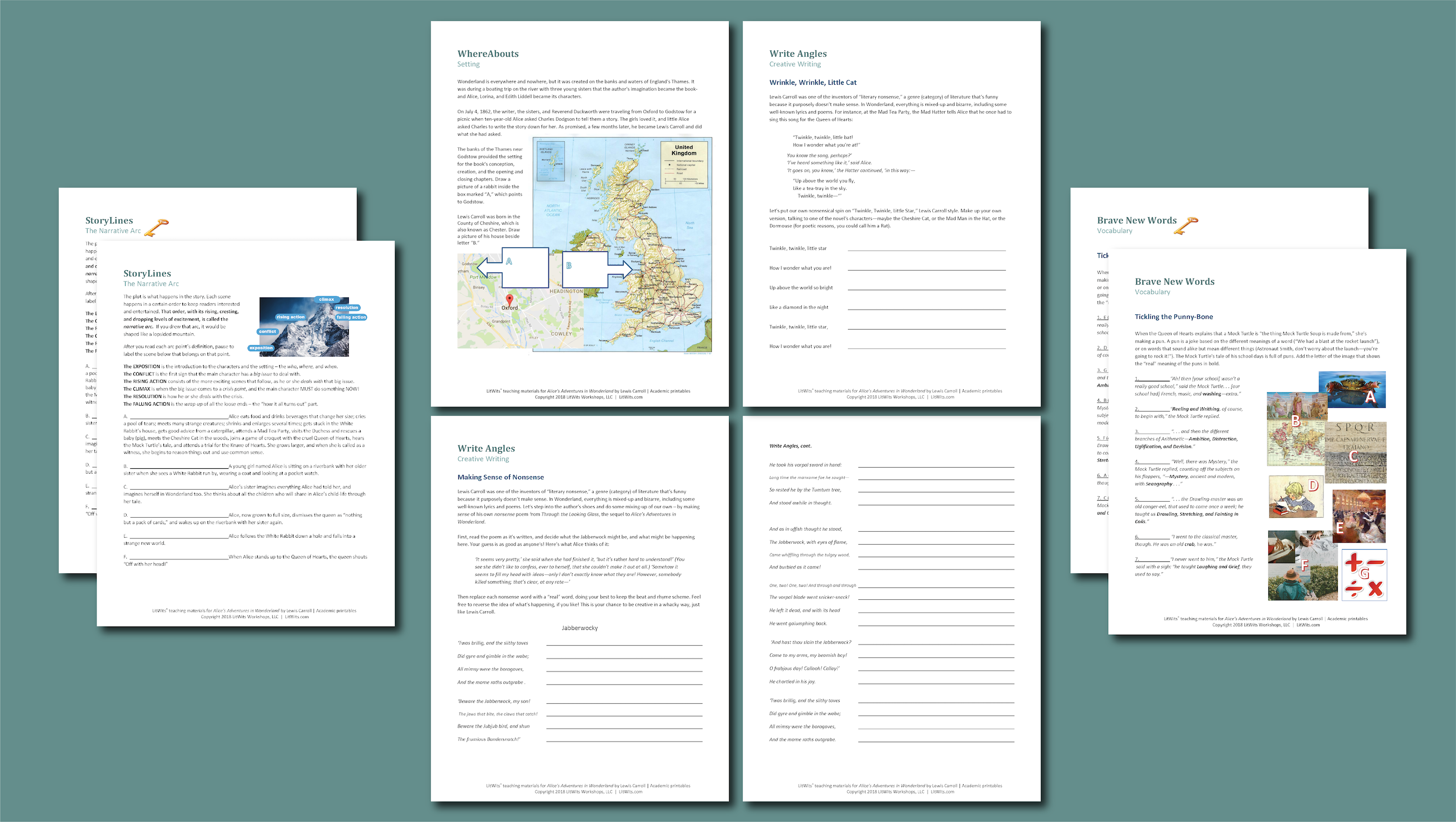
In our workshops, we do all the activities on this page, in order of the story's narrative arc. You might find our narrative arc worksheet helpful for sequencing your activities, teaching the important concept of the arc, and helping kids learn how Lewis Carroll built Alice's Adventures in Wonderland.

Carrolling

A LitWits activity from the Exposition

One of favorite things to do with great books is to examine the author's first paragraph or two, then have the kids rewrite them. By jumping into the author's shoes they learn his specific style and several key skills--not from a dry, abstract distance, but by doing.
DIRECTIONS

First, talk through Lewis Carroll's first two paragraphs, asking the kids what they notice about anything at all, and what it does for them or tells them:

Alice was beginning to get very tired of sitting by her sister on the bank, and of having nothing to do: once or twice she had peeped into the book her sister was reading, but it had no pictures or conversations in it, “and what is the use of a book,” thought Alice “without pictures or conversations?”

So she was considering in her own mind (as well as she could, for the hot day made her feel very sleepy and stupid), whether the pleasure of making a daisy-chain would be worth the trouble of getting up and picking the daisies, when suddenly a White Rabbit with pink eyes ran close by her.


Help them along as necessary:

  • each paragraph is one long sentence, which tells us it's old-fashioned writing, in an old-fashioned tone
  • there are lots of commas, which create little breaks to help make the sentences readable
  • her sister isn't named, which tells us she's not that important
  • Alice's thoughts are in quotation marks, which makes it seem like she's talking to herself
  • the word suddenly tells us something important is going to happen; pay attention!
  • the White Rabbit is capitalized like a title, which tells us he IS important, and will probably be showing up again

Once the kids grasp that each of these (and other) observations reveals an intentional technique, they'll be game to try it themselves.

Option 1:  Tell his story your way.  The easiest way is to simply to swap out synonyms and replace or modify a phrase. They could also give it a more colloquial tone, and change up the names. For instance:

Allison was starting to get sick of sitting by her sibling beside the river, and of being bored: a couple of times she'd peeked at the book her sister was reading, but there weren't any illustrations, “and what's the point of a story,” thought Alice “if it doesn't have pictures?”

Option 2: Tell your story his way.  It takes more time and thought (but is much more fun) to change entire concepts, swapping out words and phrases, but keeping the author's syntax. For instance: 

George was getting fed up with hanging out next to his brother by the flagpole. Once or twice he'd looked over his brother's shoulder at the game he was playing on his phone, but it was about fighting aliens, “and what’s the fun of a game,” thought George, “without cartoons and silly songs?” 
 
So he was thinking (but not clearly, because it had been hours since lunch and he was hangry) about whether the fun of teasing the little girls on the swing sets would be worth the trouble of sauntering over there, when suddenly a Cockerpoo with a white-tipped tail ran by him.

Once you've talked through these (or your own) examples, give the kids 15-20 minutes to go Carrollling. Then take volunteers to read their work aloud--because they don't feel it's as personal as something they completely invented, even the shy kids are often inspired to share. 

Reinterpreting an author's work a few words at a time helps kids get that writing can be fun, especially if they don't have to start with a blank page! 

The Hole Point of the Conflict

A LitWits project from the Conflict

The rabbit-hole went straight on like a tunnel for some way, and then dipped suddenly down, so suddenly that Alice had not a moment to think about stopping herself before she found herself falling down a very deep well.  —Ch. 1

Our kids loved creating this classic scene in miniature! So much of Alice is too fantastical to depict easily, but there’s something about the author’s description of her slow-motion tumble that’s perfectly clear in our minds: 

Either the well was very deep, or she fell very slowly, for she had plenty of time as she went down to look about her and to wonder what was going to happen next. First, she tried to look down and make out what she was coming to, but it was too dark to see anything; then she looked at the sides of the well, and noticed that they were filled with cupboards and book-shelves; here and there she saw maps and pictures hung upon pegs. She took down a jar from one of the shelves as she passed; it was labelled “ORANGE MARMALADE”, but to her great disappointment it was empty: she did not like to drop the jar for fear of killing somebody underneath, so managed to put it into one of the cupboards as she fell past it.  --Ch. 1

In our mind’s eye, we can easily see those bookshelves, cupboards, maps, and pictures. (And don’t forget the marmalade jar! See our "Jam-packed with Symbolism" activity for more on that.) To send Alice tumbling, we repurposed a Tenniel illustration from another part of the story, and affixed her to a string for a perpetual, ever-renewable fall toward Wonderland—and back again.

This project is fun to make, and it's even more fun to make Alice go up and down.  But "the hole point" is that it helps kids remember that this scene represents the Conflict of this story, as explained on our narrative arc worksheet, and by this boy:
 SUPPLIES

  • basics:  white glue, clear tape, scissors
  • Pringles® cans (on Amazon or from a dollar store), cut in half vertically and cover the sharp metal edge at the bottom with electrical tape - 1/2 can per student.  It's up to you to decide the fate of all the chips in the can--it might seem obvious, until you read the label. :)
  • black electrical tape 
  • can lids, cut in half - 1/2 lid per 
  • string, cut to 12″ lengths and knotted at one end, 1 per
  • black paper
  • green moss and, if you have them in your yard or neighborhood, mini daisies
  • 1/2″ x 2″ strips of any paper (to cover string on back of Alice), 1 per
Images included in our Printables:
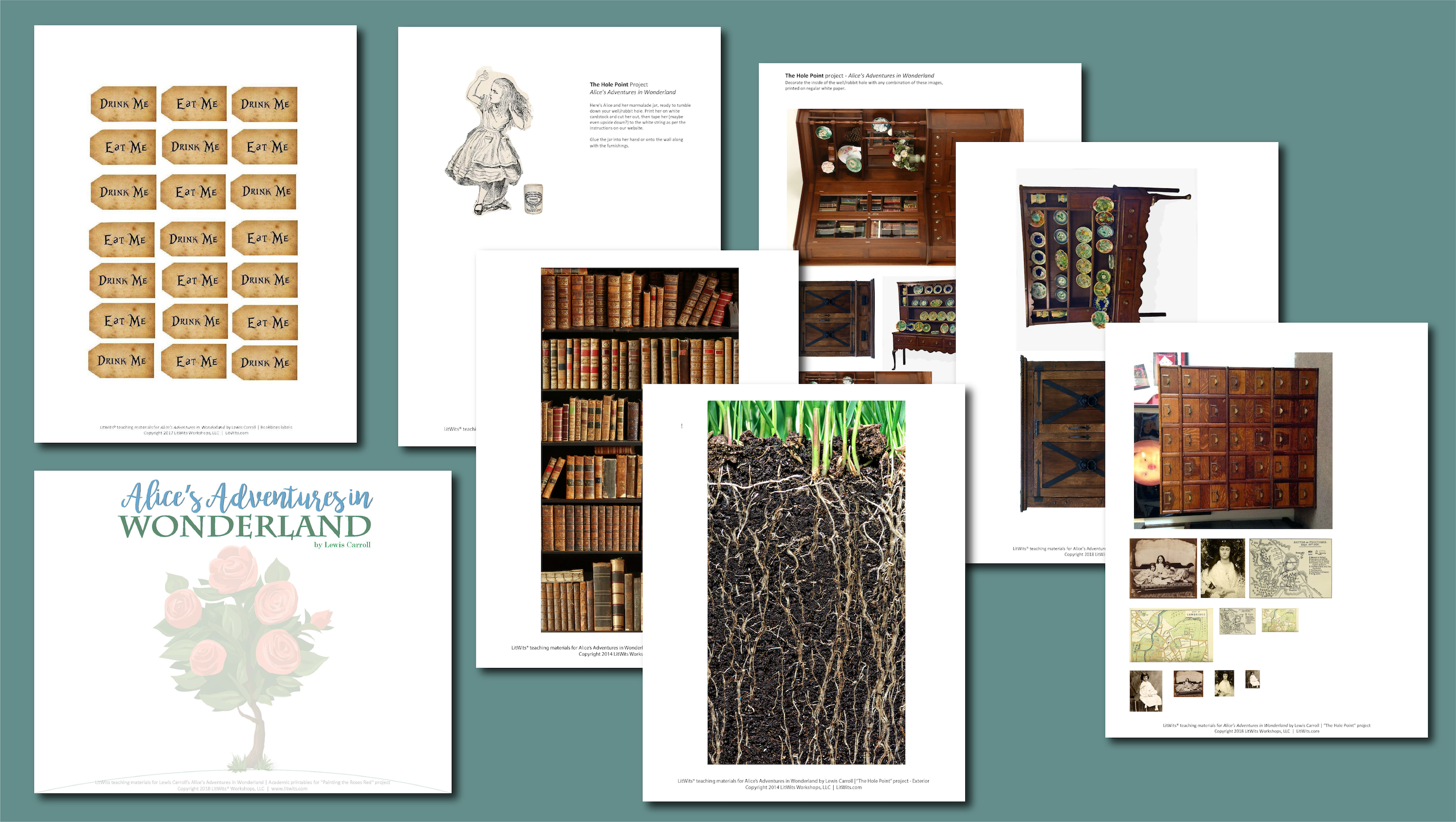
  • outside (roots) and inside (books) images, printed on regular paper, 1 set per
  • furnishings image, printed on regular paper, 1 set per 2-3
  • Alice and marmalade jar images,printed on white or ivory cardstock, 1 per
DIRECTIONS
Here's a video that walks you through the process, or you can skip to the step-by-step written directions below it.

  1. Trace the half-lid on black paper, cut it out, and glue it to the inside bottom of the can.
  2. Glue the bookcase image to the inside of the can.Trim off the excess. 
  3. Tape the half-lid to the top of the rabbit hole using electrical tape around the rim.
  4. Glue the roots image to the outside of the can.
  5. Trim off the excess.
  6. Cover the ragged vertical edges of the can with electrical tape.
  7. Decorate the inside of the rabbit hole with any assortment of shelves, hutches, pictures, and maps for Alice to fall past.
  8. Cut out the Alice image and affix the string using a tab of paper covered by a piece of tape, so that Alice slides freely along the string. Glue the marmalade jar (not pictured) onto her hand.
  9. Cut a ½” notch in the bottom of the can and slip the knotted end into the notch. Pull taut.
  10. Cut a ½” slit in the center of the lid and slide the other end of Alice’s string in. Pull taut and tape down over the edge of the lid with more electrical tape.
  11. Top with a “riverbank” of green moss and (if you have them) mini daisies.
  12. Slide Alice on her inaugural journey down to Wonderland and back up again. 
Ah, if only returning to Youth were that easy!

BookBites

Bossy Refreshments

A LitWits activity from the Rising Action

BookBites is the part of our literary experience when we get to “taste the story.”  We choose a food right out of the book, and it has to meet at least one criterion:

  • it’s important to a plot point
  • it has thematic significance
  • it’s unfamiliar for reasons of culture, era, or location
The potion that shrunk Alice, and the cake that enlarged her, hit on all three points, and were super fun for the kids--and us! Our regulars know we're sticklers for authenticity, and so when they saw a large “DRINK ME” bottle on the table, they were eager to know what was in it.  We told them we'd flown to Oxford the night before and fallen down the very same rabbit hole in the riverbank, and found the very same bottle left right where the narrator describes it. We'd brought it home so they could try it, but we were sorry we didn't have enough to serve sixty kids. Magically, however, as we started to pour it into serving-sized bottles, the potion replenished itself! The spirit of Lewis Carroll was clearly at work.
It was the same, so we said, with the single “EAT ME” cake we found in Wonderland. Every crumb replicated itself as we served the kids, until we had exactly sixty small cakes! Though the replications did not bear the painstaking (and oh yes we do mean painstaking) currant lettering, we served the kids a side of currants for a DIY version. Most kids hadn’t tasted currants, so it was extra fun to have something “weird” straight out of the story.

INSPIRATION
Soon her eye fell on a little glass box that was lying under the table: she opened it, and found in it a very small cake, on which the words ‘EAT ME’ were beautifully marked in currants. 

‘Well, I’ll eat it,’ said Alice, ‘and if it makes me grow larger, I can reach the key; and if it makes me grow smaller, I can creep under the door; so either way I’ll get into the garden, and I don’t care which happens!’    —Ch. 1
. . . round the neck of the bottle was a paper label, with the words ‘DRINK ME’ beautifully printed on it in large letters.  --Ch. 1

It was all very well to say ‘Drink me,’ but the wise little Alice was not going to do that in a hurry. ‘No, I’ll look first,’ she said, ‘and see whether it’s marked “poison” or not’ . . . However, this bottle was not marked ‘poison,’ so Alice ventured to taste it, and finding it very nice, (it had, in fact, a sort of mixed flavour of cherry-tart, custard, pine-apple, roast turkey, toffee, and hot buttered toast,) she very soon finished it off.   [. . .]
You can find small vintage bottles at a craft store or online (or here's a pretty colored option) for about two dollars each. Or you can remove the labels from 8-ounce plastic bottles of water and refill them with the potion. 

Potion recipe:  The kids loved identifying the flavors Alice described, above.  If YOU can’t magically make it to Wonderland, just mix up cherry juice, cream soda, pineapple juice, poultry seasoning, caramel topping, and a blob of butter. Yes. It works.

The "Drink me" and "Eat me" labels are included in our printables for this book, or you can make (or have your kids make) your own.

Poetry in Perspective

A LitWits activity from the Rising Action

In the BookBites portion of our workshop (above), we had the kids nibble or sip before we handed each of them a bag.  Inside was a miniature or oversized object, by which the kids knew whether they'd just grown or shrunk.  Here are some items you could find at a dollar, craft, or party store (you you don’t need to have a unique item for every child):  giant lollipops, giant glasses, giant bows; mini notebooks, mini clothespins, baby socks.  (This boy found a giant lollipop in his bag, and realized he was rapidly shrinking.)

Then, from their itty-bitty or GIANT perspective, we had the kids rewrite the poem-song “Twinkle, Twinkle, Little Star” as if to a Wonderland creature like the Cheshire Cat.
DIRECTIONS

Encourage your kids to coin words and use silly language. It's supposed to be nonsense, after all, not a masterpiece. Sure, Lewis Carroll could pull off both at the same time, but it’s perfectly fine to be plain old ridiculous!  It just needs to sound enough like “Twinkle, Twinkle, Little Star” to be recognizable as a take-off on that, à la the Mad Hatter.

For instance, a “shrunken” person writing to the Cheshire Cat might come up with something like this:

Shrinkle shrinkle giant kitty
Please be careful where you sitty
Perched above my tiny self
Like a lion on that shelf

Lots of kids love reading their creative work aloud. In our workshops we take all volunteers, and everyone gets a kick out of watching their friends crack up at their own silliness.

Painting the Roses Red

A LitWits project from the Rising Action

A large rose-tree stood near the entrance of the garden: the roses growing on it were white, but there were three gardeners at it, busily painting them red.  —Ch. 8

We love Tenniel’s iconic illustrations, especially the expressions on cards 2, 5 and 7, captured mid-squabble. This project lets kids appreciate those grimaces up close while we introduce them to a famous illustrator, AS they're putting real playing cards into the scene, AND (our favorite part) DOING WHAT THE CHARACTERS REALLY DID:  painting the roses red!  

Okay, yes, it does look like a bit of a bloodbath . . . but the important thing is, it’s not. 

This activity is best for while listening to Disney’s classic “Painting the Roses Red” song, which you will then be singing for the remainder of the week. You’re welcome.
SUPPLIES

We glued this project to a pocket folder for storing worksheets – if you’d like to do that too, add pocket folders to the list.

DIRECTIONS 

1.  Read the rose-painting scene at the beginning of Chapter 8. Explain that you’ll be recreating that scene using actual playing cards and Tenniel’s illustrations. Make a big deal to the kids about the fact that they’ll get to paint white roses red by hand, as a final step.

2.  Show them your sample (or the photo at the top of this project) and explain how to cover the tree with green leaves and white roses. Demonstrate pinching squares of tissue paper in the middle and dipping them in glue, then sticking them to the tree shape to create bushy leaves and flowers. (Or you can use white silk flowers, if you have them.) Tell them they’ll need to glue an arc of green construction paper to create the ground, and color the trunk and grass with felt tip pens or paint. Then they’ll glue the cards into position. 
3.  They can cut the card characters’ heads from the illustration themselves before gluing to the cards (while quoting “off with their heads!” of course), or you can help them by doing this ahead of time. Adding stick-figure arms and legs is easy, or kids might want to make more elaborate appendages.

4.  Their last step will be to use a paintbrush to paint those roses red. Emphasize they won’t want to paint ALL of them, since in the story the Queen approaches before the cards have a chance to finish. 

Have fun! 

Malice in Punderland

A LitWits activity from the Climax & Resolution

As teachers of Reeling and Writhing, we never knowingly pass up a chance to pun, and we love that Lewis Carroll seized so many of those chances for his magnum opus. It's only in the very end, though, that a character wittingly makes a pun, and identifies it as such:

          “Why, there they are!” said the King triumphantly, pointing to the tarts on the table. “Nothing can be clearer than that. Then again—‘before she had this fit—’ you never had fits, my dear, I think?” he said to the Queen.
          “Never!” said the Queen furiously, throwing an inkstand at the Lizard as she spoke. [...]
          “Then the words don’t 
fit you,” said the King, looking round the court with a smile. There was a dead silence.
          “It’s a pun!” the King added in an offended tone, and everybody laughed, “Let the jury consider their verdict,” the King said, for about the twentieth time that day.

It's right after this pun that the story reaches its climax, with the threat to Alice's life:

          “No, no!” said the Queen. “Sentence first—verdict afterwards.”
          “Stuff and nonsense!” said Alice loudly. “The idea of having the sentence first!”
          “Hold your tongue!” said the Queen, turning purple.
          “I won’t!” said Alice.
          “Off with her head!” the Queen shouted at the top of her voice. Nobody moved.
          “Who cares for you?” said Alice, (she had grown to her full size by this time.) “You’re nothing but a pack of cards!”

Alice resolves this crisis by rising to meet the malicious Queen, head-on. (You caught that, right? sooo satisfying.) Thank goodness she didn't hold her tongue!! To celebrate this burst of Alice's growth (don't try and stop us now!), have your kids work in pairs or teams to list as many puns from the story as they can, whether using memory or books. The team with the most puns WINS!!  Always!! 

Our "Tickling the Punny-bone" vocabulary worksheet is all about the puns in this story, if you'd like the kids to do that too. 

Jam-packed with Symbolism

A LitWits activity

Alice in Wonderland gives us a fun way in to discussing the genre of literary nonsense, which Lewis Carroll helped innovate, and which is still popular today. We talked about an author's possible motives for writing nonsense, and the differences between writing multilayered nonsense on purpose, and simply making up random words and plot lines. Even if the writing seems pure ridiculousness, there's something of the author hidden in there that makes sense. (See our Learning Links section for lots of fascinating interpretations!) We pointed out that most nonsense, like all other writing, is an expression of conscious and subconscious meanings.  
As an example, we focused on the odd symbol of the marmalade jar that Alice sees as she falls down the hole. Assuming one theme of this book is growing up, what might that jar mean?  What was it used for? What were the characteristics of what was in it? What does it mean that it's now empty? The jam is gone, like Alice’s childhood is going to be, with maybe some residual sweetness. Could the jar stand for a sweet memory of what used to be? Do you think Lewis Carroll used that symbol intentionally?
Such conversations can give you a “way in” to the idea of supporting a thesis topic with contextual evidence. If your students are on the mature or thoughtful side, ask them to pretend the Queen or King of Hearts (you!) has put them on trial for this claim that the story is all about the complexities of growing up, and that they must offer evidence to support it. Have the kids divide into groups to pore over the text together, list their findings, and present their case to you for judgment. 

Jabbersense

A LitWits activity

Many kids have already heard or read Lewis Carroll’s nonsense poem “Jabberwocky”, which shows up in Through the Looking Glass, the sequel to Alice's Adventures in Wonderland.  It's considered a great example of the literary nonsense genre, and it's a favorite of language arts teachers, because the grammatical and contextual clues help you figure out what's happening. 

It's awfully fun to read out loud, so we had the kids take turns reading stanzas. We talked about what gives certain words, like whiffling and vorpal, extra ummmph. Then we had them translate this nonsense poem into sense, and invited them to share their translations, some of which were much funnier than the original. (Two kids were inspired to go on and write short stories based on their versions of the Bandersnatch and the Jabberwock.) 

Printables previews

The worksheets and printables used for our activities are sold as a complete set.
Common Core State Standards Alignment for the comprehensive use of our teaching ideas and materials is also included for grades 3, 4, 5 and 6. 

Takeaway Topics

Why we chose this book for a "field trip"
Lewis Carroll lit up our imaginations long before we read Alice’s Adventures in Wonderland  or its sequel, Through the Looking Glass. As little tykes, anytime we took a walk on the beach with our mom, she'd quote lines from "The Walrus and the Carpenter," and we thought the poem was funny without even realizing how very clever it was. In fact, it wasn't until we were preparing to offer Alice as one of our experiential workshops that we got a deeper look at the real talent of Lewis Carroll and the depth of his fantastical story. It's a wonderland of wit and charm packed with great takeaway topics, which we're sharing below.

In our workshops, we did our best to make these teaching points tangible, meaningful, and memorable in the kids' hands. It's amazing how much kids can learn while they're "just" having fun!  

Happy teaching,
Becky and Jenny

Takeaway 1

Lewis Carroll

Watch our kid-friendly video biography here

Charles Ludwidge Dodgson, whom we know as Lewis Carroll, was a fascinating man, much more interesting than most of us have ever thought, and certainly much more than “just” the author of the Alice books!  He was a brilliant high-level mathematician, a master photographer (and pioneer in the art form), a theologian and minister, a creator of games and riddles, and a prolific inventor. 

Many of his inventions involved making reading and writing easier for people, such as:

  • the nychtograph for the writer who wakes up in the night with an idea, and doesn’t want to have to light a candle to write it down
  • a special apparatus to help a bedridden reader hold a book sideways
  • a stamp-case with special sleeves for different values, for prolific letter writers like himself; it includes a special booklet on how to be a good correspondent
  • an improvement to the typewriter that made it easier to justify the left margin.
Charles attended Christ Church College at Oxford and graduated first in his class in mathematics. He went on to teach mathematics there, and wrote stacks of books about higher math. He also loved to tell stories, invent and improve upon games, and make up puzzles,  from the time he was a child. The eldest of eleven children, he kept them entertained in all these creative ways and more. He was a master communicator, even though a childhood bout with a fever left him deaf in one ear, and a case of bronchitis went into his chest, and he suffered from a stammer (he called it his “hesitation“).

These things may have kept him from interacting fluently with adults, but they certainly didn’t keep him from developing his mind, and they made him more comfortable with children. He never married, but he played the role of an uncle to his friends’ children, as many Victorian bachelors did. He was a particular friend of George McDonald’s, and often spent time with his family and entertained his children. But perhaps his favorite was a young girl named Alice Liddell. He would often take Alice and her two sisters on both trips and picnics, and entertaining them with stories along the way.

It was on one of these excursions of the Thames River from Oxford to Godstowe that the short story of “Alice’s Adventures Underground” was first told. Alice enjoyed the story so much, she begged him to write it down, and so he did, in longhand, with his own illustrations. Alice loved it, as did her sisters and George McDonald’s children. A year the book was published as Alice’s Adventures in Wonderland under the pen name Lewis Carroll, to keep his important mathematical writings separate from this children’s fantasy story. 

The book was an instant success. There's a well-known story that Queen Victoria loved it so much, she ordered/requested/directed that Carroll dedicate his next book to her. The story goes that the author obeyed, but (perhaps not liking being told what to do) the book he wrote and dedicated to her was no delightful fantasy. It was  An Elementary Treatise on Determinants, With Their Application to Simultaneous Linear Equations and Algebraic Equations. Isn't that hilarious? We wish it were true, but it turns out it's NOT.  As we told the kids, "well-known" doesn't always mean "true"--a lesson to tuck away for research and life.  

Hands-on connections in this guide:  "Carrolling" activity;other activities as expressions of the author’s work; all props as thematic/ symbolic elements of the story; music and audiovisuals about the author’s life or book; setting, narrative arc, creative writing, and vocabulary worksheets  

Takeaway 2

Growing Up


Of course there are hundreds of interpretations of Alice’s Adventures in Wonderland, and given the divergent brilliance of its author, it’s certain the book is much more than a nonsense tale.  But the one interpretation your kids can most relate to is the idea that Alice is falling from childhood—the place of picture books and daisy chains— to adolescence, where books have no pictures and life is lived mostly in rooms full of cupboards and textbooks. There are many scenes in the story where Alice feels awkward and confused, and endures things that don’t make sense to her at all.  Kids feel and endure the same, especially as social expectations change and their bodies grow quickly. They suddenly feel too small in one way and too large in another. 

Hands-on connections in this guide:  props related to growing and shrinking; BookBites snack; “Poetry in Perspective” activity; “The Hole Point of the Conflict” project; narrative arc worksheet; "Jam-packed with Symbolism" activity

Takeaway 3

Literary Nonsense


This book and its sequel, and its sequel, Through the Looking Glass,  are two fine examples of literary nonsense, a genre innovated by Lewis Carroll and Edward Lear. Literary nonsense writing can be utterly ridiculous just for the sake of amusement, or it can be a secret text with multiple layers of meaning.

We love the entertainment value of Alice in Wonderland, but we also appreciate the encoded messages.  As in all great books, we see vestiges of the author's life and symbols of his main theme (growing up) woven through the story. This gives us a chance to talk about hidden meanings in great books--and in life, even when everything seems to be utter nonsense.

Hands-on connections in this guide: props that convey nonsensical elements of the story; “Painting the Roses Red” project; "Jam-packed with Symbolism,"  "Jabbersense," and "Poetry in Perspective" activities/creative writing and vocabulary worksheets
Alice’s Adventures in Wonderland is chock-full of other topics to explore too, from its hidden mathematics to Victorian influences on the story to the wildlife of Oxfordshire.  Scroll down to see our curated Learning Links for more tangential teaching opportunities, and to see how we brought this book and its ideas to life. 

Learning Links

Explore these links to supplement your reading experience, research points of interest, and prompt tangential learning opportunities.


About the Author

The LitWits Author Chat - child-friendly video biography of Lewis Carroll:


Reading of the book by Tony Walker
Biography with FAQ (Lewis Carroll Society of North America)
Biography with bibliography - Biblio.com
Biography (Oxford)
Huge biography and scholarship link collection – Lewis Carroll Society of North America
Author's photography (Lewis Carroll Society of North America)
Author's artistry - Lewis Carroll Society of North America
Author's mathematics - Lewis Carroll Society of North America
Author's math and logic puzzles (University of Hawai-
Friendship with George MacDonald family (Geo. MacDonald Info Web)
Scholarship on the friendship with the MacDonald family - RB Shaberman, St. Norbert College
“10 Fascinating Facts About Lewis Carroll” - Mental Floss
“10 Whimsical Words Coined by Lewis Carroll" - The Week
Video (22m) about Carroll as a mathematician (University of Adelaide)

About the Book

Full text of the book (Gutenberg)
Details of a rare first edition (Christie’s)
On the theme of growing up (AIW.net)
Rich resource (Wikiwand)
Interpretations of the book (The Guardian)
Interpretations of the book (Carleton College)
John Tenniel, illustrator – comprehensive page (Alice in Wonderland.net)
Plot overview (SparkNotes)
“10 Things You Didn’t Know About Alice in Wonderland” (The Guardian)
"Alice in Wonderland: Stuff and Nonsense" (British Council)
About literary nonsense (Carleton College)
How to write a nonsense poem (Thanet Writers)
About possible drug references/use (BBC News)
Hidden mathematics in the book (The Curious Reader)
“The Mad Hatter’s Secret Ingredient” (NPR)
Tenniel’s illustrations for the book (Gutenberg)


Editions and commentaries for purchase on Amazon*

Alice in Wonderland (MacMillan paperback, with Tenniel illustrations)
Alice in Wonderland and Through the Looking Glass (hardcover MinaLima edition, with interactive elements)
Children's hardcover edition of Through the Looking Glass
The Annotated Alice:  The Definitive Edition
Abridged edition of Alice and its sequel, with Tenniel illustrations
Lewis Carroll in Numberland
Alice’s Adventures in Wonderland Decoded, with full commentary and multiple interpretations of the text

*any purchases made through these links earn us a small commission, at no additional cost to you

Prop Ideas

 When choosing props for our live workshops, we always try to focus on two important categories: props that are unique to the setting, because they help kids understand “what that was like,” and props that are symbolic of themes, because they make big ideas visual and tangible. Both kinds of props generate those wide-eyed, “aha!” moments.

Below is an overview of the display we put together for our live workshop, and under that we've given more details. You could easily have your kids contribute items to a table over time, as the book is being read. 

Sometimes we create a printable prop; our "Eat Me" and "Drink Me" tags are included in the printables for this book.

A pocket watch

. . . the Rabbit actually took a watch out of its waistcoat-pocket and looked at it and then hurried on`` - and a large version representing Alice's view later:  . . . "really I’m quite tired of being such a tiny little thing!’`` —Ch. 1   

Pepper

. . . 'There’s certainly too much pepper in that soup!’ Alice said to herself as well as she could for sneezing. / There was certainly too much of it in the air. —Ch. 9

Bottle of magic potion

...this time she found a little bottle on it . . . and round the neck of the bottle was a paper label with the words ‘DRINK ME’ beautifully printed on it in large letters. —Ch. 1

Empty marmalade jar

She took down a jar from one of the shelves as she passed; it was labelled ‘ORANGE MARMALADE’ but to her great disappointment it was empty. —Ch. 1

Cake with currants

Soon her eye fell on a little glass box that was lying under the table: she opened it and found in it a very small cake on which the words ‘EAT ME’ were beautifully marked in currants. —Ch. 1

Really big mushroom

Alice remained looking thoughtfully at the mushroom for a minute trying to make out which were the two sides of it; and as it was perfectly round she found this a very difficult question. However at last she stretched her arms round it as far as they would go and broke off a bit of the edge with each hand. —Ch. 5

Tiny gold key

...there was nothing on it except a tiny golden key and Alice’s first thought was that it might belong to one of the doors of the hall; but alas! —Ch. 1

Tea set

There was a table set out under a tree in front of the house and the March Hare and the Hatter were having tea at it... —Ch. 7

Raven

The Hatter opened his eyes very wide on hearing this; but all he said was ‘Why is a raven like a writing-desk?'
—Ch. 7. (We happened to have one - he has appeared in many of our workshops!)

Red paint and white roses

A large rose-tree stood near the entrance of the garden: the roses growing on it were white but there were three gardeners at it busily painting them red. —Ch. 8 

King and Queen of hearts

..last of all this grand procession came THE KING AND QUEEN OF HEARTS. —Ch. 8

Comfits

...in despair she put her hand in her pocket and pulled out a box of comfits (luckily the salt water had not got into it) and handed them round as prizes. There was exactly one a-piece all round. —Ch. 3 (Comfits are candy-coated nuts or licorice or fruit)

Great Quotes

QUOTES FROM ALICE'S ADVENTURES IN WONDERLAND

“And what is the use of a book,” thought Alice, “without pictures or conversations?” —Ch. 1
*
For, you see, so many out-of-the-way things had happened lately, that Alice had begun to think that very few things indeed were really impossible. —Ch. 1
*
“But it’s no use now,” thought poor Alice, “to pretend to be two people! Why, there’s hardly enough of me left to make one respectable person!” —Ch. 1
*
“Curiouser and curiouser!” cried Alice (she was so much surprised, that for the moment she quite forgot how to speak good English). —Ch. *
“I’m older than you, and must know better.” —Ch. 3
*
“The best way to explain it is to do it.” —Ch. 3
*
“When I used to read fairy tales, I fancied that kind of thing never happened, and now here I am in the middle of one!” —Ch. 4
*
“What do you mean by that?” said the Caterpillar, sternly. “Explain yourself!”

“I ca’n’t explain myself, I’m afraid, Sir,” said Alice, “because I am not myself, you see.” —Ch. 5
*
“Well! I’ve often seen a cat without a grin,” thought Alice; “but a grin without a cat! It’s the most curious thing I ever saw in all my life!” —Ch. 6
*
“I don’t see how he can ever finish, if he doesn’t begin.” —Ch. 9
*
“And the moral of that is—‘Be what you would seem to be’—or, if you’d like it put more simply—‘Never imagine yourself not to be otherwise than what it might appear to others that what you were or might have been was not otherwise than what you had been would have appeared to them to be otherwise.’” —Ch. 9
*
“If there’s no meaning in it,” said the King, “that saves a world of trouble, you know, as we needn’t try to find any.” —Ch. 12
We're glad you're here!

You're literally on our page about inspiring kids to love great books.  YAY! We're eager to share our passion for LitWitting and the work we've done for over a decade.

We're also eager to keep doing it! :)  So if you find this guide-page inspiring* and useful, please share it with your social world. And if you buy our printables for this book, thank you. We appreciate you helping us keep the lights on at LitWits! 

Happy teaching,
Becky and Jenny
Sisters, best friends, and partners
*We hope we've inspired you!  If you're feeling a little overwhelmed (we hear that sometimes), remember, you're LitWitting whether you do a lot or a little. You can't go wrong!  The learning is happening, trust us. Just take the pressure off and do what works for your kids, time, and budget.  It's all about inspiring kids to read for fun, so they want to read more—because kids who read more great books learn more great things.

Now get ready for a bunch of wide-eyed kids having “aha!” moments . . . and you, grinning ear to ear because your kids are happily engaged with a great book.

Terms of Use

The Becky & Jenny version:  Feel free to print pages for teaching use, and make copies of printables for your students. Please don’t use our name, ideas, or materials commercially or share our printables, though we'd love for you to share these free pages with your fellow educators.

The blah legal version: You are granted exclusive use of our products in download or print version as follows: You have the right of reproduction that is limited to your use only in whatever quantity is necessary to meet your needs and those of your student participants. This right is unlimited and extends for as long as you need the materials during which time they cannot be given to or shared with any other person(s) through any means of delivery, materially or digitally via the Internet. As such you have the right to store the product(s) on the hard drive of your computer or as hard copy in your resource file.  Any misuse of these rights is in violation of copyright law.

LitWits® is a registered trademark of LitWits Workshops, LLC.

LitWits teaching ideas and materials for Alice’s Adventures in Wonderland  by Lewis Carroll 
Copyright 2017 by LitWits Workshops, LLC.  All Rights Reserved.

Want ideas for more great books?