Caddie is a smart, brave girl growing up in early Wisconsin. She's fantastic at figuring things out, including mechanical things, and she'd much rather be outside hunting or doing farm work than inside baking and sewing. But it's her friendship with the Indians, who scare most of the neighbors, that says the most about who Caddie is--and puts her character and courage to the test. Caddie Woodlawn* --the story and the girl--exemplifies the value and necessity of acting on one’s values and convictions.
Read reviews / buy the book We make a small commission on anything you buy through our Amazon affiliate links.
Hands-on Fun
Making a plan . . .
There are many ideas in this Hands-on Fun section—don't feel you have to do them all! Go with whatever works best for you and your kids. If you want to focus on a particular teaching point, our Takeaway Topics section can help you narrow down the activity options. And you can enhance discussions during any activity with audiovisual aids from Learning Links or story objects from Prop Ideas.
In our workshops, we do all the activities on this page, in order of the story's narrative arc. You might find our narrative arc handout helpful for sequencing your activities, teaching the important concept of the arc, and helping kids learn how Carol Ryrie Brink put Caddie Woodlawn together.
The first thing Caddie actually DOES in this book is unfasten "the many troublesome little buttons on the back of her tight-waisted dress" and then pause "to see if she could balance a fresh-water clam shell on her big toe. She found that she could." (Ch. 1)
Doesn't that scene make you pause, too, and say WHAT? How does such a weird little action get into Scene 1 of Act 1? But of course, the author is showing us who Caddie is--a girl in uncomfortable clothes who can't resist the chance to balance a clam shell on her big toe. We're getting a glimpse of why her brothers "accepted her as one of themselves."
This scene also demonstrates the author's "show don't tell" skills. In our workshop, we talked about this while the kids searched for clamshells hidden in the creekbed (okay, the classroom) and did what Caddie did. Or tried.
SUPPLIES
One clam shell per child--preferably fresh water clams, but any kind will do.
DIRECTIONS
Ask if anyone remembers what Caddie paused to do as she was getting undressed before her swim. Once someone mentions the part where she balances a clam shell on her big toe, they’ll all be ready for the challenge and eager to prove that “it’s not that hard!” Pro tip: don't stand it on its pointy end; hang it like a hat. Get ready to see lots of feet in the air and have your camera ready!
FOR DISCUSSION
After the hubbub dies down, remind kids that authors always have reasons for adding details like this, and ask what Caddie’s action here tells us about her personality. What kind of a person is she? (Thoughtful, curious, the opposite of prissy, prim or proper, etc.) What is her relationship with her brothers like? (comfortable, competitive, etc.). What is her relationship with nature like? Why is it important for us to understand these things about Caddie before the story gets going?
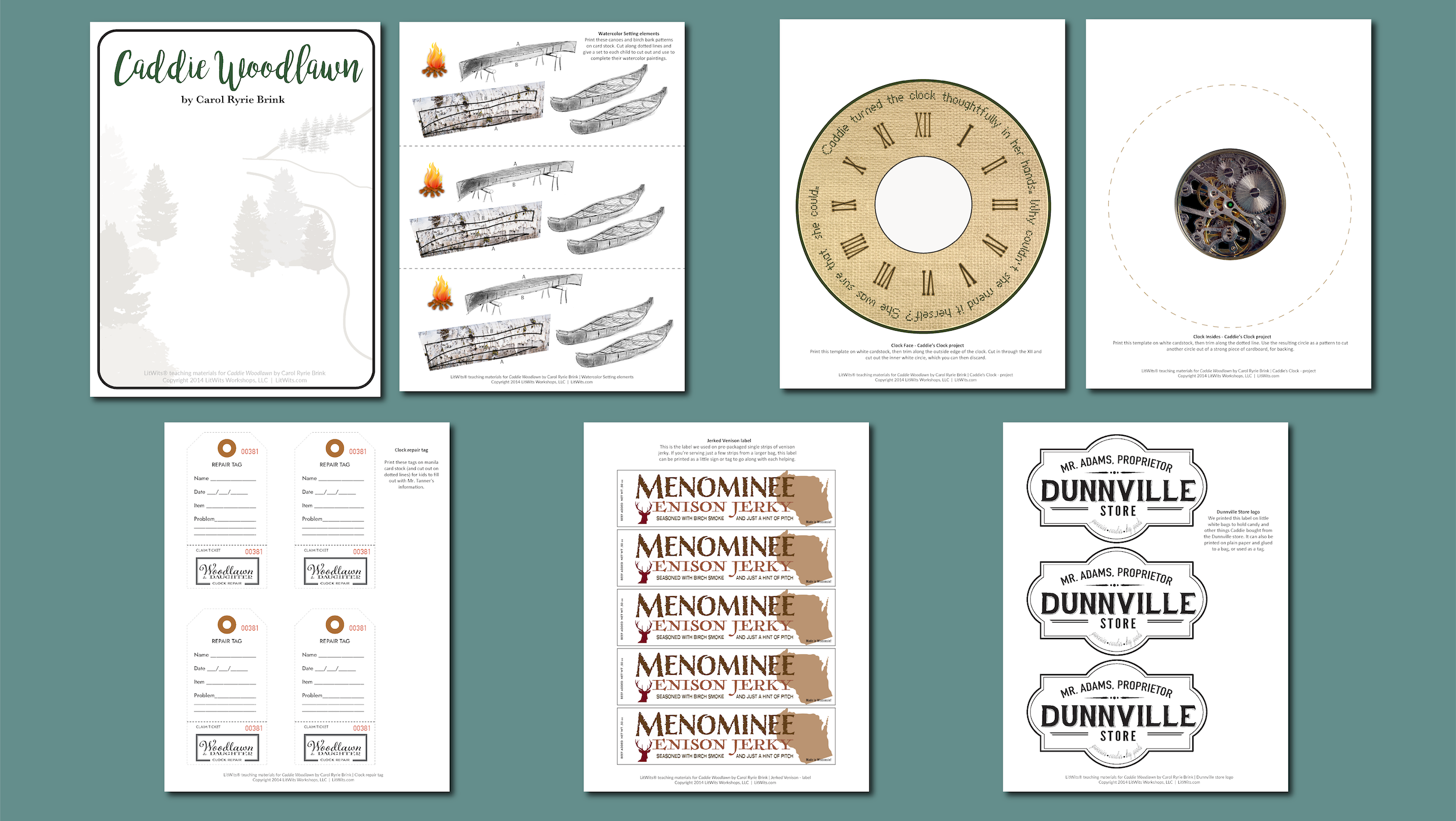
Now that we’ve dipped our toes into the story, let’s do something with our hands to appreciate the setting. This watercolor art project starts with a template to give some guidance, but the final result will be unique to each child, as they mix and choose their colors and add details of their own.
INSPIRATION
Now that they were dressed, they sped along the river bank in the direction of the smoke. Several
Indian canoes were drawn up on shore in the shelter of a little cove and beyond them in a clearing the Indians moved to and fro about a fire. Propped on two logs was the crude framework of a canoe which was already partly covered with birch bark. The smell of birch smoke and hot pitch filled
the air. Caddie lifted her head and sniffed. It was perfume to her, as sweet as the perfume of the
clover fields. - Ch. 1
Ask the kids what details they notice about the scene. Explain that they’ll be creating a watercolor picture of the scene (minus the Indians, as if they had just left), and then add canoes and fire. Our template includes images of birchbark to glue onto the half-finished canoe.
First, create different colors of green to add depth and interest to the scene; then paint the river and clearing. Add a little Woodlawn home up the hill, where the family and the circuit rider are gathered around the table, wondering where Caddie is. Add smoke curling up from the chimney, scenting the air.
Once the scene is dry, add the canoes and fire. Cut out the images of birchbark pieces (or use real birchbark) and glue them to the canoe propped on the logs.
Woodlawn & Daughter Clock Repair
A LitWits activity from the Rising Action
Caddie was great at figuring things out, wasn’t she? All through this story, she learns by doing--and sometimes by making mistakes the first time. For instance, she really should NOT have been messing around with the circuit rider's clock! But when it exploded into little mechanical pieces, her father used the opportunity to teach her how to mend it.
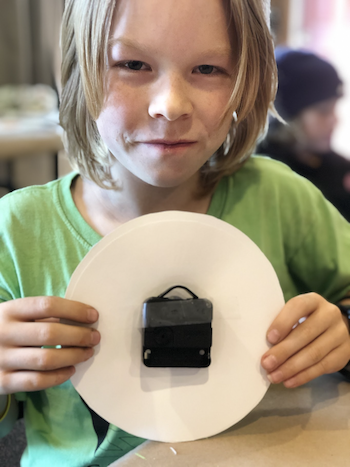
This scene represents one of Caddie's unique aptitudes, her father's understanding and support of her "tomboyishness," and a skill she learned directly from him. So as a perfect straight-from-the-story project, we created our own custom timepiece. It's easy! Our clock face template lets kids easily transform a simple store-bought clock mechanism into a custom-made timepiece.
Kids get pretty excited when they find out they're going to make their own clocks that really work, and we loved how this project reinforces the idea that kids CAN figure things out for themselves, and when they can't, there's usually an adult around to help.
Read the description of Caddie’s clock-repairing scene in chapter 7 out loud. Ask the kids to pretend that when Caddie got older, she and her dad opened up their own clock repair shop, and that we're going to put together our very own clock!
Have them fill out the repair tag as if Mr. Tanner, the circuit rider, is leaving his clock with the Woodlawn & Daughter repair shop. They should write down the “problem” as he described it.
Tell them to have both templates in front of them and to look first at the clock face. If they're are unfamiliar with Roman numerals, explain the basics of I, V and X and how to find XII. Read what the clock face template says around the edge; it's written in a cross-stitch style to represent Caddie’s blend of skills.
Now ask them to look at the gears, or "clock insides" template and notice the intricate workings. Tell them "we're leaving some of the insides exposed to remind us that Caddie (and YOU!) can figure out hard things."
DIRECTIONS FOR KIDS
Cut out the clock face.
Cut through the face at XII to remove the white circle from the inside. Make sure no white is left.
Cut out the clock gears template on the dotted line.
Trace around the cut-out gears template to create a circle on the piece of cardboard; then cut out that circle.
Glue the gears template to the cardboard circle.
Glue the clock face to the gears template so the gears show through the cut-out space.
On the back, mark the location of XII. You might also want to write on the back: "Jacob Alien, Tremont St., Boston."
Use a pencil to poke through the green dot in the middle of the clock face. Poke through all the layers to the diameter of the pencil itself.
Poke the clock mechanism through the gears template, from the back.
Align the top of the clock mechanism with the marked location of XII, and tape it in place.
Assemble the hands, along with washers and nuts, as directed in the instructions that came with the clock mechanism.
Set the current time, add the battery, and watch the second hand begin to move!
Because the clocks Mr. Woodlawn mended were wind-up clocks, you might want to share how clocks used to work and how most clocks work today, using quartz movement. It's interesting that though today's source of power is different, clock mechanisms, with their cogs and wheels and ticking motion, are still the same.
BookBites is the part of our literary experience when we get to “taste the story.” We choose a food right out of the book, and it has to meet at least one criterion:
it’s important to a plot point
it has thematic significance
it’s unfamiliar for reasons of culture, era, or location
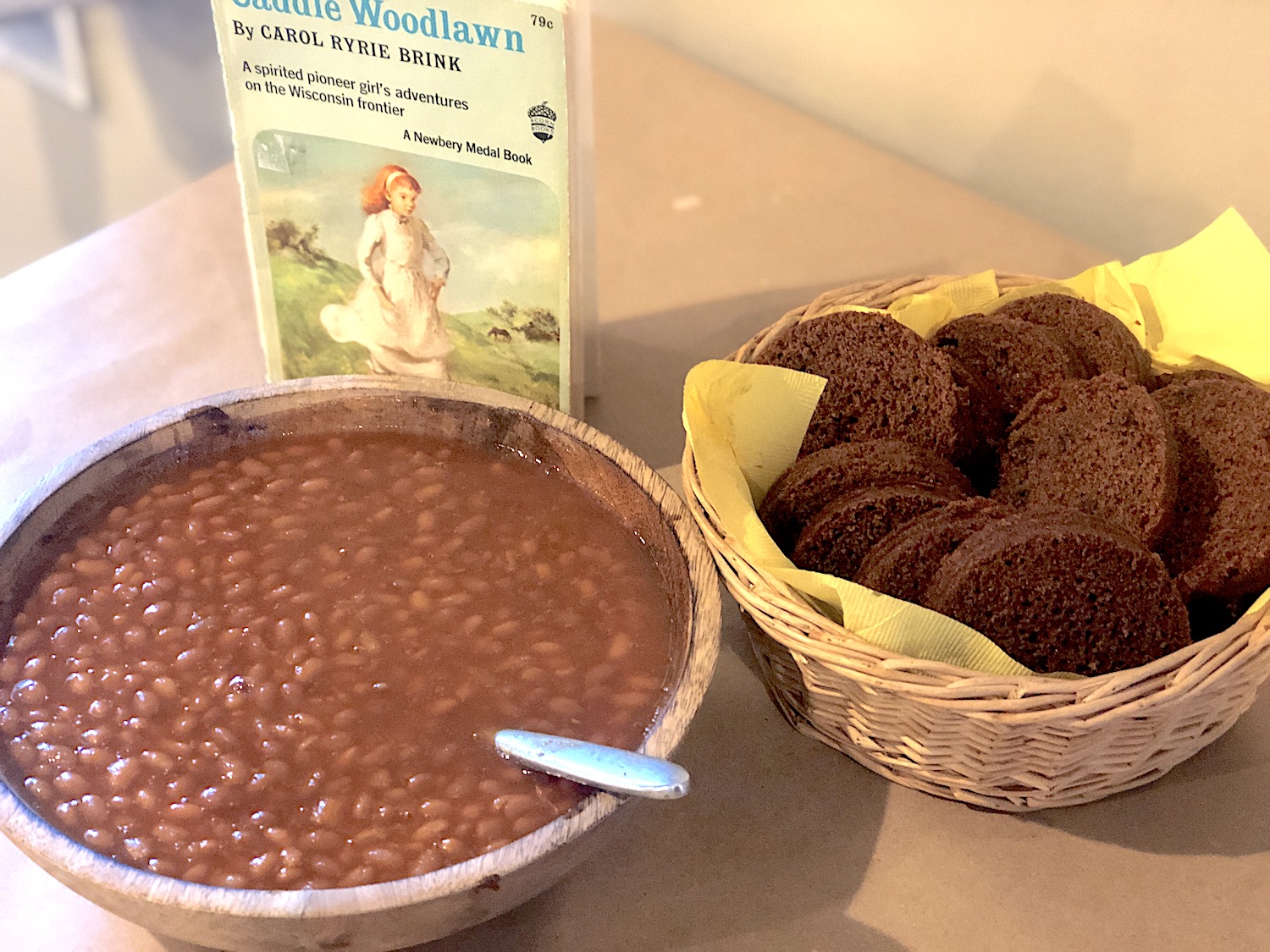
To bring the tastes of this story home to kids in one workshop, we served some brown bread and Boston baked beans. If you want to make a real impression, kids will be especially enthralled/confused by the vintage-style bread in a can that we enjoyed when we were kids.
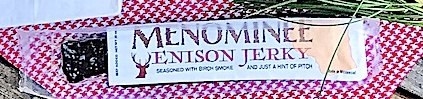
In a later workshop session we served venison jerky, inspired by this scene when the Indians are showing the Woodlawn kids their canoes:
Perhaps it was the odor of jerked venison, simmering over the fire, which had begun to mingle with the odors of birch and pitch, that made Warren remember he was hungry. -Ch. 1
We imagined that one of the local tribes was able to market their secret jerky recipe to the settlers, and this was the delicious "not turkey" meat Ma served to Caddie on the red-checkered cloth when she was missing Nero. (The label's in our printables).
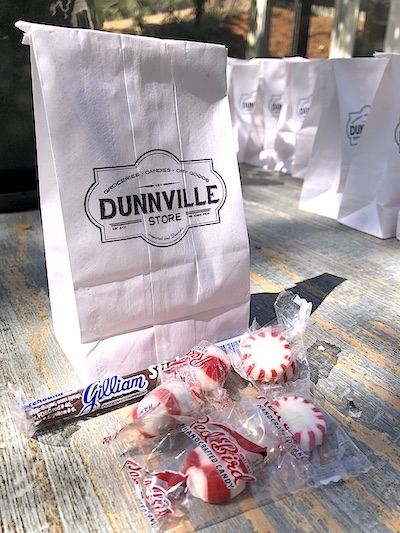
And for a sweeter treat, in taste and symbolism, we also gave each child penny candy (hoarhounds and soft peppermints) in a Dunnville store-labeled bag. (The label's in our printables). This sweet "bite of the story" was inspired by Caddie's childish desire to help Gussie, Pete and Sammie Hankinson after their Indian mother has to leave them. Caddie has decided to spend her precious silver dollar to help the children feel better:
"I want to spend it all, Mr. Adams," she said, "so you'll have to tell me when I've used it up. I want some hoarhound and peppermint and some pink wintergreens, and then I want three tops in different colors with good strong strings, and will you please tell me how much that is, because if there's anything left I wan to get some more things?"
These little candies led to some important conversations.
FOR DISCUSSION
Do what you can. We talked about Caddie's generosity, kindness, and sincerity, which are unquestionable--she's just a child doing what she can in the moment, with what she has, to make a difference. We did point out that it's a tiny, momentary difference, and its emotional effect likely lasts much longer for her than for the kids, but she's DOING it. So many in this book, and in this time period and place, did absolutely nothing, or worse.
Consider the cause. We asked the kids how they would have felt if they read about an adult making this small gesture, instead. What might they have expected of someone older, with more experience, awareness, and resources? Why were the children suffering in the first place? What was the root of the problem? (We read aloud the heart-wrenching scene of their mother's goodbye and Caddie's conversation with her own mother.) What does Caddie's mother mean when she says "Sam Hankinson hasn't a very strong character"?
Watch your language. We also made sure the kids understood that the narrator's egregious phrase "half-breeds" is one for animals, not human beings, and that it (as with many other references to Indians in this book) is an old, wrong, racist way of labeling that shouldn't be repeated. And neither should this history, ever--which, as we told them, is one reason we read this book.
Learn from the past. People are complicated. In the context of the novel, we can see that bad things aren't just done by overtly bad people. As we told the kids, in a story (especially a true one), it's easier to see how even "good people" can do bad things when fear and ignorance blend. That's something all of us should always watch out for--in old books, and in modern times.
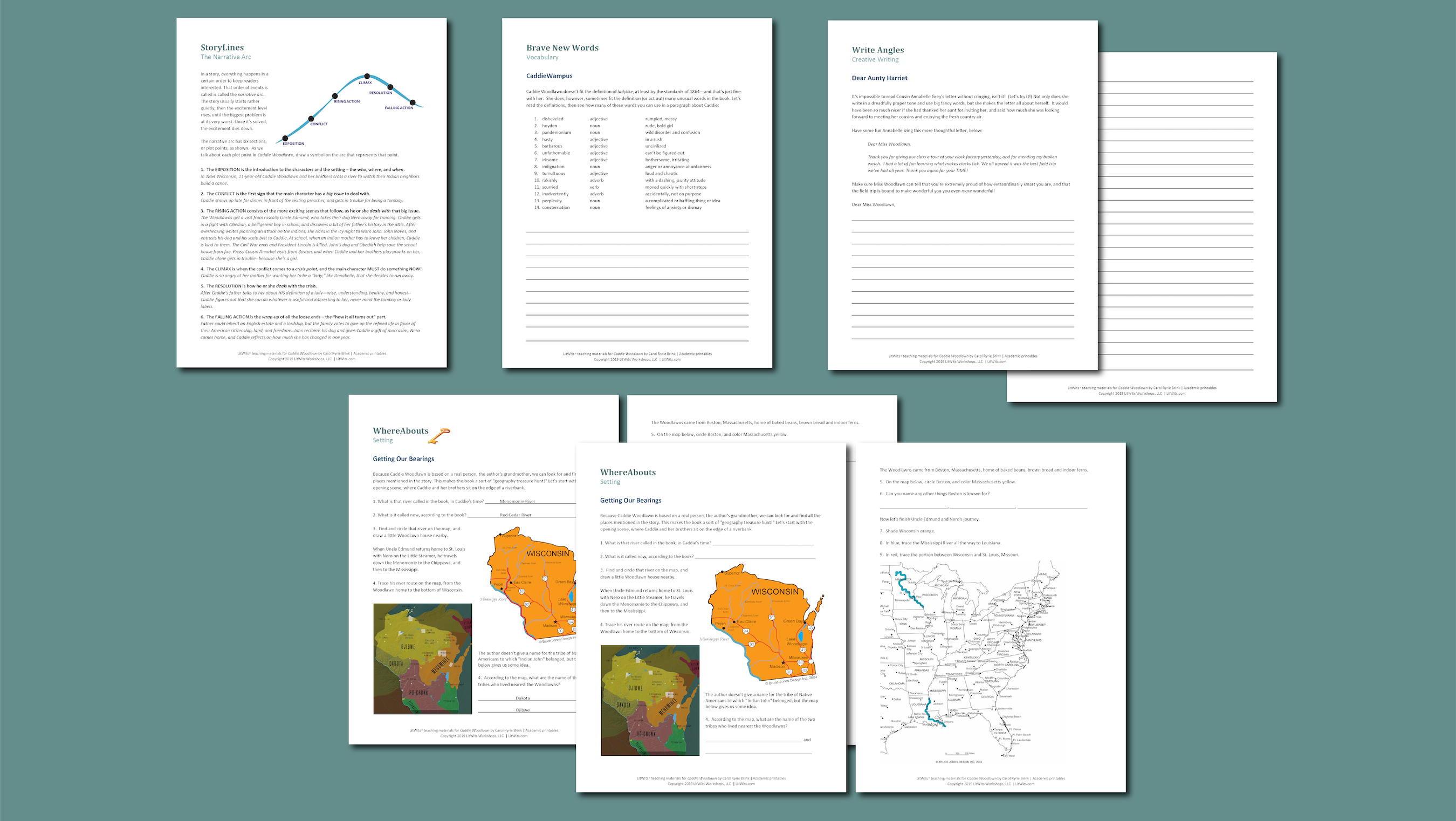
Ooooooh that Cousin Annabelle Grey--such a model of ladylike comportment and exquisite language skills! We couldn't resist having the kids do a riff on her high-falutin' way of writing, as shown below,:
I shall be charmed to visit you, dear Aunty Harriet [the letter said]. Mamma and papa think that my education will not be complete without a view of the majestic open spaces of my native land. Although I have recently been finished at the Misses Blodgett's Seminary for Young Ladies, I, myself, feel that I may yet be able to acquire some useful information in the vicissitudes of travel. -Ch. 19
Our creative writing worksheet (in our printables) helped kids see that sincerity and simplicity are usually the best way to get your ideas across, and that focusing on the other person instead of yourself is much nicer. We also got to talk about finishing schools and the definition of vicissitudes.
It also gave us a chance to point out that understanding WHY we're turned off by someone doesn't mean it's okay to be rude or even mean to them. Caddie learns that hard lesson. She also learns that Annabelle's a pretty cool cousin, after all--and can teach HER a thing or two!
A LitWits Kit is a bag or box of supplies you pack up and give to each child right before you begin your "field trip" through the story. You might be doing one-off projects as you read through the book together, or you might do everything in this guide from top to bottom after the book has been read. However you explore this book in LitWitty ways, kids love the anticipation of opening their kit.
If you'd like to build LitWits Kits for your child/ren, you could easily arrange the items in a bag, basket, or story-relevant container. Honestly, it's just as much fun to create a kit as it is to open one!
To make it all the more fun, our printables for many books include special "story packaging" for certain activity supplies, including BookBites. Click the button below for a specific list of contents for this book.
We're so glad our friends recommended Caddie Woodlawn to us! This bright, brave girl has an open heart and always stands up for what's right--even if it gets her in trouble. She's not perfect! Caddie Woodlawn is the true story of a great kid who learns some great things. And it's packed with great "takeaway topics," which we're sharing below.
So we chose it for one of our experiential workshops, where we made these teaching points tangible, meaningful, and memorable in the kids' hands. It's amazing how much kids can learn while they're "just" having fun!
Happy teaching, Becky & Jenny
Takeaway 1: Figuring things out
Caddie's a smart, open-hearted, girl who's good at figuring things out--and not just how to fix clocks. More importantly, she figures out what makes people worthy of respect, be that her annoying little sister, an obnoxious cousin, a schoolhouse bully, or her Indian friends the neighbors so deeply fear. She also figures out how to earn her own self-respect: how to be who she is, regardless of anyone's labels. Through her firsthand experiences and with her father's help, she figures out what's fair and right.
Hands-on connections in this guide: "Woodlawn & Daughter Clock Repair," "Annabellizing" creative writing worksheet, "Riverside Recreation" project, BookBites activity
Figuring things out doesn't do you any good if you don't put the truth to good use. In this story, Caddie doesn't just befriend the local Indians; she rides through the icy night to warn them of fearful neighbors' disastrous plans. In doing so, she shows faith in her friends and the courage to uphold her beliefs. It's easy to talk the easy talk--but Caddie rides the dark and wild ride.
Hands-on connections in this guide: narrative arc worksheet, BookBites activity
This true story takes place in the mid-1800s, when ideas about American Indians were often wrong and offensive. Caddie and her father don't subscribe to these ideas, and in fact are friends of the unidentified local tribe (very possibly Ojibwe, who settled the area). But Caddie's mother, the neighbors, and even the narrator use language from the past that should not be repeated today.
This book has disrespectful words in it because there were disrespectful beliefs in people’s heads at that time. Sooner or later, kids will hear these words. We'd much rather they heard them in a context that emphasizes their awfulness, and gives us a "way in" to teaching where those rotten words and ideas came from. (We've written more on that here.) After all, we can't learn from the past if we choose to ignore or erase it.
If instead we face the past, we have a setup to prevent the continuation of disrespect. We can talk about fear-driven stereotyping vs. critical thinking skills, and learn about the valuable culture and history of the Ojibwe who settled the Chippewa Valley. Those lessons can deepen respect and prevent more mistakes.
Hands-on connections in this guide: "Riverside Recreation" project, BookBites activity, setting worksheet.
A-wun-ne-wa-be, Bird of Thunder George Catlin, 1845
Caddie Woodlawn is chock-full of other subjects to explore, too--from the Wisconsin state facts to Manifest Destiny. Scroll down to see our curated Learning Links for more tangential teaching opportunities, and to see how we brought this book and its ideas to life.
Learning Links
Explore these links to supplement your reading experience, research points of interest, and prompt tangential learning opportunities.
When choosing props for our live workshops, we always try to focus on two important categories: props that are unique to the setting, because they help kids understand “what that was like,” and props that are symbolic of themes, because they make big ideas visual and tangible. Both kinds of props generate those wide-eyed, “aha!” moments.
Below is an overview of the display we put together for our live workshop, and under that we've given more details. You could easily have your kids contribute items to a table over time, as the book is being read.
(Sometimes we create a printable prop; click the button to see what we made for this book.)
The children were fascinated. Their own canoe on the lake was an Indian canoe. But it had been hollowed out of a single log. They had seen the birch-bark canoes on the river, but had never been so close to the making of one. -Ch.1
The circuit rider's clock
The circuit rider's clock no longer looked like the "face of a dead friend." It appeared to be very much alive and spoke up with a cheerful tick. - Ch. 7
Moccasins
When John had eaten, he took from his bag a pair of moccasins, decorated with the brightly dyed quills of porcupine, and held them out to Caddie. They were just her size and very beautiful. - Ch. 24
Old family Bible
. . . each child shall decide for himself what he wishes to do. Then, without telling anyone else what he has decided, he shall write 'Go' or 'Stay' on a piece of paper which he shall then fold and place between the leaves of the family Bible in the parlor. - Ch. 23
Silver dollar in wooden trinket box
Christmas came and went while Caddie wets still recovering. She had intended to spend some of her silver dollar for presents, but it still lay snug and safe in the wooden trinket box, because she was not able to take it to the store. - Ch.7
Kerosene lamp
The supper cloth had been removed with the dishes, and a homespun cloth of red and white had taken its place with a lamp in the middle. The lamp was still rather wonderful to the little Woodlawns. They remembered when Father had first brought it home to replace the candles, and how they had all stood around to see it lighted and hear Father explain its use. - Ch. 5
Great Quotes
“It was a hard struggle, but what I have in life I have earned with my own hands. I have done well, and I have an honest man's honest pride. I want no lands and honors which I have not won by my own good sense and industry.” * “How far I've come! I'm the same girl and yet not the same. I wonder if it's always like that? Folks keep growing from one person into another all their lives, and life is just a lot of everyday adventures. Well, whatever life is, I like it.” * “Life is just a lot of everyday adventures.” * “If at first you don't fricassee, Fry, fry a hen!” * “No, that is not what I want for you, my little girl. I want you to be a woman with a wise and understanding heart, healthy in body and honest in mind.” * . . . the three adventurers were overcome by that delicious weariness which suddenly overtakes one at the end of an outdoor day. *
“In those days the worst vice in England was pride, I guess—the worst vice of all, because folks thought it was a virtue.”
You're literally on our page about inspiring kids to love great books. YAY! We're eager to share our passion for LitWitting and the work we've done for over a decade.
We're also eager to keep doing it! :) So if you find this guide-page inspiring* and useful, please share it with your social world. And if you buy our printables for this book, thank you. We appreciate you helping us keep the lights on at LitWits!
Happy teaching, Becky and Jenny Sisters, best friends, and partners
*We hope we've inspired you! If you're feeling a little overwhelmed (we hear that sometimes), remember, you're LitWitting whether you do a lot or a little. You can't go wrong! The learning is happening, trust us. Just take the pressure off and do what works for your kids, time, and budget. It's all about inspiring kids to read for fun, so they want to read more—because kids who read more great books learn more great things.
Now get ready for a bunch of wide-eyed kids having “aha!” moments . . . and you, grinning ear to ear because your kids are happily engaged with a great book.
Terms of Use
The Becky & Jenny version: Feel free to print pages for teaching use, and make copies of printables for your students. Please don’t use our name, ideas, or materials commercially or share our printables, though we'd love for you to share these free pages with your fellow educators.
The blah legal version: You are granted exclusive use of our products in download or print version as follows: You have the right of reproduction that is limited to your use only in whatever quantity is necessary to meet your needs and those of your student participants. This right is unlimited and extends for as long as you need the materials during which time they cannot be given to or shared with any other person(s) through any means of delivery, materially or digitally via the Internet. As such you have the right to store the product(s) on the hard drive of your computer or as hard copy in your resource file. Any misuse of these rights is in violation of copyright law.
LitWits® is a registered trademark of LitWits Workshops, LLC.
LitWits teaching ideas and materials for Caddie Woodlawn by Carol Ryrie Brink Copyright 2021 by LitWits Workshops, LLC. All Rights Reserved.
%20banner%20copy.jpg)

