Creative Teaching Resources for
by Dorothy Sterling (1954)
LitWits Activities, Takeaway Topics, Learning Links, and Prop Ideas
Born into slavery, young Harriet Tubman knew only hard work and hunger. Escape seemed impossible -- certainly dangerous. Yet Harriet was strong-willed and courageous. "Some day," she said, "I'm going to be free." When finally she did escape North, by the secret route called the "Underground Railroad," Harriet didn't forget her people. Again and again she risked her life to lead them on the same secret, dangerous journey. Freedom Train is the exciting, true story of Harriet Tubman's bold and daring life. - from the book

ACTIVITIES ON THIS PAGE:
Meet the author
Make sweet dreams come true
Learn to show, not tell
Set Harriet's star over Rit's quilt
Understand the language of outrage
Rethink what "wanted" means
Find out what "Will power" did
Step up and speak out
Review plot points on the narrative arc
ON THIS PAGE:
Printables: preview of worksheets and activity printables for sale
Takeaway Topics: teaching points made meaningful through activities
Prop Ideas: story objects that make abstract ideas more memorable
Learning Links: curated external links for lesson prep or tangential learning
Great Quotes: some favorite lines to discuss
Terms of Use: how you may use LitWits® resources
"
LitWits makes a small commission on supplies or books you buy through our Amazon affiliate links.
Creative Teaching Idea #1
Without the author and her life experiences, Freedom Train: The Story of Harriet Tubman would never have been written! Introduce your kids to Dorothy Sterling through the short video below, which shares six kid-friendly, interesting aspects of her life.
You’ll find a worksheet for author note-taking and conversation-starting in our printables set.
Creative Teaching Idea #2
BookBites
This "bite of the book" emphasizes a plot point (the Conflict) and a theme (freedom). Hungry little Harriet, who survives on hoecake and salt pork, dreams of good things to eat, "of platters of chicken and brown gravy, of frosted cakes and mounds of candy." When she has to serve lunch in the Big House and sees sugar lumps in a silver bowl, she can't help reaching out for one. For this, she is eventually flogged--and that night, she dreams of the North Star and freedom.
Little Harriet deserved that sugar cube she never got, along with all the good food she dreamed of. While your students enjoy the sugar cube and frosted cakes Harriet craved, ask them to think of other good things it's easy to take for granted—like the sweet taste of freedom.
Creative Teaching Idea #3
"Showing, not telling" is a vital writing skill, for all kinds of writing. Dorothy Sterling gives us wonderful examples of why that's so, for both readers and writers. Her writing skills help kids "see why they see what they see" as readers—especially in the very beginning of a story, where we start to "get the picture" before the narrator fills in the gaps.
Have your kids deconstruct and discuss the first few paragraphs of this book to figure out key details given through "showing, not telling."
Our creative writing worksheet is a useful aid for this conversation and writing exercise.
Scroll for more, or browse other titles.
Creative Teaching Idea #4
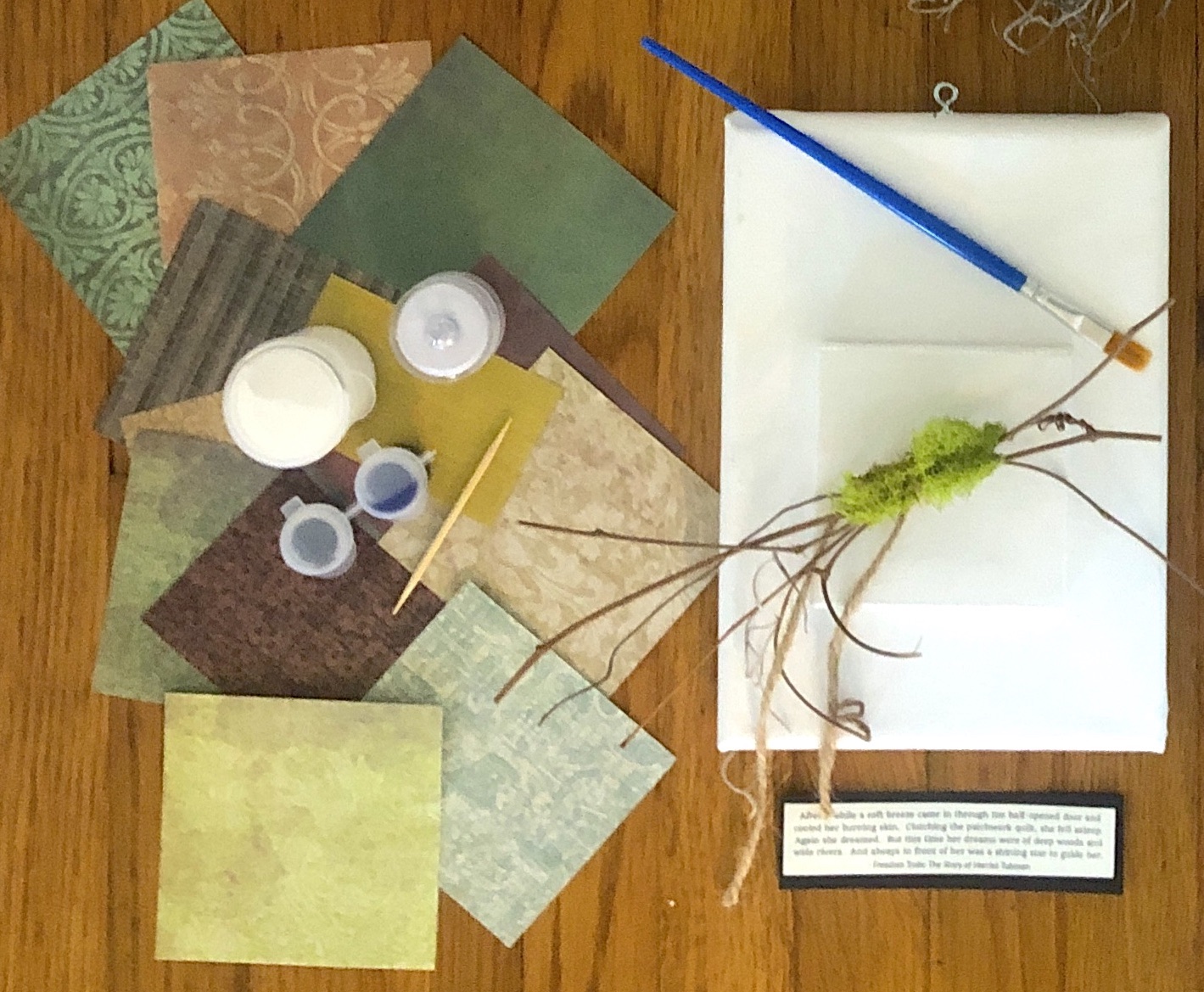
This project, centering on eight-year-old Harriet's dream after being flogged, is layered with tangible symbols of that dream and her destiny:
After a while a soft breeze came in through the half-opened door and cooled her burning skin. Clutching the patchwork quilt, she fell asleep. Again she dreamed. But this time her dreams were of deep woods and wide rivers. And always in front of her was a shining star to guide her. —from the chapter "A Peck of Trouble"
Project elements include the special quilt that covered her that night, and the North Star and woods that Harriet dreamed of. The moss of the woods also represents north, and the grapevine of the woods also stands for her people's message system. It's what we call a fully loaded project! Click open "What this represents," below, to discover the source and meaning of all its layers.
Quilt "fabric" swatches and a blank quote template (not typed as shown) are included in our printables.
Here's this project's "story from the story," with project elements in bold:
After little Harriet runs from her irate mistress, she hides in a pigpen for 24 hours, "hungry, cold, and miserable." At night, she watches the North Star:
A row of stars pointed to one which Harriet knew. Each night, when the other stars moved across the sky in steady procession, Harriet's star stood still. [...] Watching it, she remembered talk she had overheard about the free land to which this star could lead. - "Little Girl, Little Girl"
The next day Daddy Ben finds her and takes her back to their cabin, where she sleeps under torn rags. But Daddy Ben & Rit's bed is covered with "a glowing patchwork quilt of green and brown and yellow cloth." Harriet remembers her mother making the quilt from bits of "torn dresses and men's suits from the Big House."
It was warm and soft and colorful, the household's only treasure. "When I grow up," Harriet always promised herself, "I'm going to make one exactly like it." [And she did.] - "Peck of Trouble"
When she is finally flogged for her offense of reaching for a sugar cube, her mother "greased the torn back with lard, then gently covered her with the patchwork quilt."
After a while a soft breeze came in through the half-opened door and cooled her burning skin. Clutching the patchwork quilt, she fell asleep. Again she dreamed. But this time her dreams were of deep woods and wide rivers. And always in front of her was a shining star to guide her. - "A Peck of Trouble"
When Harriet does follow the North Star toward freedom, she finds herself in forests filled with grapevine—a reminder of the figurative grapevine her people use to secretly communicate. She also pays attention to the moss Daddy Ben had taught her grew on the north side of trees. She is well-equipped with courage, strength, skills, determination, and knowledge.
Harriet isn't chasing her dream—she's taking charge of it.
Per student:
5x7 cardstock
3x3 canvas (stretched on frame)
5x7 canvas (stretched on frame)
eye hook
Mod Podge
small paintbrush
black acrylic paint
blue acrylic paint
battery-operated tea-light
grapevine twigs
moss
twine to tie twigs & moss
black cardstock for quote
quote paper (in our printables*)
quilt fabrics matching the author's description (paper versions in our printables)
*For copyright reasons, the quote pictured below is not for sale, but we do include a sized template for your kids to write the quote themselves—see the previews here.
LitWits makes a small commission on supplies or books you buy through our Amazon affiliate links.
A note about the quote: For copyright reasons, the quote pictured in the video is not for sale, but our printables do include a sized template for your kids to write the quote themselves—see the previews here.
Creative Teaching Idea #5
Pictured: Walker's Appeal - Library of Congress, Prints and Photographs Division
It's David Walker's powerful, outraged Appeal, specifically written to his people, that Harriet hears Old Cudjoe reading aloud, in the chapter titled “School Days.”
The educated author was sure he had written it “in language so very simple, that the most ignorant, who can read at all, may easily understand”—but it’s not the kind of language we’d call simple today.
Have your kids choose an excerpt from Appeal, and circle the words they don't understand. They should make their best guess from contextual clues before looking up definitions.
Our vocabulary worksheet provides an excerpt and helpful word bank.
Creative Teaching Idea #6
After Harriet gets to freedom, she risks her life over and over again to help many more people get there, including her siblings and elderly parents. And after the Fugitive Slaw Law is passed, she takes her family and others farther north to safety. She refuses to rest until her people are safe. For most people, any one of those dangerous trips would be the climax of their story; for Harriet, they bring resolution to her lifelong quest.
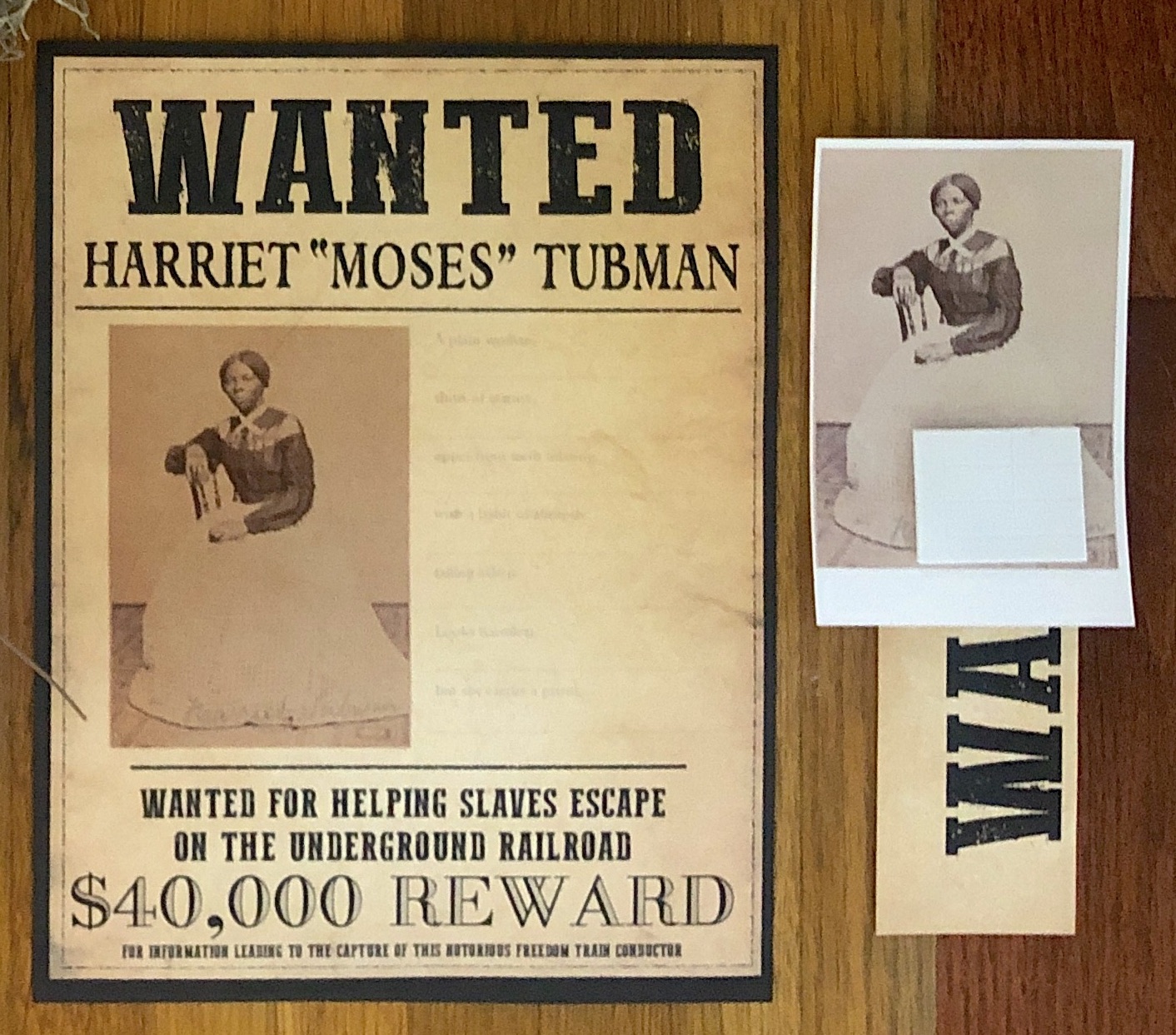
Still, in spite of her successes, she is always in danger. In the chapter titled "Moses," we read that there were handbills posted throughout the cities of Maryland, Delaware, and Virginia offering a reward for Harriet's capture, describing her as:
A PLAIN WOMAN, SHORT OF STATURE, UPPER FRONT TEETH MISSING, WITH A HABIT OF ABRUPTLY FALLING ASLEEP. LOOKS HARMLESS, BUT CARRIES A PISTOL.
As it turns out, there's no historical record of this handbill, or of any reward over $100—no one suspected this small woman of being a huge hero. But the idea of her being wanted—in a good way, by good people—is valid, and so is her worthiness. So have your kids reimagine this fictional poster, popping out the word Wanted and Harriet's image (to emphasize her stand-out character!), and replacing its physical description of her with a description of her beautiful inner qualities. There's no question those are truly Wanted now!
Hearing your kids read their descriptions of Harriet aloud will give you hope for America's future. Here are just a few examples of revisions that have touched our own hearts:
a beautiful spirit vs. a plain woman
lacking any selfishness vs. upper front teeth missing
a habit of helping others vs. a habit of falling abruptly asleep
is courageous, and carries compassion vs. looks harmless, and carries a pistol
Per student:
glue stick
scissors
pen or marker
adhesive pop-outs
black card stock
templates (in our printables)
LitWits makes a small commission on supplies or books you buy through our Amazon affiliate links.
Scroll for more, or browse other titles.
Creative Teaching Idea #7
William Still enters this story as Harriet Tubman's first friend in Philadelphia. At the time, he was the secretary of the Pennsylvania chapter of the Anti-Slavery Society, which had been founded by William Lloyd Garrison and others in 1833. Born to a former slave himself, William Still had been just a boy when he helped a slave escape. As a Society clerk and janitor, and then secretary, he helped 800 more. Here's a brief overview of his mighty life; see our curated Learning Links for more resources.
As the "Father of the Underground Railroad" he's well worth learning about, and our history worksheet helps kids do that.

Creative Teaching Idea #8
Like William Garrison in this story, many courageous journalists and other public writers advocated against slavery and its horrors. Together, they were a powerful force for good. Give your kids to step up and speak out, too!
Tell them to pretend it’s 1836 and they're writing a letter to the editor of a pro-slavery newspaper. They'll need to argue for three top reasons why slavery should be abolished.
We have a creative writing worksheet to help with that.
Creative Teaching Idea #9
Help kids learn the important concept of story order (useful for all communications!) and see how Dorothy Sterling arranged Freedom Train. You can discuss and/or do our narrative arc worksheet in any of these three ways:
At the end of your activities, introduce the concept of the narrative arc, then help kids figure out where the different parts of this story fit on it.
OR introduce the concept and complete the worksheet before the activities, so kids have a review of the story fresh in their heads first, and you can remind them "where we are" on the arc as you go.
OR introduce the concept up front, but save the story's scenes to discuss as you go, pausing to "do what the characters did" in fun hands-on ways, while weaving in discussions and other worksheets.
You're off to share the best of this great book in fun, hands-on ways!
Scroll for more, or browse other titles.
When we were young, our first reading of Freedom Train renewed our horror that slavery was ever legal in America, and left us in complete awe of Harriet Tubman. We couldn't imagine having her courage—not only to escape slavery, but to re-risk her life over and over to save others too. And her decades of major contributions besides that were mind-boggling, too. Yet to us, it all seemed part of a distant, terrible phase of America's past.
But when we read Freedom Train as adults and teachers, the 1800s seemed much closer than they had before, and slavery's lingering repercussions more obvious. There's much more to Black history than enslavement, of course—but acknowledging its foundational role in our nation is essential to understanding why things are what they are today, and why people feel the way they do. Empathetic understanding has always been our focus here at LitWits. So, because Dorothy Sterling's well-told story honors Harriet so well and imparts such necessary truths, we chose Freedom Train for one of our experiential workshops.
Read through these Takeaway Topics, then explore the supportive Prop Ideas and Learning Links below them. Make notes as you go, so you’ll remember what you want to share, and when.
Our worksheets and activity printables connect to these key ideas.
Takeaway 1
They say having courage is doing something even though you're afraid. Harriet seems unafraid—William Still notes that "She seems wholly devoid of personal fear"—but she wasn't superhuman. She wasn't fearless as she forged her way through harsh conditions and dangerous circumstances; she was courageous. Through her life and this book, she serves as a model for all of us, not just for kids.
Eastman Johnson's A Ride for Liberty – The Fugitive Slaves, 1863, Brooklyn Museum
Takeaway 2
Harriet was one of the most courageous and successful conductors on the Underground Railroad--but she wasn't alone. The events in this story give us a launching point for introducing kids to some other legendary Black heroes like William Still, along with Quakers and other white abolitionists. Talking about the facts of the Underground Railroad is a way in to talking about the power of compassionate, selfless, courageous collaborators to do what's right.
William Still (1821-1902), Naxos American Classics
Takeaway 3
Harriet Tubman, approximately 46 years old (photograph c. 1868-69) - Collection of the Smithsonian National Museum of African American History and Culture shared with the Library of Congress; Photograph by Benjamin F. Powelson; Owned by Emily Howland - Source article
Harriet Tubman's first, most critical cause was freedom from enslavement, and not only for herself--after escaping at age 27, she went back into the danger zone 13 times to rescue at least 70 others. But she was also actively involved in Civil War espionage, recruiting, and raids; women's suffrage and equality; nursing and hospital organizing, and the fight for equal military pay--and establishing housing for the elderly, schools for freed Blacks, and the National Association of Colored Women! What an incredible collection of contributions--and from an "uneducated" woman who grew up enslaved and lived most of her life with the debilitating effects of a severe head injury!
Freedom Train is chock-full of other subjects to explore, too--from the tobacco economy of the 19th century to the history of slavery in Maryland to the early abolitionist movement. Scroll down to see our curated Learning Links for more tangential teaching opportunities, and to see how we brought this book and its ideas to life.
Scroll for more, or browse other titles.
A table of props pulled “straight from the story” can lead to all sorts of wonderful discussions and wide-eyed, “aha!” moments. Props that are unique to the setting, help kids understand “what that was like,” and props that are symbolic of takeaway topics make big ideas visual and tangible.
As you read, keep an eye out for items from the book you might like to collect and share, and ask your kids to do the same. You’d be surprised how many things might be hiding in plain sight. Grandparents, garages, attics, and junk drawers sometimes yield the greatest treasures.
Here are a few prop ideas for this book.
The children's beds were covered with torn rags, but Rit and Daddy Ben's was spread with a glowing patchwork quilt of green and brown and yellow cloth. Harriet's eyes lit up when she looked at the quilt. . . [her mother] had patiently collected bits of material, torn dresses, and fragments of men's suits from the Big House. . . It was warm and soft and colorful, their household's only treasure. - "Peck of Trouble"
This is an antique "crazy quilt" that's been in our family for generations, but you can find them on eBay.
Scroll for more, or browse other titles.
Explore these links to supplement your reading experience, research points of interest, and prompt tangential learning opportunities.
About the Author and Book
Video: LitWits "Six interesting things about Dorothy Sterling
Close to My Heart: An Autobiography by Dorothy Sterling - Publisher's Weekly
Obituary - LA Times
Obituary - NY Times
Short bio - African American Registry
Reader review - blogger Reading for Sanity
About Harriet Tubman
Solid biography - National Park Service
Resource guide for Harriet Tubman - Library of Congress
Harriet's route to freedom (museum guide & driving tour map) - HT Byways
Article on Harriet's courage and self-sacrifice - American Civil War Museum
Harriet Tubman for Kids - video (10min video - start at 1:17; for young kids) - Homeschool Pop
Harriet Tubman: A Maryland Story (25-min video of hometown museum tour)- MMAR-2 TV
Harriet Tubman’s Road to Freedom (8min video) - CBS Sunday Morning
Harriet Tubman: Civil Rights Activist (video) - Bio.com
What You Never Knew About Harriet Tubman (video) - Smithsonian
Tubman Talks (video tributes in her hometown of Dorchester MD) - National Park Service
Maryland Historical Trust (blog)
Further explorations of Harriet Tubman in historical context - for educators - NEH
STORY SUPPLEMENTS
Setting & Context
Life Aboard a Slave Ship, for older kids; use discretion (video) - History Channel
History of Maryland Slavery (PDF) - mdslavery.net
"Hell on Water: The Brutal Misery of Life on Slave Ships" (for adults/mature older students) - Ranker
African Americans in Slavery (1847-1863) (PDF) - National Humanities Center
Treatment of enslaved people in the US - Wikipedia
Flogging as control - Spartacus Educational
The tobacco economy in early America - World History Encyclopedia
Maryland muskrats - MD Dept of Natural Resources
Muskrats (video) - University of Wyoming
Magnolias - Chesapeake Bay.net
Calls of Northern Mockingbird in Maryland (video) - YouTuber
Maryland's Old-Growth Forests - Sierra Club
Songs of the Enslaved
"Hushaby" (Ch. 1) - Wikipedia
Songs of the Underground Railroad - California State University Dominguez Hills
African-American Spirituals (video) - Library of Congress
Slave Songbook: Origin of the Negro Spiritual (video) - PBS
Significant Hstorical & Legal Events
Fugitive Slave Act of 1850 - PBS
Text of Fugitive Slave Act - Yale
Response to FSA 1850 (Boston riot) - PBS
"Harriet Tubman's Role in the Civil War" - Harriet Tubman Historical Society
Harriet Tubman's Civil War raid - History.com
"The Abolitionists: The Burning of Pennsylvania Hall" - PBS
Article: "The Shocking Photo of 'Whipped Peter' that Made Slavery's Brutality Impossible to Deny" - History.com
Activist Individuals
Abolitionists, alphabetical with images - American Abolitionists
John Brown - History.com
Anti-Slavery Society - Britannica.com
The William Still Story - PBS
“Sanctuary Road” - Oratorio on the writings of William Still
"Underground Railroad: The William Still Story" - PBS
William Still's Underground Railroad Records - read free online at Internet Archive
Letter from Frederick Douglass to HT August 1868 - CommonLit
Nat Turner - History.com
"Nat Turner's Rebellion" - PBS
William Lloyd Garrison - Britannica
Thomas Garrett - "Quakers & Slavery" - Bryn Mawr
Underground Railroad
Underground Railroad - History.com
Harriet Tubman and the Underground Railroad - Harriet Tubman.org
Network to Freedom - National Park Service
Map showing UR routes to Freedom (PDF) - National Park Service
Five Free Underground Railroad Resources - NEA
Books
David Walker's Appeal - PBS
David Walker's Appeal, full text - University of North Carolina
William Still’s Underground Railroad Records - buy on Amazon (affiliate link)
William Still's Underground Railroad Records - read free online at Internet Archive
Misc.
Paregoric (used to quiet baby during escape) - Britannica
BEYOND THE BOOK
Freedom's Journal, first African-American-owned newspaper beg. 1827 - Wisconsin Historical Society
Martin Luther King quotations - National Park Service
"US inmates stage nationwide prison labor strike over 'modern slavery'" - The Guardian
"Slavery by Another Name" - PBS film based on the...
...Pulitzer-winning book by Douglas Blackmon
Trailer for film Harriet - video
Harriet Tubman on the $20-bill - New York Times
"Teaching Hard History: American Slavery" (PDF) - Southern Poverty Law Center
“What Learning About Slavery Can Teach Us About Ourselves” - Tolerance.org
A group of women who walked HT’s path - Washington Post
"Plantation Dig Reveals Maryland Town's Painful Past" - NPR
About Patty Cannon, the opposite of Harriet Tubman, who ran a reverse Underground Railroad - Ranker/Wikipedia
You're literally on our page about inspiring kids to love great books. YAY! We're eager to share our passion for LitWitting and the work we've been doing ever since 2010.
We're also eager to keep doing it! :) So if you've found this page. inspiring and useful, please share it with your social world. And if you buy our printables for this book, thank you. We appreciate you helping us keep the lights on at LitWits!
Happy teaching,
Becky and Jenny
Sisters, best friends, and partners
The Becky & Jenny version: Feel free to print pages for teaching use, and make copies of printables for your students. Please don’t use our name, ideas, or materials commercially or share our printables, though we'd love for you to share these free pages with your fellow educators.
The blah legal version: You are granted exclusive use of our products in download or print version as follows: You have the right of reproduction that is limited to your use only in whatever quantity is necessary to meet your needs and those of your student participants. This right is unlimited and extends for as long as you need the materials during which time they cannot be given to or shared with any other person(s) through any means of delivery, materially or digitally via the Internet. As such you have the right to store the product(s) on the hard drive of your computer or as hard copy in your resource file. Any misuse of these rights is in violation of copyright law.
LitWits® is a registered trademark of LitWits Workshops, LLC.
LitWits teaching ideas and materials for Freedom Train: The Story of Harriet Tubman by Dorothy Sterling
Copyright 2020 by LitWits Workshops, LLC. All Rights Reserved.