After James Henry Trotter's parents are tragically eaten by a rhinoceros, he goes to live with his two horrible aunts, Spiker and Sponge. Life there is no fun, until James accidentally drops some magic crystals by the old peach tree and strange things start to happen. The peach at the top of the tree begins to grow, and before long it's as big as a house. Inside, James meets a bunch of oversized friends—Grasshopper, Centipede, Ladybug, and more. With a snip of the stem, the peach starts rolling away, and the great adventure of James and the Giant Peach begins!
There are many ideas in this Hands-on Fun section—don't feel you have to do them all! Go with whatever works best for you and your kids. If you want to focus on a particular teaching point, our Takeaway Topics section can help you narrow down the activity options. And you can enhance discussions during any activity with audiovisual aids from Learning Links or story objects from Prop Ideas.
In our workshops, we do all the activities on this page, in order of the story's narrative arc. You might find our narrative arc worksheet helpful for sequencing your activities, teaching the important concept of the arc, and helping kids learn how Roald Dahl built James and the Giant Peach.
A LitWits activity from the Rising Action, Climax, & Resolution
Where did the great peach's journey begin? Where exactly did it end? The White Cliffs of Dover are a perfect “jumping off place” to talk about the geography of James and his friends' journey across the Atlantic Ocean, and to get this beautiful storytelling art project underway.
Our setting worksheet (included in our printables) gives the fascinating geology behind those famous cliffs, and shows a map of the journey itself.
Time to get out your canvas, chalk, straight-edge, and pen!
1. Use the straight edge and A permanent marker to divide the canvas into four equal sections, like this.
2. Draw, freehand, a side view of the cliffs of Dover in the first section on the right, like this. Color the cliffs with white chalk (of course!), and green watercolor grass on top.
3. Paint a beautiful blue Atlantic ocean with a nice straight horizon, like this. The ocean should look darker as it reaches the horizon.
4. Paint the sky a different color than the ocean. It could be a lovely summer blue or an angry stormy purple or a rosy sunset, just as long it isn’t the same color as the sea.
While the paint dries...
Let the canvas and peach dry while the kids cut out the little shark fins and seagulls from the project template. If the paint still isn't dry, check out our Learning Links, below. Or you might challenge the kids with this little math problem:
The author describes the giant peach as being about the size of a small house. If a small house weighs 60,000 lbs and the average seagull can lift up to half its body weight, and the average seagull weighs 2.5 lbs, how many seagulls would it ACTUALLY take to lift the giant peach?
Now that the peach and canvas are dry, finish adding these important elements to the story sections:
5. Glue the sharks and seagulls in their appropriate places in panel 2.
6. Add cotton Cloud-Men with their googly eyes to the sky in panel 3.
7. Add Manhattan and the Empire State Building from the template in panel 4.
8. Now for the peach! Tape the cut-out peach from the template to the middle of the string.
9. Snugly tie the string around the back of the canvas so that when you're holding the picture facing outwards, you can slide the peach from Dover to Manhattan and back again, as shown in the video.
Pro tip: Tape folded pieces of paper at the edges of the canvas back and run the string through them. This will keep the string from riding up and down the sides of the canvas, so the peach won't jump up and down as it moves back and forth. A jittery peach will make the Centipede seasick.
We're always reading with an eye out for characters who make something, since we're all about “doing what the characters did.” And no one in this story is more inventive and creative than those wonderful, rascally, blustery Cloud-Men! Who wouldn't love to make rainbows and tornadoes, if they could?
And we knew our kids COULD--but first, they'd have to get into character.
1. Read Roald Dahl’s description of the Cloud-Men: tall, whispy, wraith-like, shadowy white creatures who looked as though they were made out of a mixture of cotton-wool and candy floss and thin white hairs. - Ch. 27
2. Show pictures below of five types of clouds, pointing out their differences. Your kids might be interested to know that nephology is the study of clouds--not to be confused with nephrology, which is the study of kidneys!
Stratus
Flat, hazy, featureless clouds that hang around at low altitudes. They can look like a fog that doesn't quite touch the ground.
Thin, whispy strands of clouds that look somewhat like hair. Sometimes people call them "mare's tales" because they're shaped like the tail of a horse. They're actually made of ice crystals! By PiccoloNamek at the English-language Wikipedia
Strato-cumulus
These clouds are low, large, dark, lumpy, and grey. Sometimes they spread out, and sometimes they line up in rows. by John Robert McPherson
3. Have the kids glue the cotton onto their masks, and encourage them to identify their mask-clouds as stratus, cirrus, stratocumulus, cumulus, or cumulonimbus clouds! When they’re done, they’re ready to make some weather (below).
Now’s it's time for your little Cloud-People to put their own spin on tornado-making, and to get another little physics lesson (weather they like it or not!)
SUPPLIES for each child
small mason (or other kind) of jar. We chose these plastic ones so they would be easier and safer for smaller hands.
a tablespoon of white vinegar
one drop of blue food coloring
water
DIRECTIONS
1.Put the vinegar and food coloring in the jar, add water almost to the top, and tighten the lid.
2. Swirl the water in the jar as if you were stirring stiff cookie batter. (While the kids are swirling and admiring, explain that the tornado in the jar is formed by the friction of water against the glass; the water against the glass is slowed, but the water inside is free to spin. Yes, it’s more accurately called a whirlpool).
For beautiful footage of REAL tornadoes, check out this amazing video – the most mesmerizing and magnificent tornado film we’ve found so far! Some of these tornados even include rainbows. Here’s another great video about the science behind tornados.
"That enormous arch--they seem to be painting it!" whispered James, and that was indeed what the Cloud-men were doing! . . . they were splashing the paint onto the great curvy arch in a frenzy of speed, so fast, in fact, that in a few minutes the whole of the arch became covered with the most glorious colors--reds, blues, greens, yellows, and purples. - Ch. 28
This simple activity is a whimsical mix of physics, meteorology and art, all tied together with a beautiful bow. A rainbow, that is!
SUPPLIES (for each child): You'll just need a cup of water, paper towels, and water-based felt pens in red, orange, yellow, green, blue, and purple.
DIRECTIONS
1. Have kids cut a strip of paper towel approximately 2” x 5.5”. (That’s a half a paper towel sheet, cut into 2” strips the short way.)
2. Color one end of the strip with the rainbow colors in order, as shown: red, orange, yellow, green, blue and purple.
3. Gently dip a small part of the colored end of the strip into the water and WAIT. The color will eventually travel the entire length of the paper towel, until it becomes a lovely watercolor rainbow. (Or you could have the kids color each end of the strip with matching colors and dip both ends in water. The colors will climb and meet in the middle!)
4. While kids are coloring and waiting for their colors to climb, ask why they think the colors travel up the paper towel, against the pull of gravity. The answer is found in the fascinating phenomenon of capillary action. Here’s a great description of this project, with pictures, as well as the scientific explanation behind it. (Thanks, Mombrite.com!) This is also a great time to watch this video about the science behind rainbows.
Once your Cloud-People have spun all their lovely tornados, don't let that jar go to waste! Empty out the stormy blue water and refurbish the jar as an upscale estate worthy of Manhattan's most prestigious residents: Roald Dahl's bookbugs, of course.
SUPPLIES and DIRECTIONS
The mason jar used for the tornadoes, with holes poked in the lid. (If your jar has a screw top, as pictured above, add fabric to the ring.)
Bugs from inside the book and outside your house - ladybugs, grasshoppers, crickets, earthworms, etc. Any bug will do, really, but don't include bugs in the jar that are predators of one another, or this happy project may take a tragic downturn.
Dirt, twigs, grass, leaves from wherever the bugs were found. Add these to the jar. This will help the bugs feel comfortable in their new home, and ensure that they have something to eat.
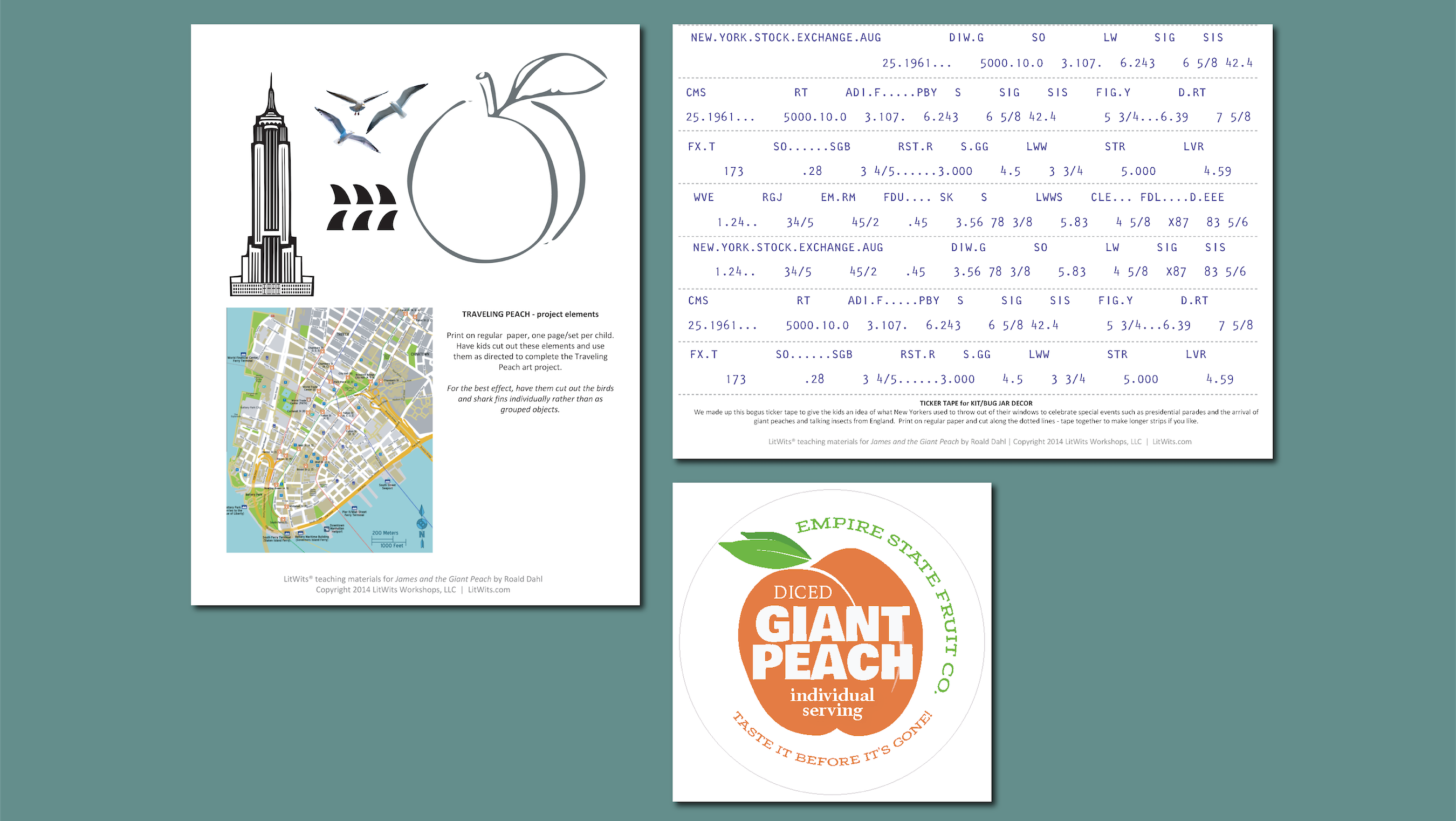
A peach pit and a strip or two of tickertape (in our printables) turns this simple bug jar into the abode of James himself, right in the middle of Central Park, where he lives to this day, spending his time writing wonderful stories, surrounded by his buggy, extra-large friends.
A LitWits activity from the Exposition & Falling Action
BookBites is the part of our literary experience when we get to “taste the story.” We choose a food right out of the book, and it has to meet at least one criterion:
it’s important to a plot point
it has thematic significance
it’s unfamiliar for reasons of culture, era, or location
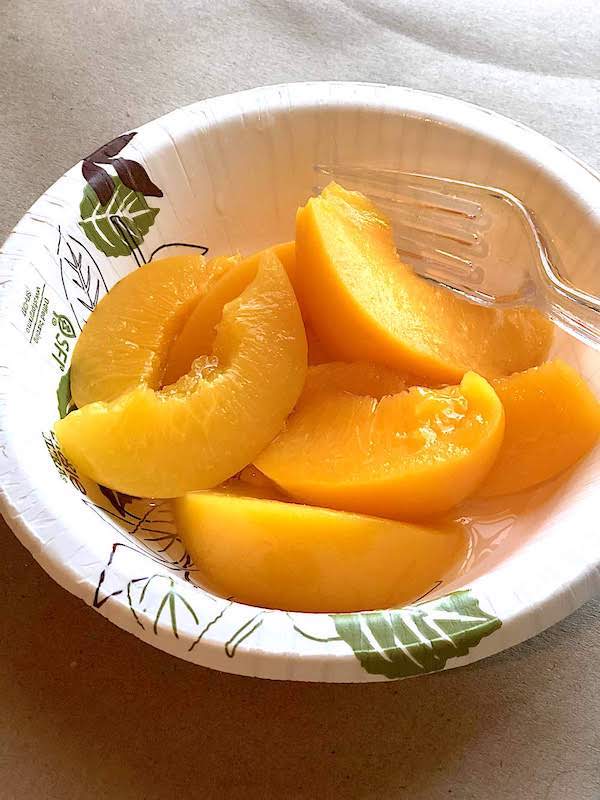
Well, we just had to serve peaches, didn't we!? Not just because a peach serves such a GIANT, titular role in this story, but because the book ends with a child asking James for "just a tiny taste of your marvelous peach," and his generous reply "Eat all you want!"
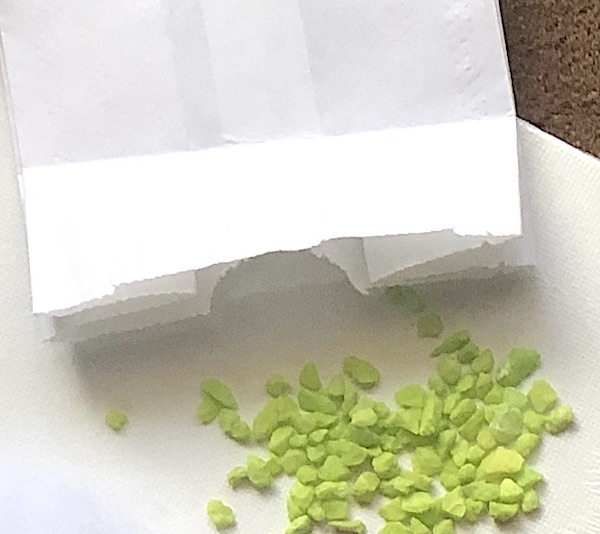
This isn't just a fun plot point, or even just a neat way to wrap up the falling action. It's thematically important, because it shows that James--the kid who had lost everything, and was given nothing but cruelty by his aunts--now has the power and ability to generously give. However, as delicious and valuable (to bodies and story) as a peach truly is, it's not a very exciting snack. Since every single person who's ever read this book cringes at that awful moment when James trips and spills all the "tiny green things" that are going to take him from misery to joy, and wishes they could undo that for him and see what happens, we gave our little readers that chance to eat--vs. spill--the beans. Once you serve these, tell your kids you're going to keep a close eye on them for the next minute or two--that you might have to excuse yourself to print up some tickets and a big sign for the front yard. It's pretty magical watching tiny half-smiles expand into giant grins.
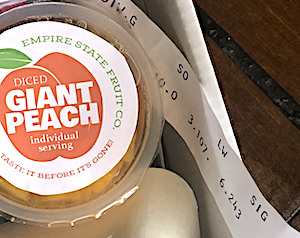
We made this label to fit the top of a single serving of diced peaches. It can be printed on full-page sticker paper and cut out by hand OR printed on pre-cut stickers using Avery template 94501. If you don't have sticker paper, just print on regular paper and use glue.
FOR DISCUSSION
While the kids were eating their tiny tastes of the famous peach, we told them we were going to talk about James' rise from the pits of despair to the peak of success. We let that soak in for a minute. After the groans subsided, we asked them these questions to get some juicy (but not dicey) conversations going:
What are some of the awful names the awful aunts call James? (Disgusting little beast, filthy nuisance, miserable creature, nasty little beast, disgusting little worm, lazy little beast. -Ch. 1)
What names do you think the aunts would have called any grasshopper, spider, centipede, ladybug, or worm? (The same, of course--the aunts see James as no better than vermin.)
At what moment does James change from "one of the lowlies" to their leader--the captain of the peach? (When he comes up with the plan to save them from the sharks: "He was the captain now, and everyone knew it. They would do whatever he told them." -Ch. 21)
What else does James do to earn their respect and save their lives? (Throughout the Rising Action--ha!!--he learns and admires the value of his friends; saves the Centipede's life; identifies the Cloud Men; warns his friends to lie down before hailstones hit; and comes up with a plan to lower the peach gently in New York. - Ch. 24-34)
Once the peach lands on the needle of the Empire State Building, how does James's leadership once again save them all? (The city officials are terrified of the enormous bugs and are likely to get weapons until James emerges and introduces them in a song that explains how valuable each of the insects are. -Ch. 37)
How does the Mayor honor James, once the crew is on the ground? (a welcome speech and a ticker-tape parade, with a limo for James and his friends. -Ch. 38)
Honor feels great, but more importantly, what does James end up with that he was missing most at the start of this story? (Love, friendship, companionship, beauty, joy, fun, a sense of value--by the end, he has it all! -Ch. 1-9)
We concluded by pointing out that between the cliffs of Dover and the borough of Manhattan, James has risen (ha!) "from vermin to victor," just by being courteous and kind to those below him (ha!), and open-minded enough to learn new things about his new friends, and by stepping up to do just the right thing at just the right time. He also doesn't let either misery or success ruin him. Like the author did, James survives the difficult things he can't control, and makes the most of his lessons to pass them along to others.
And what else do James Trotter and Roald Dahl have in common? Yep, they both became famous authors of fantastic books.
We found this a good time to segue to "A Peach of a Scoop," the creative writing worksheet that's included in our printables.
A LitWits Kit is a bag or box of supplies you pack up and give to each child right before you begin your "field trip" through the story. You might be doing one-off projects as you read through the book together, or you might do everything in this guide from top to bottom after the book has been read. However you explore this book in LitWitty ways, kids love the anticipation of opening their kit.
If you'd like to build LitWits Kits for your child/ren, you could easily arrange the items in a bag, basket, or story-relevant container. Honestly, it's just as much fun to create a kit as it is to open one!
To make it all the more fun, our printables for many books include special "story packaging" for certain activity supplies, including BookBites. Click the button below for a specific list of contents for this book.
James and the Giant Peach gives us characters we love to hate (the aunts), hate to love (the bugs), and love to love (James)--and the satisfaction of everyone getting what they deserve. Plus, it's hilarious! We appreciate it even more as adults than we did as kids (maybe because, as moms, we feel even more intensely for James). And it's packed with great "takeaway topics," which we're sharing below.
So we chose it for one of our experiential workshops, where we made these teaching points tangible, meaningful, and memorable in the kids' hands. It's amazing how much kids can learn while they're "just" having fun!
Happy teaching! Becky and Jenny
Takeaway 1
Leadership
James' rise from complete helplessness to master of the universe (or at least the peach pit, the Atlantic, the skies, and all of Manhattan) is a spectacular example of what we each have inside us: the ability to do what must be done, rise above our circumstances, and end up on top --without that even being our goal. As in all great books for kids, the message here isn't just for kids.
Hands-on connections in this guide: "Rising to the Peak" project, setting and narrative arc worksheets, "Tiny Green Things & Tiny Tastes of the Giant Peach" activity, "Palace for Pitpals" project
A flight through the skies in a peach full of bugs is the perfect setup for exploring both weather and entomology. We happily seized this STEMmy chance to learn (we'd never miss such a fruitful opportunity to pun) by literally "facing the Cloud-Men," then bringing in some expertise via video (because WE aren't scientists).
Hands-on connections in this guide: "Get Your Cloud-Man On" project, "Run for the Rainbow" project, "Spinning up a Storm" project, "Palace for Pitpals" project
Roald Dahl's skillful creation of over-the-top characters--their extreme characteristics, behaviors, settings, and situations--makes us cheer all the louder at the demise of the awful and the elevation (literally) of the awesome. Understanding his use of "extremism" as an effective creative writing technique helps kids understand how it's done--and makes them want to do it, too.
Hands-on connections in this guide: "Rising to the Peak" project, creative writing and vocabulary worksheets
As in any book, there are many events, characteristics, and ideas in the story that relate to its author’s life. Finding those connections helps us understand why the characters do what they do, and what they're supposed to learn by doing them. Roald Dahl had a childhood and youth filled with loss and hardship, as did James, but he put his experiences to successful use in his wonderful books. As did James, per this book's final sentence!
Hands-on connections in this guide: setting, creative writing, and vocabulary worksheets, "Rising to the Peak" project
James and the Giant Peach is chock-full of other subjects to explore, too--from the botany of fruit trees to the history of the Empire State Building. Scroll down to see our curated Learning Links for more tangential teaching opportunities, and to see how we brought this book and its ideas to life.
When choosing props for our live workshops, we always try to focus on two important categories: props that are unique to the setting, because they help kids understand “what that was like,” and props that are symbolic of themes, because they make big ideas visual and tangible. Both kinds of props generate those wide-eyed, “aha!” moments.
Below is an overview of the display we put together for our live workshop, and under that we've shown the individual props up close. You could easily have your kids contribute items to a table over time, as the book is being read.
Sometimes we create a printable prop; click the button to check the list for this book.
“The skin of the peach was very beautiful - a rich buttery yellow with patches of brilliant pink and red.” If you've timed it right, you'll be exploring this book during peach season and can provide a luscious, aromatic centerpiece of juicy peachy goodness, even if it's not the size of a small house.
Magic crystals & a peach pit
"'Take a look, my dear,' he said, opening the bag and tilting it towards James. Inside it, James could see a mass of tiny green things that looked like little stones or crystals, each one about the size of a grain of rice. They were extraordinarily beautiful, and there was a strange brightness about them, a sort of luminous quality that made them glow and sparkle in the most wonderful way." Green apple Pop Rocks or sugar crystals have a lovely sparkle and are delightfully edible. (The green gravel in this picture is also pretty but decidedly less delicious.)
Peach branches
"'A peach! Right up there on the highest branch! Can't you see it?'" We brought in some apple branches from the family farm, since we didn't have a peach tree. Just having part of an old fruit tree in the room added to the sensory experience. That's what we're all about. (Lucky for the kids, we didn't have a reasonable facsimile of Aunt Sponge and Aunt Spiker at hand. OR DID WE?)
Globe
"'You know what those buildings are?' shouted James, jumping up and down with excitement. 'Those are skyscrapers! So this must be America! And that, my friends, means that we have crossed the Atlantic Ocean overnight!'" Having a globe within reach makes it easy to trace the marvelous peach's journey from England to Manhattan.
New York media & map
"A vast city, glistening in the early morning sunshine, lay spread out three thousand feet below them. At that height, the cars were like little beetles crawling along the streets, and people walking on the pavements looked no larger than tiny grains of soot." The Giant Peach descends from the realms of Roald Dahl's imagination, but the Big Apple is for real!
Seagull feathers
" 'Seagulls,' James answered calmly. 'The place is full of them. Look up there!' They all looked up and saw a great mass of seagulls wheeling round and round in the sky. 'I'm going to take a long silk string,' James went on, 'and I'm going to loop one end of it round a seagull's neck. And then I'm going to tie the other end to the stem of the peach.' " In case you don't have any local gulls eager to donate feathers, these will do just fine.
Great Quotes
The night was all around him now, and high overhead a wild white moon was riding in the sky. - Ch. 9 * The garden lay soft and silver in the moonlight. The grass was wet with dew and a million dewdrops were sparkling and twinkling like diamonds around his feet. And now suddenly, the whole place, the whole garden seemed to be alive with magic. - Ch 9 * The moonlight was shining and glinting on its great curving sides, turning them to crystal and silver. It looked like a tremendous silver ball lying there in the grass, silent, mysterious, and wonderful. And then all at once, little shivers of excitement started running over the skin on James’s back. Something else, he told himself, something stranger than ever this time, is about to happen to me again soon. He was sure of it. He could feel it coming. - Ch. 9 *
“I am the only pest in this room!” * Already, he was beginning to like his new friends very much. They were not nearly as terrible as they looked. In fact, they weren't really terrible at all. - Ch. 13 * The giant peach, with the sunlight glinting on its side, was like a massive golden ball sailing upon a silver sea.
* He was the captain now, and everyone knew it. They would do whatever he told them. - Ch. 21 * “My dear young fellow,' the Old-Green-Grasshopper said gently, 'there are a whole lot of things in this world of ours you haven't started wondering about yet.” - Ch. 24
* "Of course they're not dangerous!" James answered. "Allow me to introduce them to you one by one and then I'm sure you will believe me." - Ch. 37
You're literally on our page about inspiring kids to love great books. YAY! We're eager to share our passion for LitWitting and the work we've done for over a decade.
We're also eager to keep doing it! :) So if you found this guide-page inspiring and useful,* please share it with your social world. And if you buy our printables for this book, thank you. We appreciate you helping us keep the lights on at LitWits!
Happy teaching, Becky and Jenny Sisters, best friends, and partners
*We hope we've inspired you! If you're feeling a little overwhelmed (we hear that sometimes), remember, you're LitWitting whether you do a lot or a little. You can't go wrong! The learning is happening, trust us. Just take the pressure off and do what works for your kids, time, and budget. It's all about inspiring kids to read for fun, so they want to read more—because kids who read more great books learn more great things.
Now get ready for a bunch of wide-eyed kids having “aha!” moments—and you, grinning ear to ear because your kids are happily engaged with a great book.
Terms of Use
The Becky & Jenny version: Feel free to print pages for teaching use, and make copies of printables for your students. Please don’t use our name, ideas, or materials commercially or share our printables, though we'd love for you to share these free pages with your fellow educators.
The blah legal version: You are granted exclusive use of our products in download or print version as follows: You have the right of reproduction that is limited to your use only in whatever quantity is necessary to meet your needs and those of your student participants. This right is unlimited and extends for as long as you need the materials during which time they cannot be given to or shared with any other person(s) through any means of delivery, materially or digitally via the Internet. As such you have the right to store the product(s) on the hard drive of your computer or as hard copy in your resource file. Any misuse of these rights is in violation of copyright law.
LitWits® is a registered trademark of LitWits Workshops, LLC.
LitWits teaching ideas and materials for James and the Giant Peach by Roald Dahl Copyright 2019 by LitWits Workshops, LLC. All Rights Reserved.


%20banner.jpg)
