Creative Teaching Ideas for
by Esther Forbes (1943)
Plus: Takeaway Topics, Learning Links, and Prop Ideas
Johnny Tremain, winner of the 1944 Newbery Medal, is one of the finest historical novels ever written for children [about] the defining events leading up to the American Revolutionary War. Fourteen-year-old Johnny Tremain, an apprentice silversmith with a bright future ahead of him, injures his hand in a tragic accident, forcing him to look for other work. In his new job as a horse-boy, riding for the patriotic newspaper, The Boston Observer, and as a messenger for the Sons of Liberty, he becomes involved in the pivotal events shaping the American Revolution, from the Boston Tea Party to the first shots fired at Lexington. —Amazon.com
LitWits makes a small commission on anything you buy through our Amazon affiliate links.

Start your experience of this story by introducing the kids to the author, so kids can see the connections between her lived story and her written story.
Below is our kid-friendly biography of Esther Forbes—it's a great discussion starter, and we've got a worksheet for author note-taking, too.
Set includes all worksheets and activity printables
BookBites
A LitWits project from the Rising Action
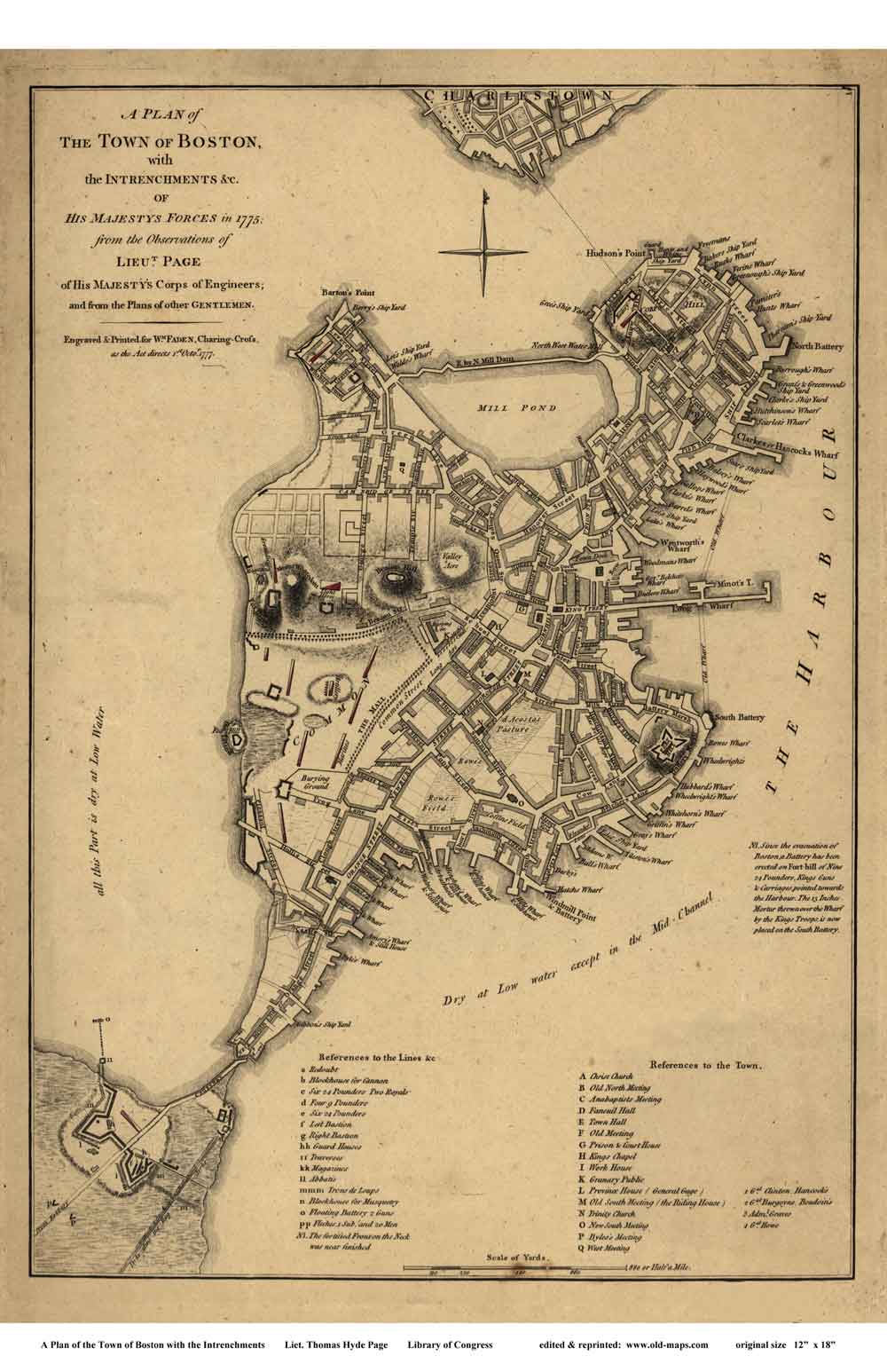
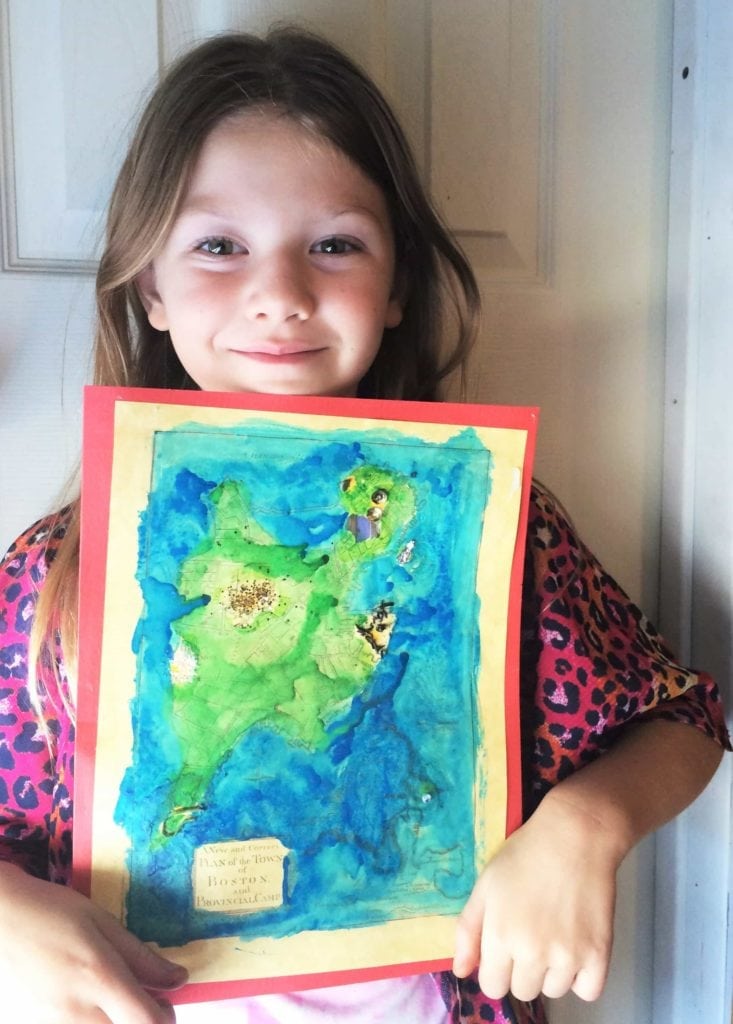
In Johnny’s darkest hour he travels through Boston on foot, winding up on his mother’s grave. To follow in his footsteps, we keyed an old map of that city with textural story elements, each one representing an important place. This helped kids “get into” the historical setting in physical ways, and it gave us a chance to talk about Johnny’s inner journey, too.
SUPPLIES
bits of tin foil
short pieces of twine
salt crystals
gold glitter
pebbles
bits of newspaper
loose tea
gold sequins
googly eyes
watercolors
copies of the numbered map template (in our printables), printed on cardstock
teacher key (in our printables)
We glued the map to a pocket folder and used it to store worksheets. If you’d like to do that, add pocket folders to the supplies list.
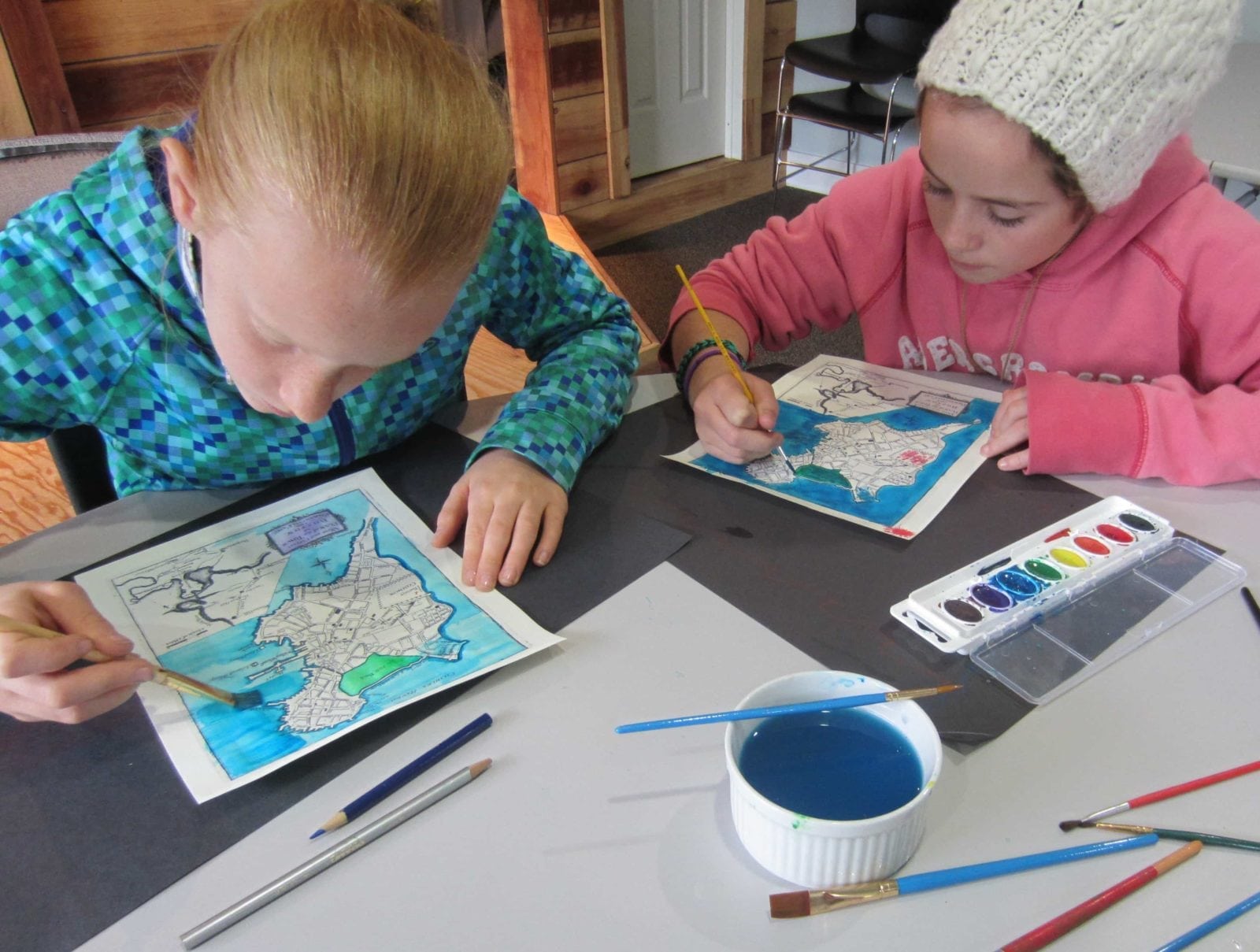
DIRECTIONS
Setup
Have the kids look at this 1775 map of Boston and see if they can identify what the symbols might represent, such as the docks, the bridge, the hills, and the wall. Explain that back in Johnny Tremain’s time, the shape of Boston was a lot different than it is today. Around the time of the Revolutionary War, the city was almost an island, with one small strip of land, the “Neck,” connecting it to the mainland.
Since that time, such a large amount of land has been “filled,” or reclaimed from the sea and the Charles River, that the city has almost doubled in size. Show a modern map that illustrates the reclaimed land vs. original land. You might want to talk about the impact this would have had on the environment and animal habitats along the shore.
Now distribute the map and “walk” through old Boston (and Johnny’s story) with the kids, handing out the textural items as you go.
Getting our bearings
1. Where does the story open? Place silver (tin foil) on Hancock’s Wharf at Lapham’s silversmith shop. This also stands for Johnny’s pride in being a superior silversmith apprentice, and the hot spilled silver that ruined his hand and career. This is a good time to discuss the art and process of silversmithing in Colonial times, and share any props or videos.
2. Where does Johnny go when Isannah hurts his feelings by saying “I hate your hand!”? Follow Johnny’s walk through Boston all the way to the town gates, and glue a loop of twine on the gallows (on the Neck!).
3. Find the “foot of the Common” and put salt on the salt marshes. Why would there be salt there? It’s an estuarine habitat, where the Charles River mixes with the salty water of the tides.
4. Make your way to Beacon Hill and put the glitter of candles there. Talk about why lights in the windows would suggest a family was wealthy. Note that tallow candles were common, but they were smelly, drippy, and didn’t last long. Those with extra money might use sweet smelling beeswax or bayberry candles. Families with access to the whaling industry would have used spermaceti, or whale-oil candles. Ask the kids which candles the Lytes and Hancocks would have used.
5. Follow Johnny’s footsteps to the Copp’s Hill. Talk about the meaning of the “dead worthies of Boston,” with their slate grave markers, as opposed to Mother, whose grave is unmarked. Talk about what kinds of things make a person “worthy.” Honor Johnny’s mother with a tombstone of her own (a pebble).
The events that followed
6. Where does Johnny eventually find work? Place a bit of newspaper at The Boston Observer office on Salt Lane. Talk about the role of The Observer, and other Whig newspapers, in preparing Bostonians for the revolution. What kinds of activities happened there besides newspaper printing? The Sons of Liberty met there in secret!
7. What important event took place in the Boston Harbor? (Discuss the “tea party” events of Chapter ) Glue some loose tea in the harbor near Griffin’s Wharf.
8. Read aloud Paul Revere’s “one if by land, two if by sea” plan as overheard by Johnny as he awakens in Dr. Warren’s surgery, in Chapter 10. Glue two lanterns (gold sequins) on North Church. Show students a map of Paul Revere’s and Billy Dawes’ rides that night.
9. What was happening across the Charles River as the lanterns were being hung in the church spire? (Read Paul Revere’s words again for a hint) Glue two watching (googly) eyes in Charles Town.
Finish the maps by painting all the water around Boston and Charles Town with beautiful watercolors while listening to American Colonial music.
If you have time, use Google maps to show students current day Boston. Find as many locations from the map project as possible using the satellite view.
A LitWits project from the Rising Action
Silversmiths’ marks are important in this story — and silver makes its own kind of mark on Johnny — so we had our kids make their own. They loved the idea of marking their own goods! And this helped get them thinking about what emblem might stand for them, and that naturally makes them think about what they stand for.
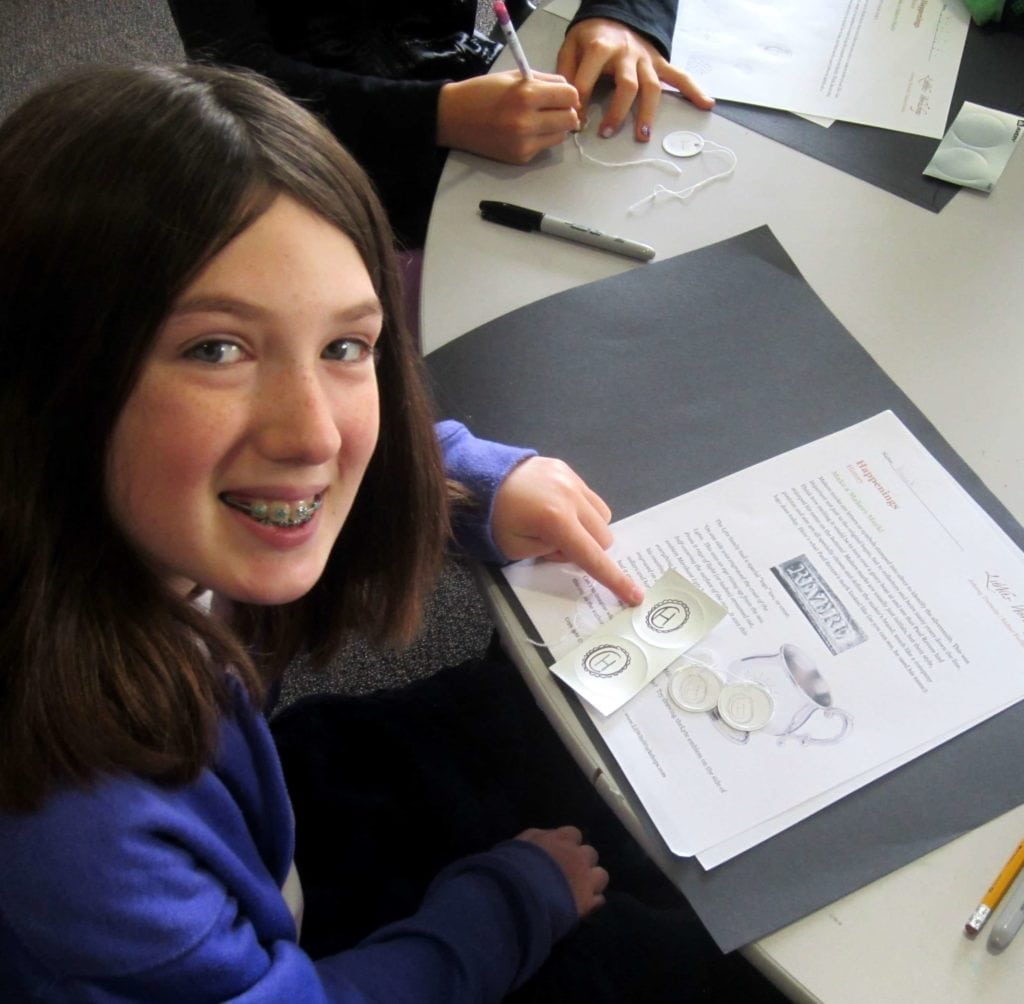
DIRECTIONS
Distribute the design worksheet (if purchased) and/or give a brief overview about the origins and purpose of maker’s marks. Ask the kids how they were used in the story. Then have the kids apply their own designs to silver labels or tags with black markers.
FOR DISCUSSION
While the kids are creating their own “maker’s mark,” show them a colonial silversmith at work, and remind them that silversmiths were an important part of colonial society. Four main families dominated the Boston silversmith industry: the Edwards, the Burts, the Hurds, and the Reveres. Silversmiths provided items that were not only beautiful but necessary, too--candlesticks, for instance, weren't just for romance or emergencies back then. Show images of commonly used silver items.
Ask the kids to come up with some other reasons why silversmiths might have been “revered.” (We couldn’t pass that up.) Have them contrast the makers and their products with, for instance, a modern company that makes plastic tubs for storing food, or a company that makes flashlights and lanterns. What are the differences, from the obvious to the nuanced?
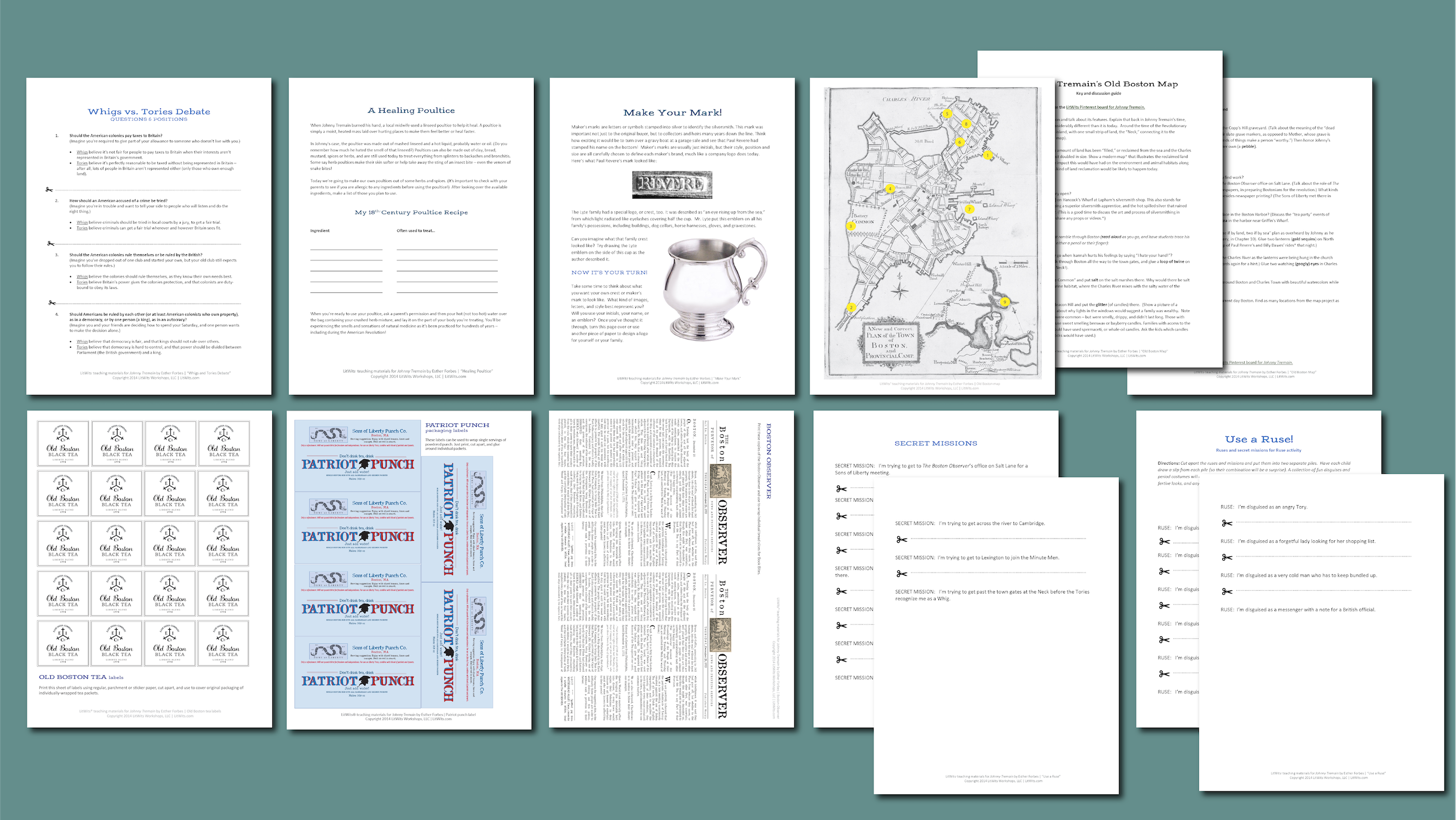
The worksheets and printables used for our activities are sold as a complete set.
Not pictured: author note-taking worksheet
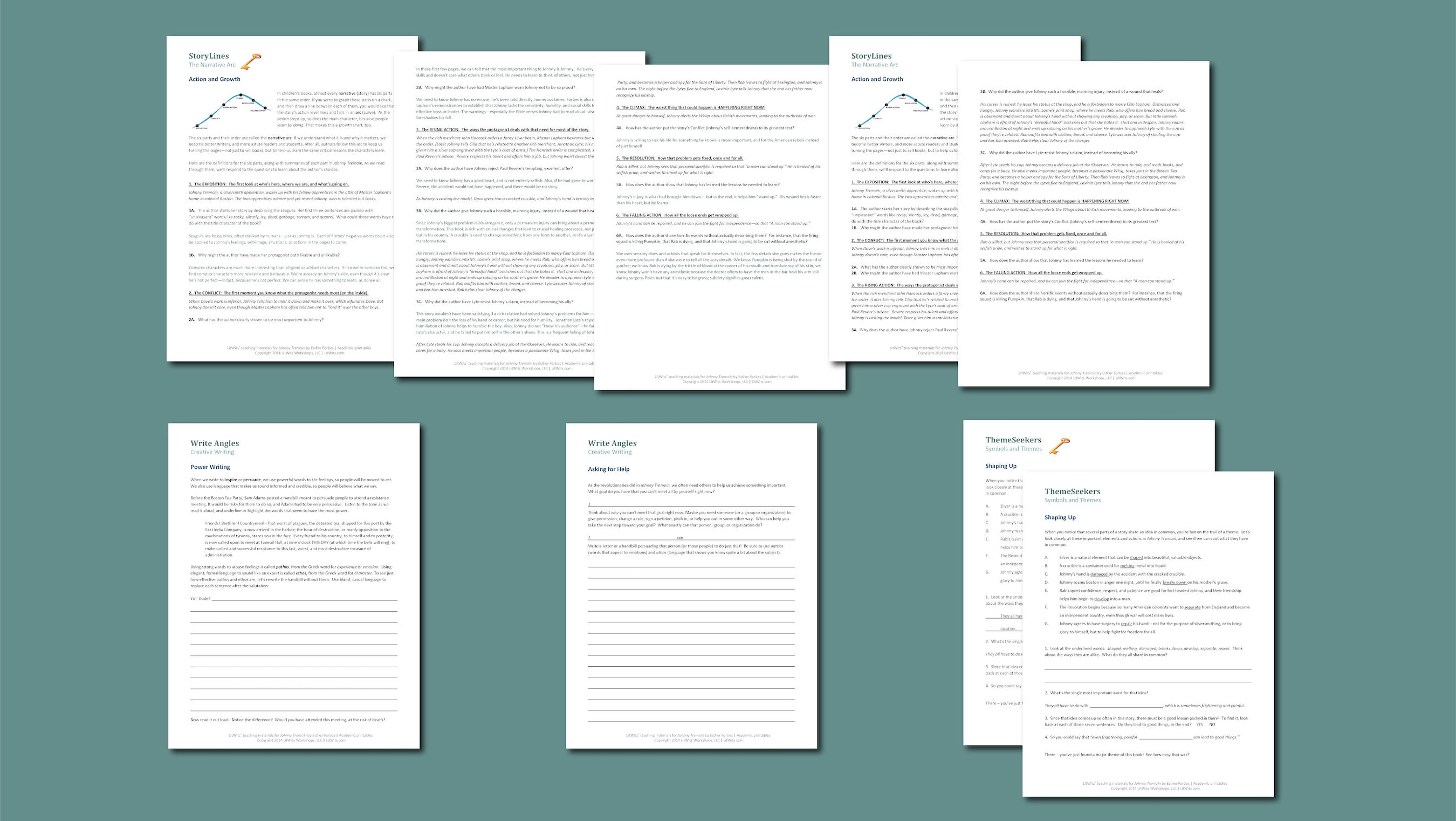
Common Core State Standards Alignment for the comprehensive use of our teaching ideas and materials is also included for grades 3, 4, 5 and 6.
This book is less about a revolution than about a boy's recovery, inside and out. Though the war gives him a chance to "stand up" and prove he's become a man, the story itself is about recovering from loss and reshaping one's life to be something shiny and new. We loved the perfect metaphor of silversmithing in this book, and the many opportunities the historian author gives us to learn what life was like in this tumultuous period. So we chose it for one of our experiential workshops. It turned out to be one of our best--not just fun, but packed with great takeaway topics, which we're sharing below.
In our workshops, we did our best to make these teaching points tangible, meaningful, and memorable in the kids' hands. It's amazing how much kids can learn while they're "just" having fun!
Happy teaching!
Becky and Jenny

Takeaway 1
Persuasion is called for many times during this story, whether people are trying to win political converts, increase attendance at meetings, or sneak past enemy lines. Persuasion is a form of teaching, and there’s both an art and a science to it. The debate activity helps kids understand the strengths and weaknesses of arguments, the ruse activity can help them see the importance of tone and body language, and the creative writing worksheets give them a chance to practice rhetorical devices such as pathos and ethos.
Hands-on connections in this guide: “Whigs & Tories Debate” activity, “Use a Ruse” activity, creative writing worksheets
Takeaway 2
There are many rich subtopics within the setting of colonial Boston. The map project gives you a chance to explore old Boston on paper and compare it to the modern topography. Once the kids have got their bearings, you might want to talk about colonial medicine (and do the poultice project), colonial politics (and have a Whigs vs. Tories debate), or Use a Ruse to sneak past the British), and/or colonial silversmithing (and do the maker's mark project).
Hands-on connections in this guide: “Healing Poultice” project, “Old Boston Map” project, “Use a Ruse” activity, “Whigs & Tories Debate” activity, "Power Writing" worksheet, “Make Your Mark” project
Takeaway 3
Explore these links to supplement your reading experience, research points of interest, and prompt tangential learning opportunities.
About the Book & Author
Goodreads reviews
Brief biographical summary - Bookology Magazine
Midlength biography - Encyclopedia.com
Biographical notes - Clark University)
Biography - Gale Literature Resource Center
Biography included in Forbes Papers Collection description - American Antiquarian Society
Story Supplements
Producing silver by hand
Colonial medicine
8 maps that show Boston's changing shorelines - WBUR News
Old newspaper article – How to make and apply a linseed poultice
Colonial silversmithing techniques
Silversmith demonstration recreating a 1704 piece
Slavery in Massachusetts
Whigs & Tories (UK Parliament)
Boston Tea Party events (BTP Historical Society)
The Rhetorical Triangle - Indiana University
Colonial silversmithing (video) - Colonial Williamsburg
Boston Tea Party – info and video (History.com)
Colonial apothecaries (video) - Townsends
Boston Tea Party – detail and images (National Humanities Center)
Copp’s Hill Graveyard - Boston.gov
Old North Church, Boston - official site
The real story of Paul Revere’s ride
Revere’s account of his ride
Freedom trail sites
Origins of “Yankee Doodle” (NPR)
Beyond the Book
Life of Paul Revere
Paul Revere’s other (more important) ride
Paul Revere House
About Revere silver (Metropolitan Museum of Art)
Colonial life in Massachusetts
How to identify silver hallmarks
Historian’s rich blog about Boston and the American Revolution, with focus on sensory elements
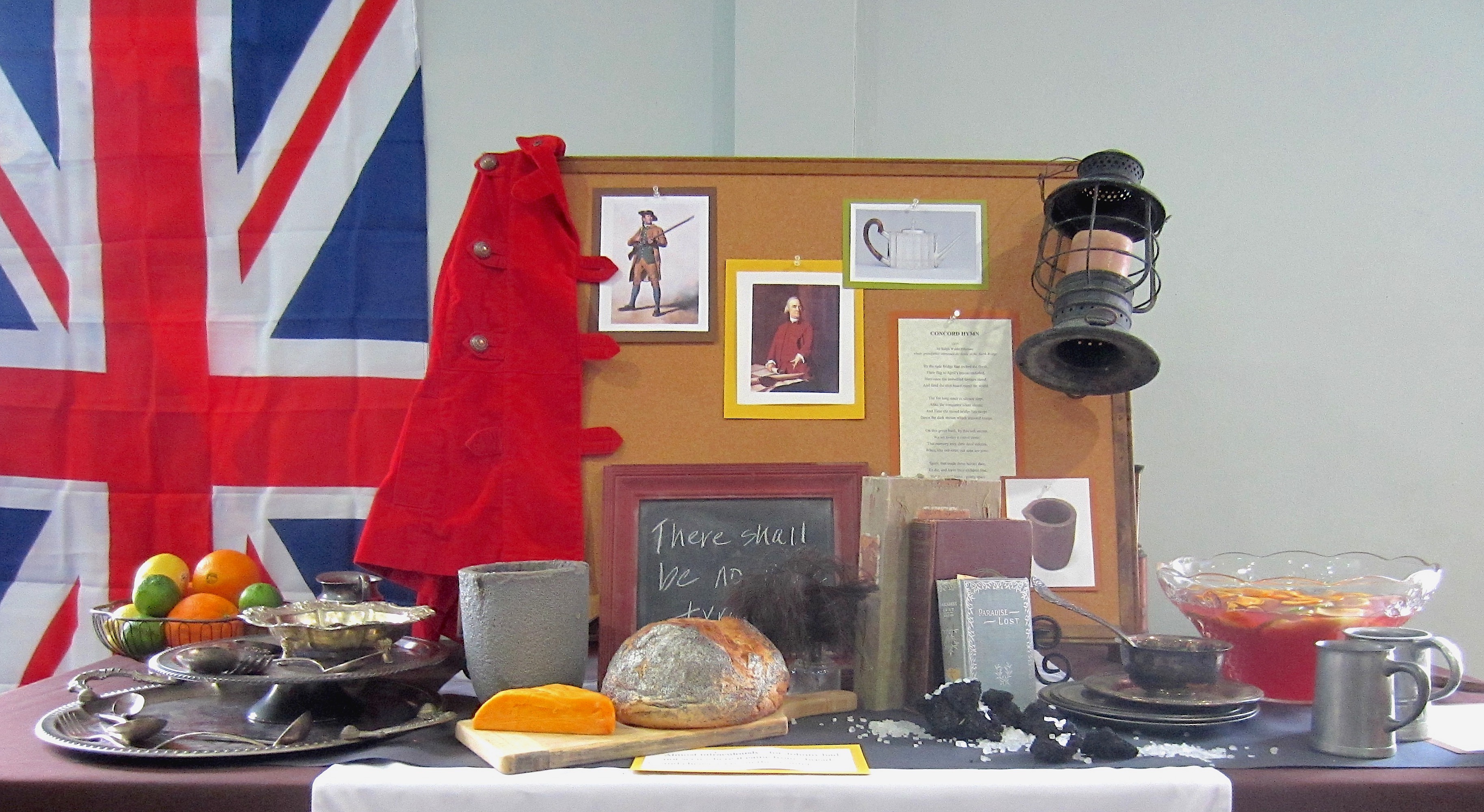
Set includes all worksheets and activity printables
You're literally on our page about inspiring kids to love great books. YAY! We're eager to share our passion for LitWitting and the work we've done for over a decade.
We're also eager to keep doing it! :) So if you found this guide-page inspiring and useful,* please share it with your social world. And if you buy our printables for this book, thank you. We appreciate you helping us keep the lights on at LitWits!
Happy teaching,
Becky and Jenny
Sisters, best friends, and partners