Creative Teaching Resources for
by Marguerite Henry (1947)
Plus: Takeaway Topics, Learning Links, and Prop Ideas
On the island of Chincoteague, off America's eastern coast, lives Phantom, an elusive mare descended from shipwrecked Spanish moor ponies. Siblings Paul and Maureen want to capture and buy her on Pony Penning Day, and they work very hard toward that goal. Yet when Paul sees Phantom in the woods with a foal he names Misty, his quest to possess is tempered by compassion. Will his right to his hard-earned reward be overriden by his growing respect for what's wild and free? Or is there a middle way?
This seemingly simple horse story is really about complex issues of balance, respect, empathy, fairness, and freedom.
LitWits makes a small commission on anything you buy through our Amazon affiliate links.

Start your experience of this story by introducing the kids to the author, so kids can asee the connections between her lived story and her written story.
Below is our kid-friendly biography of the beloved and talented Marguerite Henry. This short video is a great discussion starter, and we've got a worksheet for author note-taking, too.
Set includes all worksheets and activity printables

A LitWits activity from the backstory
In Part I, the backstory, Marguerite Henry turns the sea into a female wildcat, and the galleon into its prey. It's a beautiful example of using metaphor and imagery to word-paint an action scene, by helping us imagine the sea and ship as two living creatures. Our writing activity turns kids' creative attention toward the land—the island of Assateague—and gives them the added challenge of personification.
Use the creative writing worksheet to explore new metaphors together as a class, and to give the island human actions and characteristics.
DIRECTIONS
These instructions are for doing the activity as a class, but as another option, you could have the kids work in pairs, with each partner writing alternate sentences.
Think of some words and phrases that tell what Assateague Island does for the ponies, and how. For instance, it
feeds them
shelters them
cares for them
protects them
teaches them to care for themselves
gives them warm coats
strengthens them
Don’t those sound like things a person could do, too? Does someone special come to mind?
Of course—a parent, or any loving caregiver!
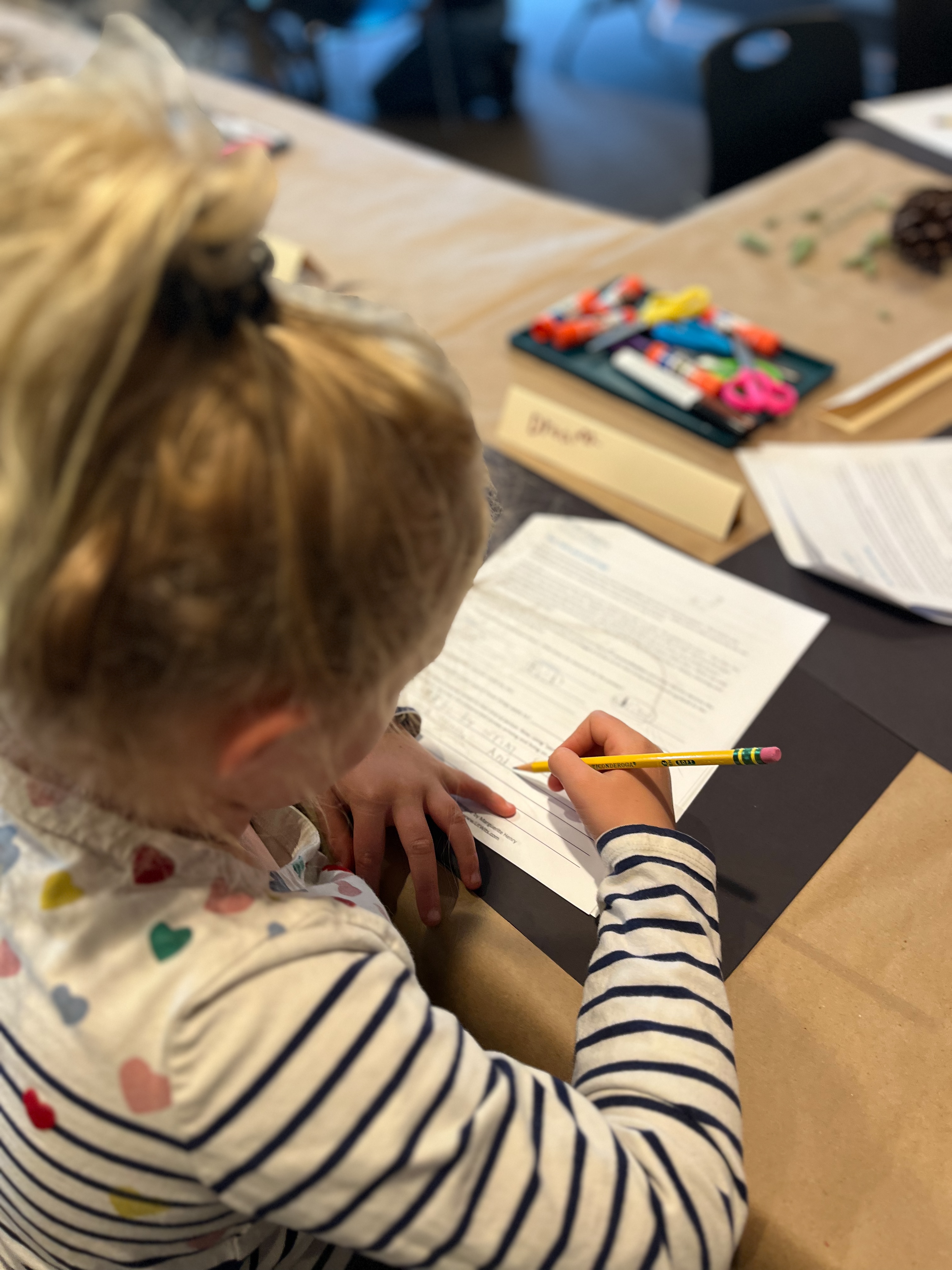
Now describe the island acting as if it were a parent or caregiver. Here's an example:
She made them beds of long grasses and gave them cool drinks of fresh water. When they had fallen asleep, she used the wind to whisper goodnight.
FOR DISCUSSION
The personification of the island as a parent or caregiver is especially meaingful since the mother-child bond is a big topic, overt and subtle, throughout this story. You might want to ask some open-ended questions about one or more of these ideas:
Maureen's sadness about the separation of mares and foals
Paul and Maureen's missing parents, and why the author might have sent them away
The fire chief's justification for separating mares and foals, and the kids' acceptance of that explanation
Misty's joy, in the last chapter, despite her mother's disappearance
Finding out how kids are feeling about an author's decisions has often led to some deep insights, even from the littlest.
Set includes all worksheets and activity printables
BookBites
A LitWits activity from the Rising Action
Before Grandpa starts deliverin' some legends an' opinions 'bout the island and Phantom to his grandkids, he grabs them there wire clippers and cuts a stick o' licorice in half fer each of 'em.
What he has to say after that is pretty durn important, but that there act itself o' jist splittin' the candy says a whole bunch about what matters in this story, an' that's the big idea of FAIRNESS.
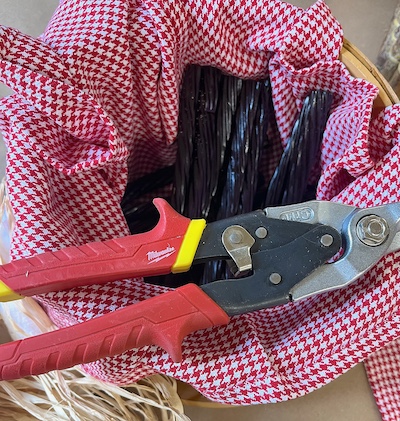
So grab yer own bran' clean clippers an' serve yer kids in pairs, each hangin' on to one end o' the candy, so Grandpa (that's you) kin snip it in half an' make it fair. Y'all be careful now.
While yer kids are chawin', ask 'em what Paul and Maureen DIDN'T share, or what don't seem fair—sich as, fer instance, Paul's decision to let Phantom go without chattin' it over with his pardner first.
Set includes all worksheets and activity printables
A LitWits activity from the Rising Action
When Paul and Maureen ask Grandpa's permission to take over a stall for Phantom, he's not very encouraging about their odds of catching the mare—you almost get the feeling, from his dreamy, poetic description of the mare, that he doesn't want them to. But in the end, he agrees to let them take over a stall, which thoroughly energizes both kids.
“Owning a stall is next best to owning a pony,” she laughed . . . -Ch. 5
In fact, everything Paul and Maureen say is said as if they already own Phantom. With that power of positive thinking in mind, give your own kids a stall to build—and then furnish it with the items mentioned in the story.
Including, of course, a pony—but don't tell them yet!!
SUPPLIES
glue stick
scissors
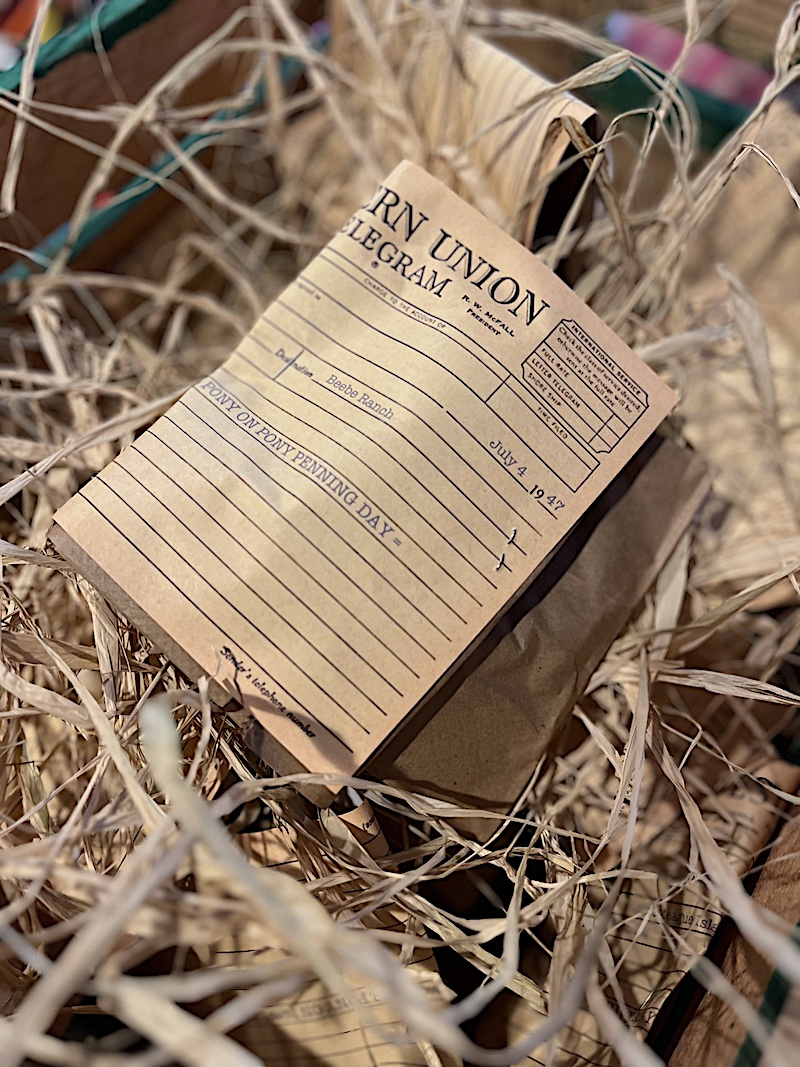
(Keep the pony a secret, to arrive as a surprise at the end. We wrapped our ponies in paper bags and attached the telegram imagined by the narrator in Chapter 5 - it's included in our printables)
a pinch of sand (for a class, use a bucket and a spoon)
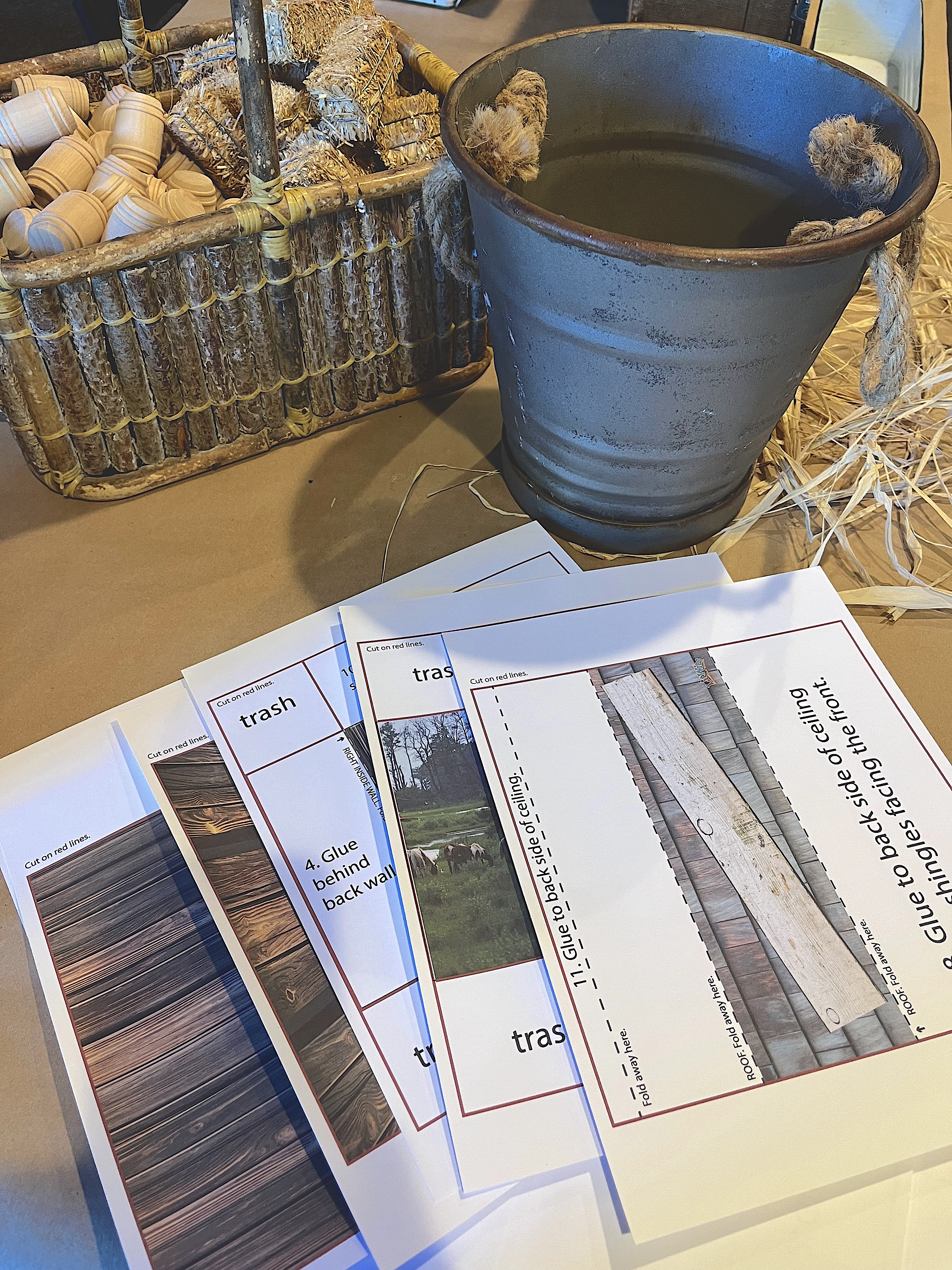
stall templates, included in our printables
Set includes all worksheets and activity printables
DIRECTIONS
1. Saw (cut) out all the lumber (templates) while we learn a few facts about the Pinto breed.
2. Choose a name for your imagined horse or ranch and write it on the stall roof.
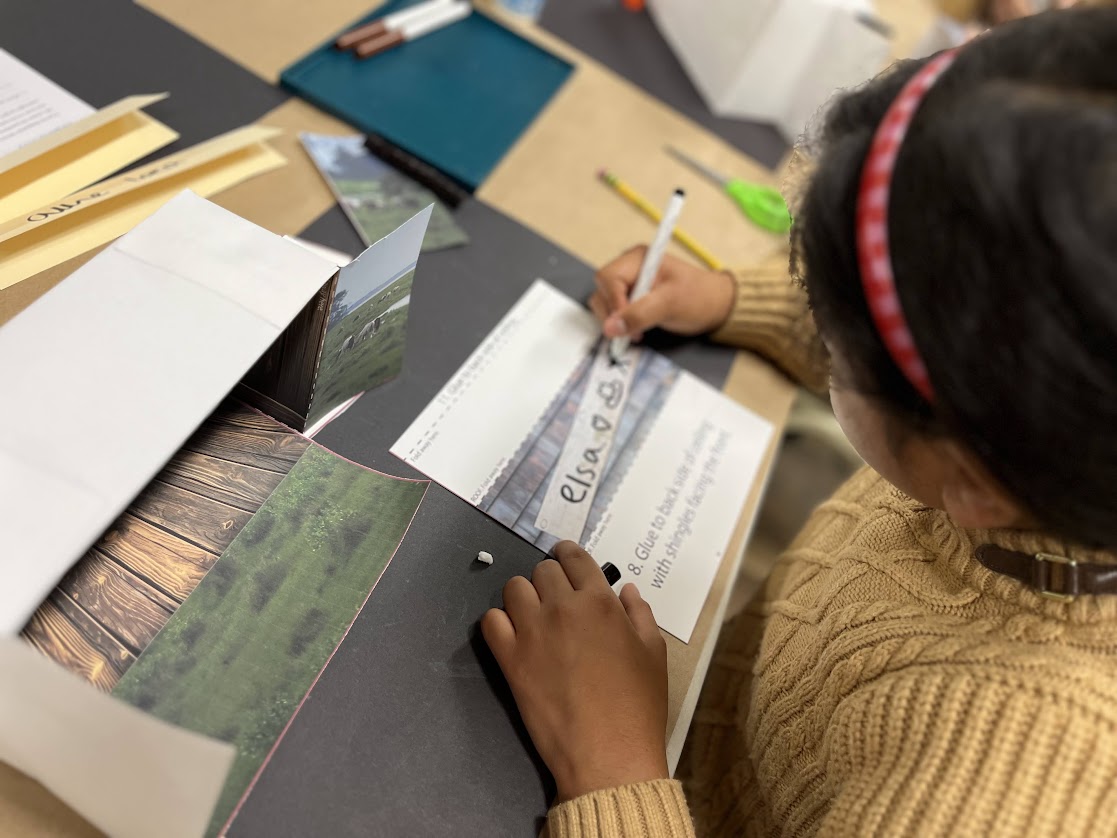
3. Nail (glue) the templates together in order (except for the manger), as instructed on the numbered templates.
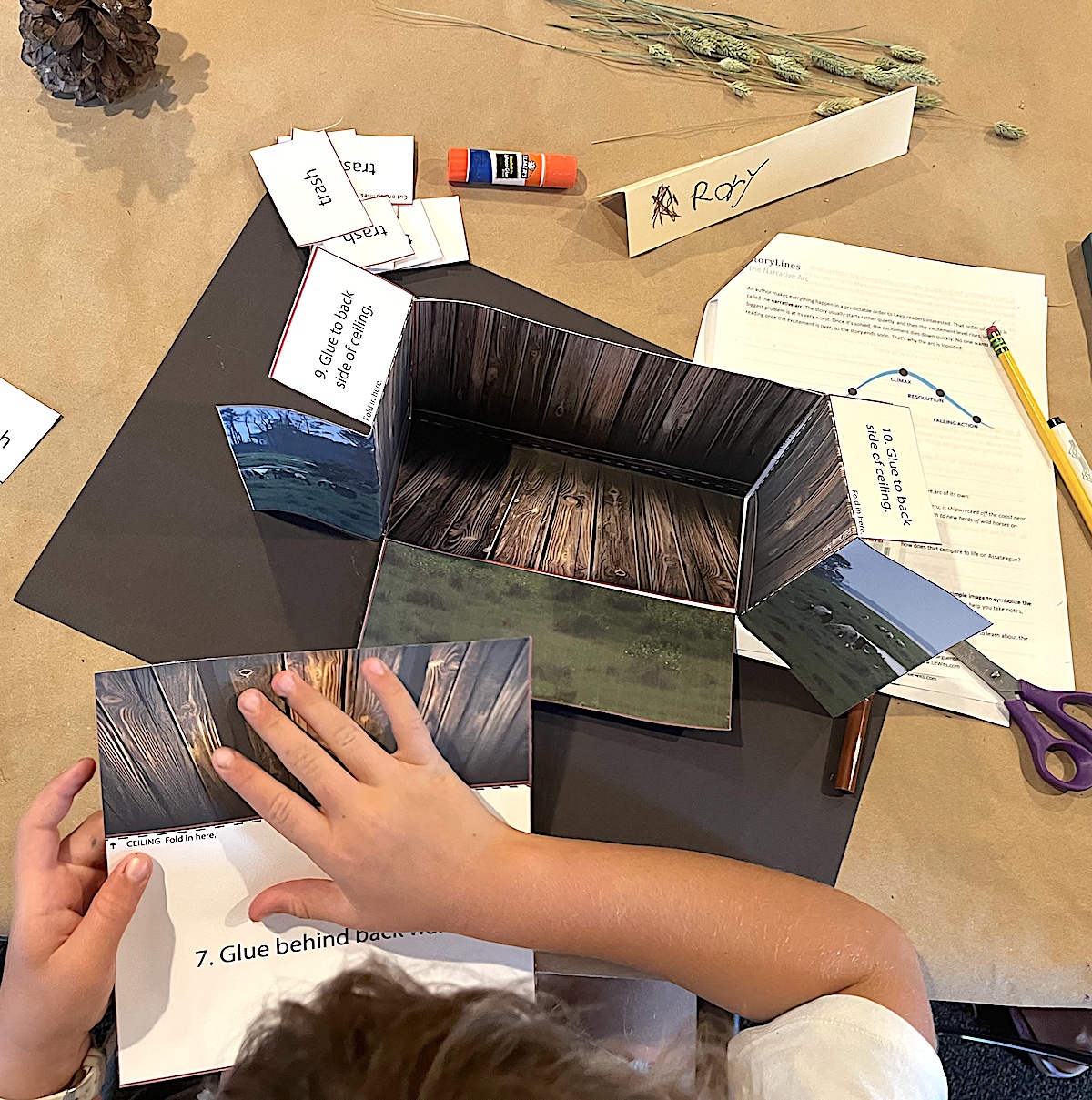
4. Now let's go to Chapter 5 and read what Paul and Maureen did with the stall, and do the same with our own:
A). With long brooms and steaming pails of water, they washed the walls and the ceiling of Phantom’s stall.
Hmm, no need to scrub this brand-new stall! What did they do next?
B). They scraped inches of sand from the hard-packed floor, dumped it in the woods, and brought in fresh, clean sand.
Smear some glue on the stall floor, sprinkle a little sand over it, and shake it around like glitter.
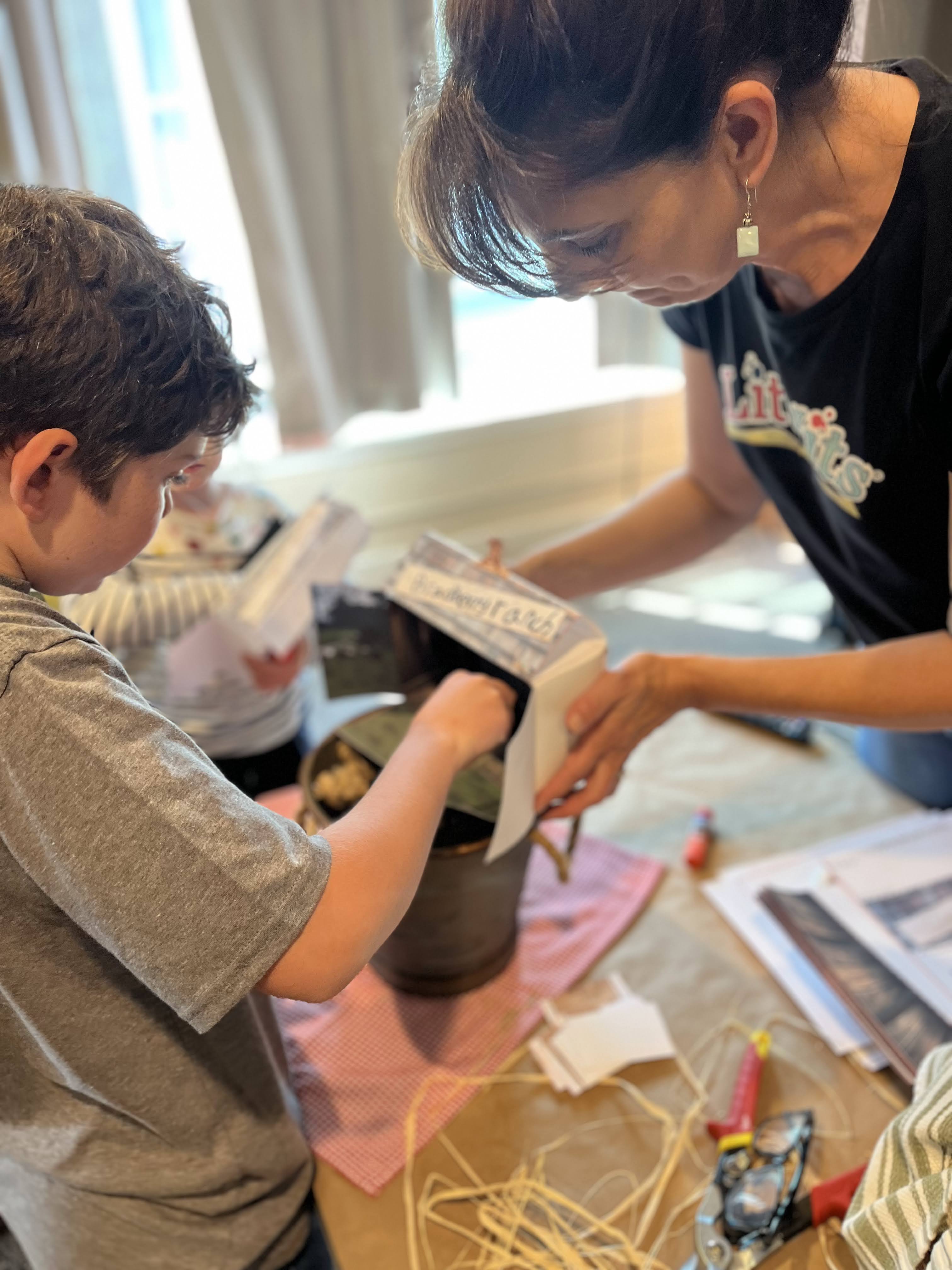
C). They built a manger, spending long moments deciding just how high it should be placed.
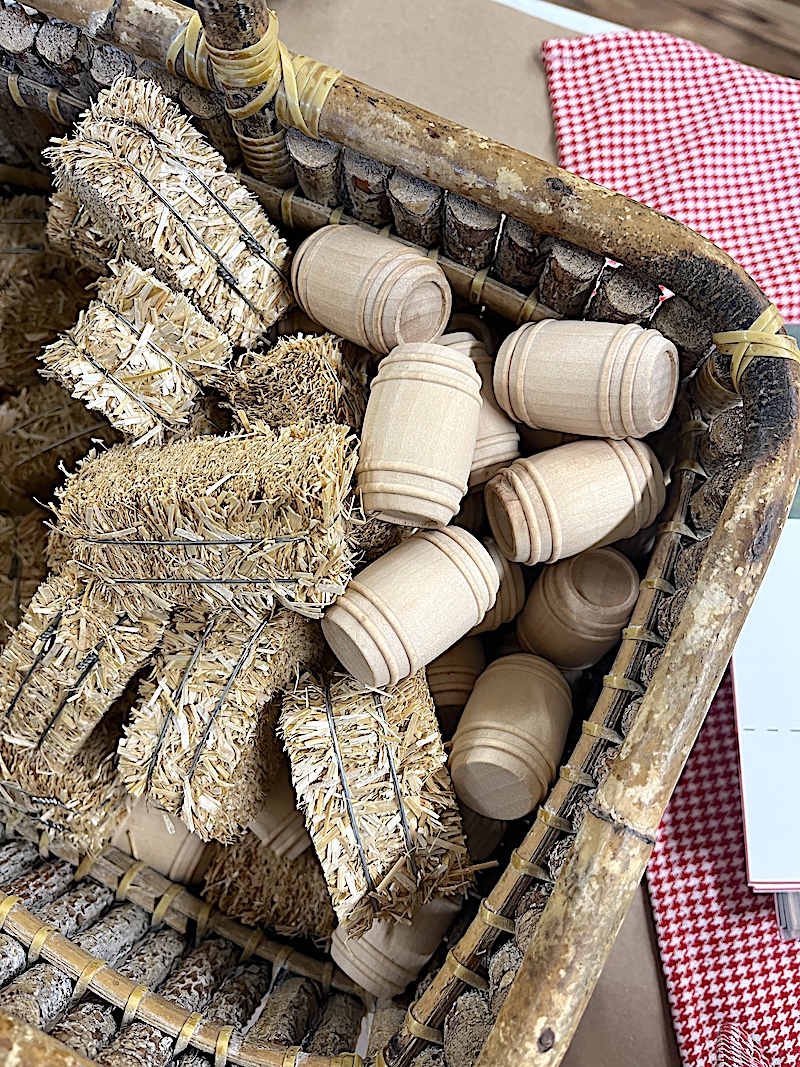
It's already built—you just need to attach it in the corner! (As shown in the picture.). And of course, add a bale of hay to the stall.
D). They scrubbed a rain barrel to be used for a watering trough.
Add the rain barrel - you might want to stain it with brown and black markers to give it a used, vintage look.
There you go! Owning a stall really is the next best thing to owning a pony, isn't it! But is it AS GOOD as owning a pony?
NAWW!!!!! And you've worked (almost) as hard as Paul and Maureen, who do eventually get att least one. You've earned YOUR own pony, too!
(While Paul and Maureen were working on the stall, they also dug up a brier root to make into a halter. To recreate the wickie tack they made, see the "Tender Tack" activity below.)
Set includes all worksheets and activity printables
BookBites
A LitWits activity from the Rising Action
Grandpa gets a little choked up when he sees Paul off to the roundup, remembering his own days of being a round-up man. Now it's his grandson's turn, and he wants Paul to fit in like one of the men.
"I hain't rode on a roundup to Assateague for two year," he smiled, hiding one hand behind his back, "but I remember we allus had a chaw and a goody after the ponies was rounded up . . ."
“Here, Paul,” he said, with a strange huskiness, “here’s a choclit bar fer ye to take along.” And he pressed the slightly squashed candy into Paul’s hand. -Ch. 6
Grandpa, who's pretty sweet AND wise, probably always has a few choclit bars on him, so load up a Levis pocket with plenty for all (including you).
Before the kids take a bite, remind them that Paul ate his after the round-up, when the saltwater cowboys treated him like a "real round-up man" and "he wanted to seem one of the men." So have them eat theirs while they watch these saltwater cowboys at the Chincoteague swiim:
Set includes all worksheets and activity printables
A LitWits activity from the Falling Action
In Chapter 5, when Paul and Maureen are preparing the stall, they "dug a 'wickie'—the long, tough root of a brier that trails along under the ground." As Maureen says, when Phantom smells and feels a halter made of this wickie, she won't be scared because "it'll be much softer than rope."
Once they capture and begin to train Phantom, they. use only wickie tack, or equipment: a come-along rope, halter, and bridle. This makes Grandpa extra proud—we can tell he cares about the horse's well-being, too.
Maureen's compassion is obvious to us from the beginning, though it's scoffed at by her brother, who has yet to learn to be more like her. This is something to talk about while your, kids braid their own wickie bridle, like the one Paul used to ride Phantom in the race.
SUPPLIES
3 strands of raffia, about 2' each
tape
scissors
DIRECTIONS
Knot three strands of raffia at the top, and tape the knot to the table.
Then braid the strands tightly. Knot at the bottom. Then follow these video instructions to put turn the rope into a bridle:
The wickie bridle is also a symbol of Paul and Maureen'sunusual relationship with Phantom. The very idea that such a wild, 'uncatchable" horse could be tamed by two kids speaks to a deeper connection between them. To ride her with a bitless bridle emphasizes that bond.
Set includes all worksheets and activity printables
A LitWits activity from the Falling Action
Paul's decision to let Phantom go comes from a new awareness in his heart that the mare really does belong back at Assateague. Though he has twinges of that idea when he first sees her and Misty in the woods, it's because he's developed a relationship with her of mutual respect that he can—that he must—let her go.
His decision makes readers happy, too (though we do think he ought to have conferred with his sister first!). And we're glad the author has made sure we know Misty is perfectly happy being left behind on Chincoteague.
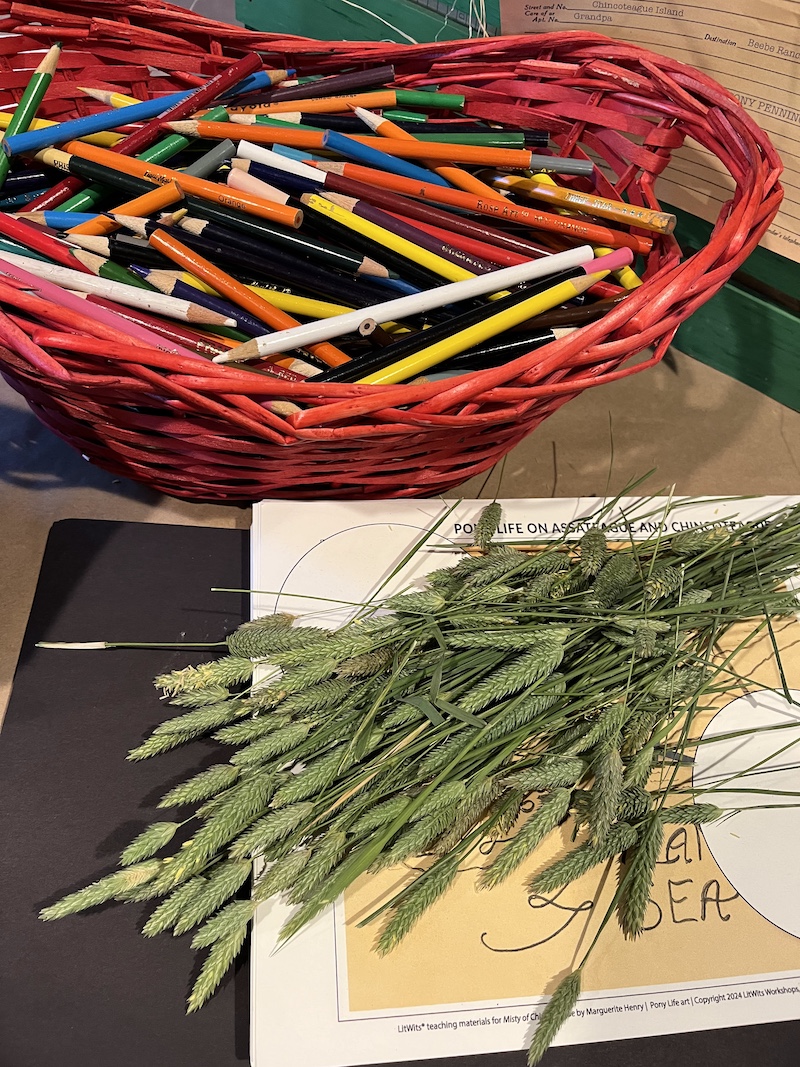
This art project helps kids see, smell, and grasp that Phantom and Misty are each getting what they need, though they're living very different lives. It also provides fodder for conversations about wildlife management, freedom, the concept of "owning," and authorial license.
SUPPLIES
template, included in our printables
AND
colored pencils or markers
AND/OR
textures (marsh grasses, hay, sand, gravel, candy hearts, mini pine cones, blue clay)
OR
nature/horse magazines for collage images
Set includes all worksheets and activity printables
DIRECTIONS
Brainstorm the benefits. As a class or in pairs, have the kids brainstorm what each horse is going to gain on her island. Ask questions to draw out specifics and sources. For instance, when the kids say "food," ask them what kind and where it will come from, or be found. When they say "shelter," ask them where exactly each horse will take shelter in a storm.
Add visual/textural elements. As you talk, have them draw pictures of these ideas in the circles representing each island. As an alternative, the kids can glue down textures that represent each island's offerings, or create collages inside each circle with magazine images.
Discuss pros and cons. No matter which media you choose, kids will see that each horse is getting its basic needs met, in different forms from different sources: food, water, shelter from weather, warmth, places to run, and love. It seems there's only one thing only Phantom has that Misty doesn't: FREEDOM. And that's something worth talking about.
PREVIEWS BELOW
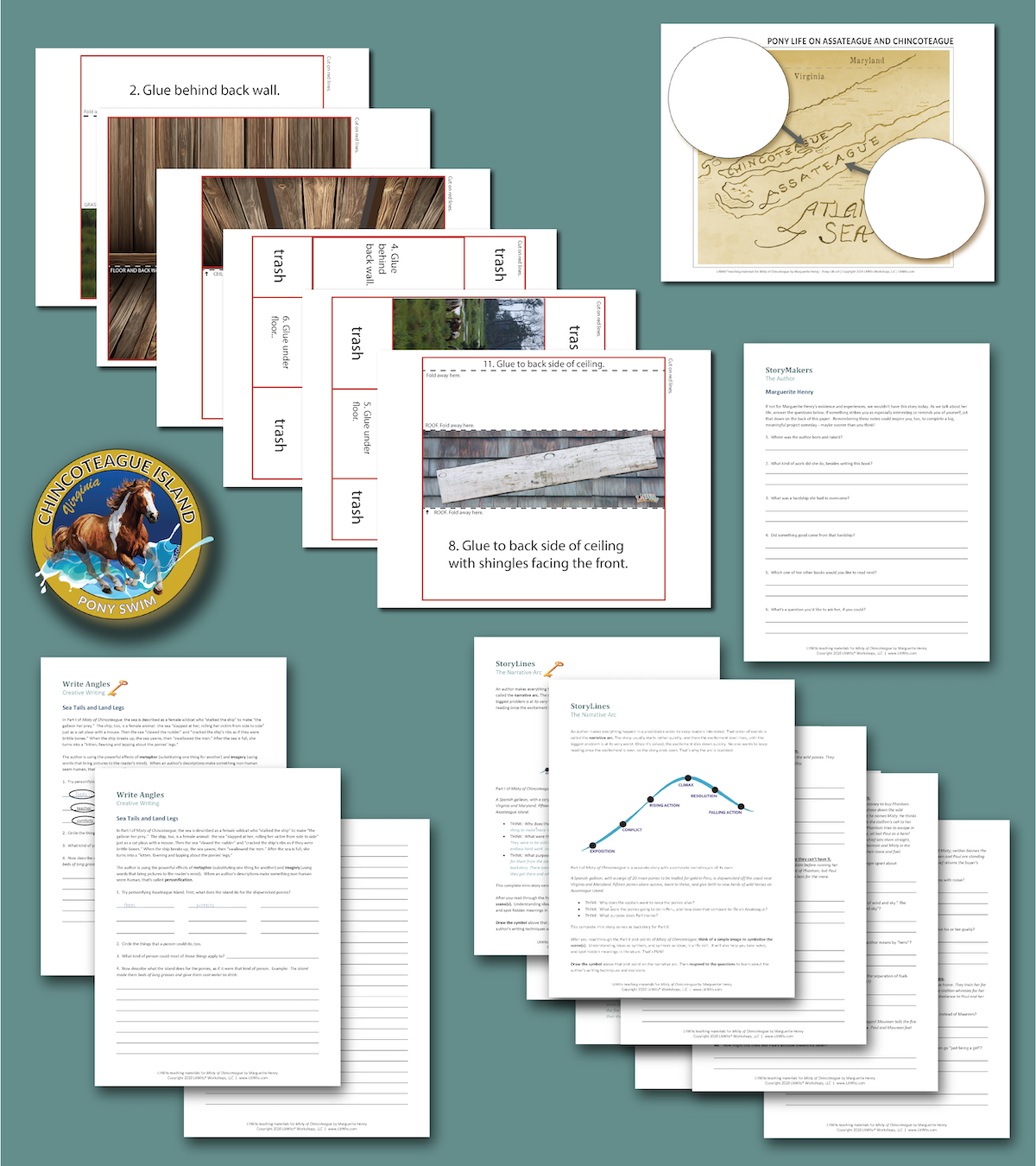
Throughout our workshops, we weave in worksheets that help kids process ideas in written form. For Misty of Chincoteague, your kids can use these three worksheets to:
take notes about the author while watching our video bio
follow the narrative arc and see how this story conforms to it
use the literary technique of personification to bring the island to life
These worksheets and all our activity printables are included in our printables set—click the red button for previews and details. Whenever we add new worksheets and printables to this set, they'll automatically show up in your account.
Set includes all worksheets and activity printables
A LitWits souvenir
Here's a travel sticker to prove kids have taken a trip through this great book, LitWits style, and have met some great people and learned some great things on the way!
Set includes all worksheets and activity printables
The worksheets and printables used for our activities are sold as a complete set.
Also included: telegram for pony packaging
Common Core State Standards Alignment for the comprehensive use of our teaching ideas and materials is also included for grades 3, 4, 5 and 6.
Set includes all worksheets and activity printables
As former-and-always horse girls, this story was always high on our "must-workshop" list. We love that its characters have a dream, and they work hard for it and keep believing in it until it comes true. But our favorite part isn't that they achieve it; it's that they find out they're willing to un-achieve (part of) it for a greater cause.
In our workshops, we did our best to make these teaching points tangible, meaningful, and memorable in the kids' hands. It's amazing how much kids can learn while they're "just" having fun!
Happy teaching!
Becky & Jenny


Takeaway 1
Only one character can be the protagonist, and in this story, it's Paul who has the most to learn. We find this out in the very first chapter of Part II, when he scoffs at his sister's compassion—for instance, when she expresses empathy for separated mothers and foals, he says "that's because you're a girl" and "quit acting like a girl!" He also calls her a goose and asks her if she's ever going to grow up.
Paul's not a bad kid; he just has some growing up to do. By the end of this book, his heart expands, like his sister’s. Grandpa confirms this at the end, when he acknowledges Phantom had never been happy, and says "Ye done the right thing" in respecting Phantom's need to be free, and to be who she is.
Takeaway 2
Paul and Maureen work tirelessly to raise money to buy Phantom. Just as importantly, they maintain a positive attitude—they "felt as certain of owning her as if someone had sent them a telegram that read, 'SHIPPING YOUR PONY ON PONY PENNING DAY." The right attitude, combined with the ability to persevere, all while learning deeper compassion, all set great lessons for all of us as challenges arise.

Takeaway 3
There's a lot of talk in this book about owning, possessing, capturing, taming, and even profiting from wild things - starting with the captain of the ship in Part I. Marguerite Henry helps us see the lessons learned by both captors and captives, and the trade-offs between freedom and security, but in the end, she has Paul do the right thing, and set Phantom free. There's an element of nobility woven throughout all the "possessing" and "owning" that touches our hearts. A lot of it comes from their grandpa, but the kids do a lot of figuring out themselves.
Misty of Chincoteague is chock-full of other subjects to explore, too—from the original people of the Eastern Shores to island wildlife and more Scroll down to see our curated Learning Links for more tangential teaching opportunities, and to see how we brought this book and its ideas to life.
Explore these links to supplement your reading experience, research points of interest, and prompt tangential learning opportunities.
About the Book & Author
Marguerite Henry - Misty of Chincoteague Foundation
Misty the Pony - Misty of Chincoteague Foundation
Dear Readers and Riders (biography of Marguerite Henry) by Lettie Teague - Amazon*
Story Supplements
Video: How to Make a Wickie Bridle - LitWits
The Assateague Indians: What Became of Them - Ocean City Museum
A Little Native History - Assateague People of Delmarva
About the Assateagues - Assateague People of Delmarva
Algonquian Peoples - Kids Britannica
Pit Ponies: Ghosts of the Coal Mines - HorseJournals
Video: About the Pinto Horse - eHorses Inernational
Points of a horse (anatomy) - Wikipedia
Video: 1954 Chincoteague Pony Swim - C-Span's Reel America, via Facebook
Video: 1924 Chincoteague Pony Swim - Library of VA
Saltmarsh Grasses - Cape May Wildlife
Video: Horse Sounds for Kids - Kiddopedia
Beyond the Book
Once Upon an Island: The History of Chincoteague by Kirk Mariner - Amazon*
Natural Wonders of Assateague Island by Mark Hendricks - Amazon*
Marguerite Henry's Ponies of Chincoteague Collection (boxed set) - Amazon*
Assateague: Island of Wild Ponies by Andrea Jauck and Larry Points - Amazon*
Dear Readers and Riders (biography of Marguerite Henry) by Lettie Teague - Amazon*
Set includes all worksheets and activity printables
When choosing props for our live workshops, we always try to focus on two important categories: props that are unique to the setting, because they help kids understand “what that was like,” and props that are symbolic of themes, because they make big ideas visual and tangible. Both kinds of props generate those wide-eyed, “aha!” moments.
Below is an overview of the display we put together for our live workshop. It included craft supplies, BookBites, and straight-from-the-story props, along with our "field trip" suitcase—now with one more travel sticker.. You could easily have your kids contribute items to a table over time, as the book is being read.
Sometimes we make a printable prop—click the button to see all our printables for this book.
Set includes all worksheets and activity printables
You're literally on our page about inspiring kids to love great books. YAY! We're eager to share our passion for LitWitting and the work we've done for over a decade.
We're also eager to keep doing it! :) So if you find this guide-page inspiring* and useful, please share it with your social world. And if you buy our printables for this book, thank you. We appreciate you helping us keep the lights on at LitWits!
Happy teaching,
Becky and Jenny
Sisters, best friends, and partners
The Becky & Jenny version: Feel free to print pages for teaching use, and make copies of printables for your students. Please don’t use our name, ideas, or materials commercially or share our printables, though we'd love for you to share these free pages with your fellow educators.
The blah legal version: You are granted exclusive use of our products in download or print version as follows: You have the right of reproduction that is limited to your use only in whatever quantity is necessary to meet your needs and those of your student participants. This right is unlimited and extends for as long as you need the materials during which time they cannot be given to or shared with any other person(s) through any means of delivery, materially or digitally via the Internet. As such you have the right to store the product(s) on the hard drive of your computer or as hard copy in your resource file. Any misuse of these rights is in violation of copyright law.
LitWits® is a registered trademark of LitWits Workshops, LLC.
LitWits teaching ideas and materials for Misty of Chincoteague by Marguerite Henry
Copyright 2020 by LitWits Workshops, LLC. All Rights Reserved.