Creative Teaching Ideas for
by Elizabeth George Speare (1958)
ON THIS PAGE: LitWits hands-on activity ideas and instructions, teaching topics, learning links, and more. Scroll on!
Newbery winner The Witch of Blackbird Pond is set in 1687, in colonial Connecticut. Sixteen-year-old Kit Tyler has just arrived from a very different, privileged life in Barbados, and her Connecticut relatives are suspicious and disapproving of her ways. Kit is strong-minded and smart, and wants to be true to herself—yet she also wants to fit in and be respectful. Her struggle for truth and love helps her to grow, but also gets her in trouble. When her different ways end in accusations of witchcraft, she faces execution. Kit’s story is one of resolving dilemmas while learning to respect differences.
Read reviews / buy the book on Amazon
We make a small commission on anything you buy through our Amazon affiliate links.
A Discussion from the Conflict
Kit's problem in this story is twofold. As she says herself, just a few pages in:
"I am forever doing foolish things. Even so, I can't understand why it should make everyone so angry" (Ch. 1).
Though Kit's smart, bold, brave, and sometimes compassionate, she has to learn to consider consequences before she acts, AND to understand how people very different from her might feel.
This twofold problem is first revealed when Kit jumps in the water to retrieve the doll for Prudence, and then scoffs at others' shocked reactions. Worse, this dismissiveness comes out, as the author intended, in her cavalier attitude about slavery. Kit has never considered that her good life on Barbados came at others’ terrible expense.
This topic is too big for this page, but here are a few questions we asked and some information we shared to get this conversation going. See our Learning Links section for more resources.
1. What was a white girl doing in Barbados in 1687?
Sixty years earlier, an English captain with 80 settlers and ten slaves had landed there to occupy and settle the island. People with money and status were given land, which they quickly deforested to grow tobacco, cotton, and sugarcane.
2. How do you think these plantations were staffed? Who did all the work?
Some workers were slaves sold out of Africa, some were kidnapped servants, and some were criminals working out their punishments. In fact, Barbados was Britain's first Black slave society.
3. Where in the story do we pick up on Kit's attitude about slave ownership?
When John asks if any women cared for Kit on Barbados, she matter-of-factly says “Oh, slaves of course. I had a black nursemaid.” (Ch. 2)
When Nat points out that Kit's grandfather’s slaves had been shipped as human cargo, she told Nat she had never even thought about that. (Ch. 2)
Kit laments to Matthew that she “had to sell my own Negro girl” to pay for her passage to Connecticut — “the little African slave who had been her shadow for twelve years.” (Ch. 3)
4. Kit's a bright, well-read person—how can she have such a big “blind spot?”
She grew up with slavery, and takes it for granted. As far as she's concerned, it's just the way things have always been.
Her grandfather owned slaves, and she loved him dearly; she's never considered he could do anything wrong. His example has implied that slavery is acceptable.
5. Slavery was legal in Kit's time. Does that mean it was right then, and wrong now?
Just because something is legal doesn't make it right. Below is a video revealing some laws for controlling enslaved people on Barbados. These laws came from beliefs that some people aren't really people—an idea that has never been (and never will be) right.
Viewer discretion advised, especially for younger children.
The Witch of Blackbird Pond isn't about slavery—but it is. Throughout the book, her every mention of enslaved people is fraught with Kit's lack of understanding. It's not the problem that gets solved by the end, but her changes in other areas imply a future transformation in this one. We can hope all we want for this fictional person, of course, but we certainly don't imagine Nat and Kit returning to Barbados to manage a plantation. In our sequel, they'd free as many enslaved people as possible, start a school to serve their needs, and raise abolitionist children.
Photo credit: “Planting the sugar-cane” (Credit: Schomburg Center for Research in Black Culture, Photographs and Prints Division, The New York Public Library).
A LitWits activity from the Rising Action
This story is full of conflicts between two ideas, groups, beliefs, people, traditions, and more. During this fun "mashup" collage activity, kids learn the history of and core differences between Roundheads and Royalists, then "get into their heads," so to speak, AND learn some vocabulary words!
"Puritan? You mean a Roundhead? One of those traitors who murdered King Charles?" (Ch. 1)
Our kids had a blast creating this mashup. Most began with the royal head of Charles I, for obvious reasons.
SUPPLIES
scissors, glue
history worksheet (in our printables)
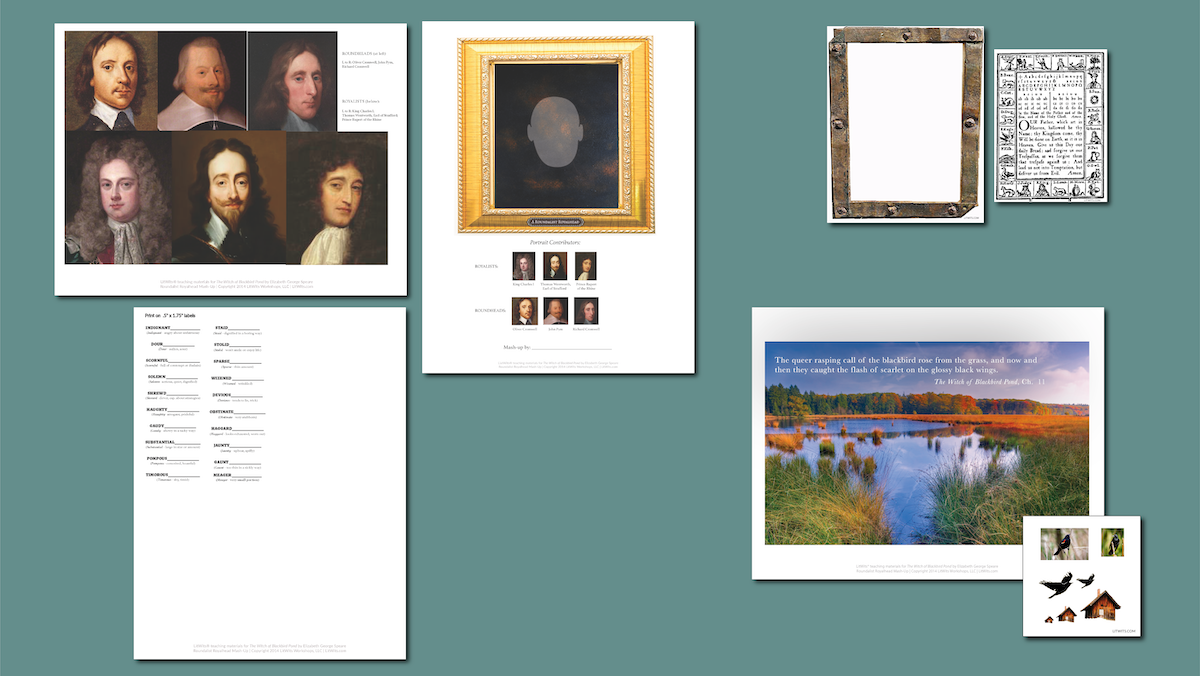
Royalist and Roundhead portraits, portrait template, and vocabulary labels (in our printables)
DIRECTIONS
Do the history handout to understand the defining differences between these two groups.
Cut out and reassemble some Royalist and Roundhead parts in a single portrait of a "Roundalist Royalhead."
Use the mashup portrait to make artistic use of some vocabulary words. Read the definitions and then look for "portrait parts" that sem to match that definition. "Substantial hair," for instance, and "gaudy necktie" and "haggard eye."
There's an instructional video below that you can pause as kids work through the different steps of the project.
While the kids are cutting and pasting, you can also share this short funny video:
A LitWits activity from the Rising Action
In this fast-paced relay, little Roundheads and Royalists race to complete four of Kit's tasks, while their teammates cheer them on in very unPuritan fashion.
SUPPLIES
apron (or dishcloth to tuck into necklines) for each team
10’ lengths of wool yarn, one for each child
two ears of corn (with the husks on) for each child
large basket
burlap or paper bag
kettle full of water
long-handled wooden spoon for each team
tablespoon for each team
bowl of dry cornmeal
pile of hay or straw (we cut dry yellow weeds from a meadow)
6” lengths of twine or brown wired twists, one for each child
DIRECTIONS
1. Set up the four stations, as far apart as you can. We held our quadrathlon in a gym, but a backyard, field, park, cul-de-sac, or even a garage would work just fine! For that matter, you could set up your stations in different rooms in a house (ideally not on carpet).
3. Divide the kids into two team, the Roundheads and Royalists, and tell them that they’ll be experiencing some routine Puritan activities at a very rapid pace. They’ll each take turns putting on an apron and running from station to station, where they’ll do these things as fast as they can:
4. Tell the kids ahead of time that each step must pass inspection by a student at each station. Then the “runner” will run back to the waiting team, take off the apron, and the next person in line will do it all over again. The first team to finish wins!
5. Put on some feisty fiddle music and count down 3, 2, 1… GO!
A LitWits activity from the Rising Action
From the first moment Kit sees the meadow, it's important to her—not just because she meets Hannah there, but because it's where she'll grow and transform. This is where her relationships with Hannah, Nat, and Prudence take shape, and come back to help her later in powerful ways.
So we added color and earthy textures to bring Blackbird Pond to botanical life with sensory elements from the story. The kids loved turning that scene into a hands-on here-and-now experience!
SUPPLIES
masking tape (cut or torn to length of template - not shown)
scissors
raffia or dry weeds
faux or dried grasses
copies of the pond and house templates, in our printables
DIRECTIONS
Glue the template to the card stock, so that the black is showing equally at the top, left, and right (there will be more showing at the bottom)
Decide whether you want Hannah's cottage to be close to the front (use large house), farther back (use medium sized house), or farthest back (use smallest house). Cut out the appropriate size house, and glue it to the template.
Squirt glue on the golden part of the meadow, so it looks like yellow grass stubble in the distance. Sprinkle a little cornmeal over the glue, and "tip and tap" the paper to get rid of the excess.
Cut the weeds and grasses and place them on the sticky side of the masking tape. Then turn it over and stick it just below the white frame of the template, like this (never mind that the photos don't show the house and cornmeal added first):
Put glue on top of the masking tape, and fold the lower black edge upward to cover it. Don't cover up the white frame, though.
Cut out the blackbirds and glue them to the grasses and weeds.
That's it! While the kids work, you might want to talk about:
the Pequot and Wangunk tribes that occupied the area first. and fought to retain their own honor, freedom, and land (as Nat says himself in Chapter 12, "A man's first loyalty is to the soil he stands on.")
Or you might just listen to some lovely blackbird songs and talk about Connecticut wildlife.
A LitWits activity from the Rising Action
The Puritans were strong believers in education, and Kit teaches lessons to children (and learns quite a few herself), so a Puritan hornbook seemed a perfect "let's do THAT!" project.
A hornbook, as we learn in Chapter 9, is a colonial-era tool for young children learning to read. Hornbooks typically included the alphabet, a set of phonics, and "The Lord’s Prayer." They were covered with a thin sheet of animal horn which had been boiled until soft, and cut so thin that one could read through it. This was fastened to the board with metal strips and small nails.
SUPPLIES
coffee for staining paddles (grown on Barbados at the time)
antique rim template, in our printables
copies of the hornbook lesson, in our printables
vellum paper – trim vellum and the printed lesson into rectangles to fit your board. The edges will be covered by the metallic paper strips.
DIRECTIONS (or see video below)
In a small container, add about 2 tsp warm water to the instant coffee.
Using a brush or wadded-up rag or paper towel, stain the paddle and blot the excess.
Cut out the antique rim.
Assemble the papers: Center the lesson page, top it with the vellum, and then place the rim on top.
Push the nailhead trim through all three papers, on top of the printed nailheads on the printed rim.
String leather or twine through the handle hole.
VIDEO INSTRUCTIONS
FOR DISCUSSION
While the kids are creating this colonial "lesson book," you might want to talk about hard lessons from colonial life—or at least hard tests and terrible punishments. Here are some starter questions and comments to get this conversation going:
1. What gets Kit in trouble before she even arrives in Wethersfield? (Talk about the swimming test for witches.)
If a woman who sank was innocent (but had drowned), and a woman who swam was a witch (but would then be burned)—was there ever a survivor? (It was a lose-lose test/death sentence!)
2. How was Hannah was scarred?
“Criminals” were branded with the first letter of their crimes: R for rogue, B for blasphemer and H for heretic. You might want to define those terms and point out their subjectiveness; go into the Quaker persecution if this suits your teaching goals.)
3. How is Nat punished for his jack-o-lantern prank?
He was put in the stocks. Prisoners were sometimes held captive in stocks and pillories for days while people bombed them with rotten food, random objects, and poop. At first your kids might giggle, but ask them to imagine not being able to lie down, or go to the bathroom, or scratch an itch, or wipe the gunk off their faces. It was truly a terrible punishment, doled out for the smallest offenses. (In Boston, a ship captain who had been at sea for three years kissed his wife upon his return — in public, on a Sunday. For this he was put in the stocks for several hours. Welcome home!)
4. What does the constable say might happen to Kit, besides branding?
She might "just" have an ear cut off! To think that losing an ear (and in a brutal, non-aestheticized way) was considered a minor punishment for first-time offenders!
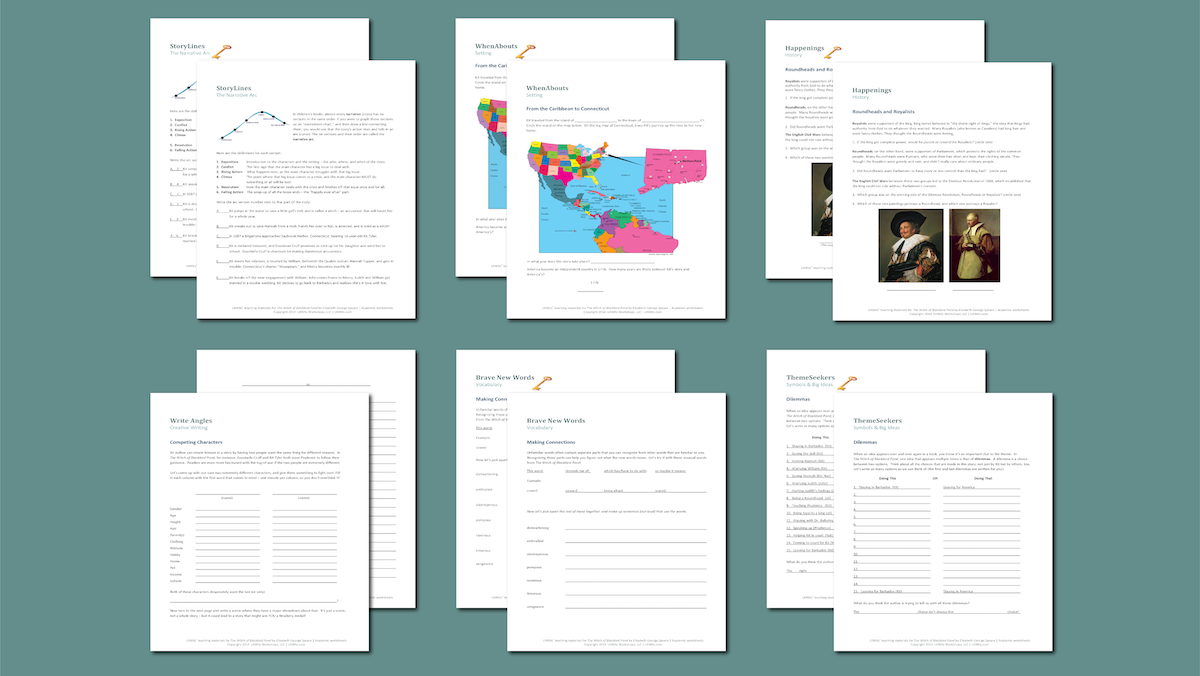
Throughout our workshops, we weave in worksheets that help kids process ideas in written form. For The Witch of Blackbird Pond, the kids used our six worksheets to:
follow the narrative arc
find the setting on a map
learn about Royalists and Roundheads
create contrasting characters
learn new words
delve into the story's dilemmas
These worksheets and all our activity printables are included in our printables set—click the red button for previews and details. Whenever we add new worksheets and printable to this set, they'll automatically show up in your account.
BookBites
A LitWits activity from the Rising Action
BookBites is the part of our literary experience when we get to “taste the story.” We choose a food right out of the book, and it has to meet at least one criterion:
it’s important to a plot point
it has thematic significance
it’s unfamiliar for reasons of culture, era, or location
To soak up the moment when Kit first meets “the witch of Blackbird Pond,” we served Hannah’s simple offering of blueberry corncake as described in Chapter 9. Hannah’s hostessing of Kit represents the first step in their friendship, and goes to show that “the witch” is not only harmless but kind and intelligent. It’s a turning point in the plot, and in Kit’s life, and it’s a snack right out of the earth where this story is set.
We made cornbread from a mix and added fresh blueberries. If you want to add the "yellow goat's milk," that would be very authentic. We didn't look very hard for that.
FOR DISCUSSION
Because Hannah and Kit had to make so many difficult choices, we chose this time to talk about the "takeaway topic" of dilemmas. Here are some conversation starters and questions to get your kids talking about hard choices.
How does Kit's choice to save the doll affect the whole story?
What makes Kit consider settling for comfort and kindness with William, instead of love?
What two choices does Kit face about Hannah and Prudence — and why does she choose to put herself at risk?
John must decide between proposing to Mercy or allowing Judith to think he loves her. Do you think he makes the right decision?
When the sisters need Dr. Bulkeley, do you think Matthew makes the right decision?
What is he choosing between?
What decision does Kit face when Hannah is in danger?
What decision do William and Nat face when Kit goes to court?
What does each man stands to lose and gain by showing up?
What does Prudence do, and at what risk?
Kit’s final dilemma is again between Barbados and Connecticut. What does she choose to do?
What changes that decision?
What do you think was Kit’s most difficult choice, and why was it so hard?
Note that marrying Nat means they’ll live on the “middle ground”: the open sea between North America and the West Indies. It’s the first time she hasn’t had to make a black-and-white decision between two things!
A Discussion from the Rising Action
The story' gives us glimpses of American colonial life that can be a "way in" to talking about colonial history, too—like the “Charter Oak Incident.”
In the story, Kit’s uncle and other colonists are upset that Governor Andros wants to remove Connecticut’s charter. We told our kids what a charter is, and why Matthew is relieved when the governor shows up and the charter has been stolen. They were thrilled to learn this really happened—that the lights went out and the charter disappeared, just like in the story.
According to tradition, the charter was hidden in the trunk of a white oak tree. The tree blew down in a windstorm in 1856, and funeral dirges were played on the site. There’s a monument there today, and In fact, its famous charter is framed in wood from that tree. The legend is the reason why the white oak is Connecticut’s state tree today.
Image credit: Charles De Wolf Brownell, Charter Oak,1857, oil on canvas. 1956.1.1. - Connecticut Historical Society
The worksheets and printables used for our activities are sold as a complete set.
Common Core State Standards Alignment for the comprehensive use of our teaching ideas and materials is also included for grades 3, 4, 5 and 6.
Join our email list and we'll send you a code for $4 off all printables!


Takeaway 1
This story includes many choices that must be made between two things – a kind of choice known as a dilemma. Besides the political and religious dilemmas, there are very personal choices each character makesa about what to do, and who to be. Like life, a good story is full of tough calls that help make us who we are. The right choice isn’t always the easy one!
Hands-on connections in this guide: "Roundalist Royalhead Mashup;" history, theme, and creative writing worksheets; props that connote life on Barbados vs. life in Wethersfield

Takeaway 2
For kids, the most intriguing aspect of American colonial life is bound to be the awful punishments. Talking about these is an attention-grabbing “way in” to discussing American colonial beliefs and laws. This book also offers many excellent chances to talk about American history, and Connecticut history in particular, such as the “Charter Oak Incident.” And every book set on American soil, especially during this time period, is an opportunity to talk about the Indigenous peoples who were displaced by Europeans and fought to retain their honor, freedom, and homes. As Nat says himself, "A man's first loyalty is to the soil he stands on." (Ch. 12)
Hands-on connections in this guide: “HornPad 1.0” project;”Puritan Quadrathlon” activity; props that connote Colonial life (candles, wool and spool, Latin primer, pewter mug and plates, wooden bowl, fall harvest vegetables); BookBites snack

Takeaway 3
There are multiple examples of othering, or judgment-based exclusion, in this story. There are lines drawn between Roundhead and Royalist, Puritan and Quaker, rich and poor, men and women, and more. Hannah is an obvious victim of othering, and so is Kit herself.
But the most extreme example of "othering" is that of slavery. It gets little story space, but Kit's life on Barbados and her resulting attitudes impact her whole demeanor. A big part of what makes Kit so different from her cousins is her previous life on Barbados, but as the author reminds us several times, that life came at others’ expense.
Hands-on connections in this guide: "Kit's History" discussion/video; props that connote slavery (chains, ship model)
The Witch of Blackbird Pond is full of other topics to explore, from Quakerism to early American textiles and fashions. Scroll down to see our curated Learning Links for more tangential teaching opportunities, and to see how we brought this book and its ideas to life.
Explore these links to supplement your reading experience, research points of interest, and prompt tangential learning opportunities.
About the Book & Author
Story Supplements
Slavery
Facts About the Slave Trade and Slavery (The Gilder Lehrman Institute of American History)
Slavery in Colonial America (American Battlefield Trust)
Barbados colonial plantation from the 1650s
Firsthand account of Olaudah Equiano, an African slave, with photo
Ships used in the slave trade
About Barbados the first black slave society (Black Perspectives)
About the slave trade to Barbados (Colonial Williamsburg)
About the brutal slave codes of Barbados (Smithsonian Channel)
About life aboard a slave ship (History)
Setting
About the history of Wethersfield, CT (Wethersfield Historical Society)
About the Indigenous peoples of the area - Wongunk and Pequot (Wikipedia)
About the Wangunk (Chattham Historical Society)
About John Oldham, founder of Wethersfield, CT (New England Historical Society)
About historic buildings of Wethersfield, CT (Historic Buildings of CT)
Historic Wethersfield website
Cove Museum in Wethersfield – warehouse where West Indies trade goods were stored
Thomas Lee House in Connecticut (video)
“Colonial House” interactive history feature (PBS)
Politics & History
Are you a Roundhead or a Cavalier? (video) - BBC
Roundhead info
Cavaliers (Royalists) info
Charter Oak Incident (Society of Colonial Wars, CT)
Brief history of the Colony of Connecticut
About differences between Puritans and Quakers (Have Fun With History)
Colonial Life
About brigantines of the era and setting (Colonial Society)
About the swimming of witches (Foxearth & District Local History Society)
About the swimming of witches (Library of Congress)
Quakers (brief overview by a Quaker)
American colonial punishments (PBS)
Video: American Colonial fiddle music associated with Jamaica
Images of hornbooks
Other
The Accidence (implied to be a Latin grammar, but that Accidence wasn’t published until 1700s – this is the sea grammar published 1626-36 for maritime men)
Salt mines in the Dutch West Indies (travel site)
Beyond the Book
Wethersfield Historical Society - teacher resources
Colonial Connecticut — attractions to visit
Colonial Connecticut – places and things to see
Connecticut wildlife - possibly in Hannah's meadow
When choosing props for our live workshops, we always try to focus on two important categories: props that are unique to the setting, because they help kids understand “what that was like,” and props that are symbolic of themes, because they make big ideas visual and tangible. Both kinds of props generate those wide-eyed, “aha!” moments.
Below is an overview of the display we put together for one of our live workshops, and under that we've given more details. You could easily have your kids contribute items to a table over time, as the book is being read.
Sometimes we create a printable prop; click the button to see the list for this book.
“What a pity every child couldn't learn to read under a willow tree...”
“She snatched at the dream that had comforted her for so long. It was faded and thin, like a letter too often read.”
“There is no escape if love is not there," Hannah had said.
“How right- how incredibly, utterly right- and how impossible!”
“The maple tree in front of the doorstep burned like a gigantic red torch. The oaks along the roadway glowed yellow and bronze. The fields stretched like a carpet of jewels, emerald and topaz and garnet. Everywhere she walked the color shouted and sang around her. The dried brown leaves crackled beneath her feet and gave off a delicious smoky fragrance. No one had ever told her about autumn in New England. The excitement of it beat in her blood. Every morning she woke with a new confidence and buoyancy she could not explain. In October any wonderful unexpected thing might be possible.
“If you ask me, it's all that schooling. It takes the fun out of life, being cooped up like that day after day...Books, now that's different. There's nothing like a book to keep you company of a long voyage.”
“A man's first loyalty is to the soil he stands on.” -Ch. 12
She saw now that she could not tell him about the books she had loved any more than she could make him see the palm trees swaying under a brilliant blue sky.
How often she would come back she had no way of foreseeing, nor could she know that never, in the months to come, would the Meadows break the promise they held for her at this moment, a promise of peace and quietness and of comfort for a troubled heart.
“Because they have never tried to get to know her. People are afraid of things they don’t understand.”
“Hannah’s magic cure for every ill,” Nat had said. “Blueberry cake and a kitten.” Kit smiled to see it working its charm on Prudence. But there was an invisible ingredient that made the cure unfailing. The Bible name for it was love.
There was the Dolphin coming up the river with all her sails. The curving tail of the prow was chipped and dull, the hull was battered and knobby with barnacles, the canvas dark and weathered, yet how beautiful she was!
From that first moment, in a way she could never explain, the Meadows claimed her and made her their own.
For Prudence was an entirely different child from the woebegone shrinking creature who had stood in the roadway outside the school. The tight little bud that was the real Prudence had steadily opened its petals in the sunshine of Kit’s friendship and Hannah’s gentle affection.
There was something strange about this country of America, something that they all seemed to share and understand and she did not.
And Mercy had answered serenely, 'Oh, I settled that a long time ago. I remember it very well. Father had carried me to the doorstep, and I sat there watching the children playing a game in the road. I thought of all the things I would never be able to do. Since then I've just never thought much about it.”