Creative Teaching Ideas for

TUCK EVERLASTING

by Natalie Babbitt (1975)


ON THIS PAGE: LitWits hands-on activity ideas and instructions, teaching topics, learning links, and more. Scroll on!

About the story

In the late 1700s, Jesse Tuck and his family drank from a magical spring, and they've been unable to die ever since. Sure, immortality sounds  like a good thing—but they've learned there are downsides to being a Tuck Everlasting,  and they've been living in seclusion for eight decades to keep their secret. But when ten-year-old  Winnie Foster explores the forest and discovers their magical spring, they can't risk the exposure. They kidnap her to explain why she can’t drink the water herself, or tell anyone else about it. After Winnie hears their story she forms an attachment to the family—especially Jesse. 

Meanwhile, a mysterious stranger with selfish intentions is on their trail, and things get complicated fast. When his actions escalate and the Tucks are in danger, Winnie must make decisions with long-lasting--perhaps ETERNAL-- consequences!

Read reviews / buy the book
We make a small commission on anything you buy through our Amazon affiliate links. 

Hands-on Fun

Making a plan . . .


There are many ideas in this Hands-on Fun section—don't feel you have to do them all! Go with whatever works best for you and your kids. If you want to focus on a particular teaching point, our Takeaway Topics section can help you narrow down the activity options. And you can enhance discussions during any activity with audiovisual aids from Learning Links or story objects from Prop Ideas.

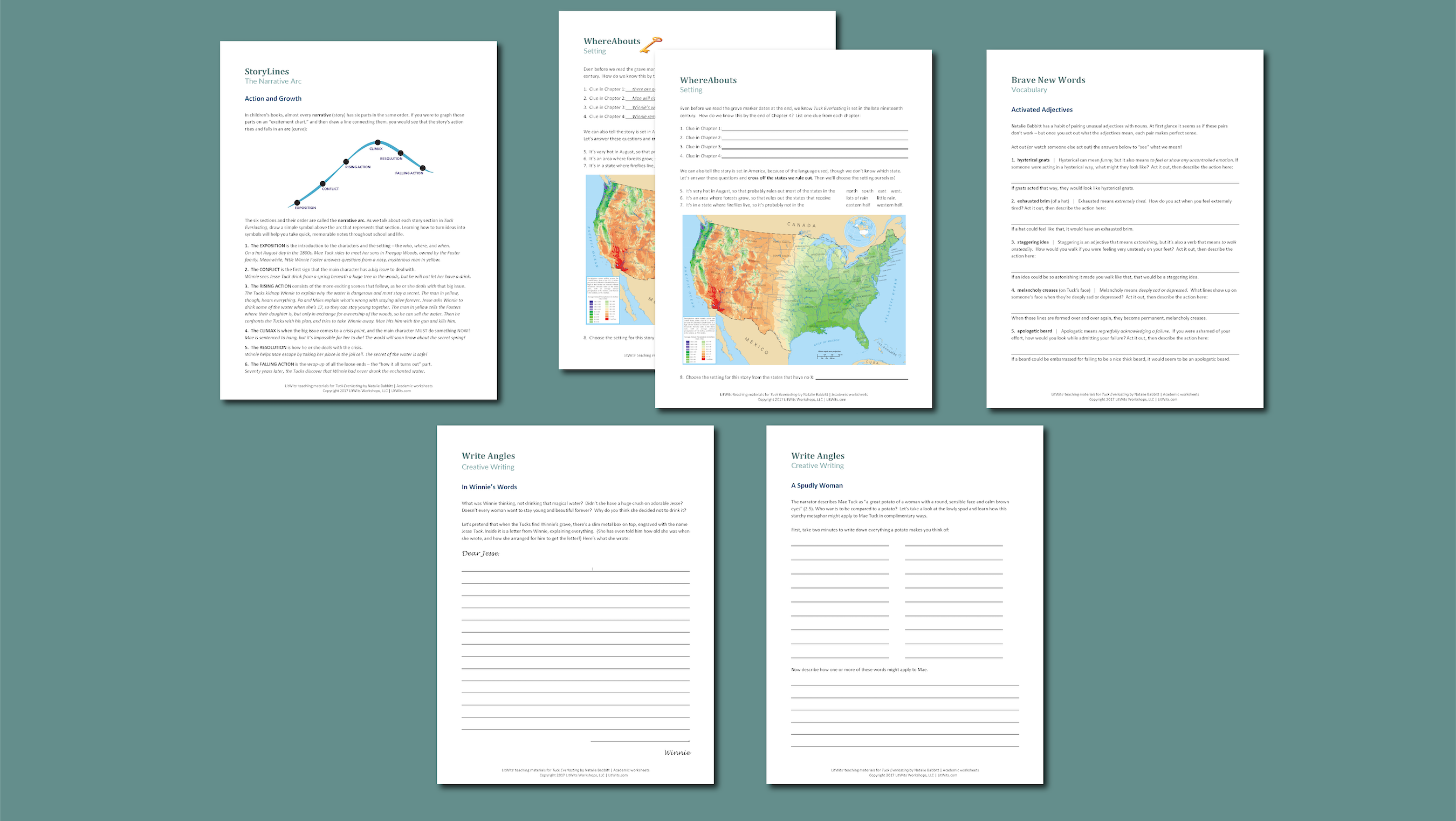
In our workshops, we do all the activities on this page, in order of the story's narrative arc. You might find our narrative arc guide helpful for sequencing your activities, teaching the important concept of the arc, and helping kids learn how Natalie Babbitt put Tuck Everlasting together.

Mystery Setting

A LitWits activity from the story's Exposition

Even before we read the grave marker dates at the end, we know Tuck Everlasting is set in the late nineteenth century. We can also tell the story is set in America, because of the language used, though we don’t know which state. Have the kids work together to find clues in the story that define its setting as nineteenth-century America.

(You can do this freestyle, or have them use our setting worksheet, which helps them narrow down and choose a setting.)

Producing Characters

A LitWits activity from the story's Exposition

In Chapter 2, Mae is described as “a great potato of a woman,” which doesn’t sound like a flattering comparison. It’s also kind of weird. How can a person be like a potato?

But after we’d done our creative writing worksheet, “A Spudly Woman,” the kids understood why it works. Mae is down to earth, rustic, wholesome, plain but hearty, and more--she's even wearing brown and white. She's a TOTAL spud! (Though when she squeezed through the jailhouse window and into her sons’ waiting arms, Miles and Jesse might have wished she were more like a French fry.) 

Before doing our worksheet, we had  covered an assortment of odd veggies and fruits with a cloth. After the kids had finished the worksheet and we'd talked about Mae's spudliness, we whipped the cloth away from a table, and told our kids to create their own produce-based  character in writing.

We pointed out that telling the comparisons would be boring, so they should just let the (well-named) character look, speak, and act like the chosen fruit or veggie.  This example of “showing” helped:

Not this:

Tom is like a tomato because he blushes easily. His green hat is like a stem.

More like this:

Tom’s round face is almost always red with embarrassment. When kids giggle at him, he tugs his bright green cap over his eyes.

The kids got the giggles writing their character sketches and reading them out loud, while their classmates guessed which fruit or veggie they’d chosen. And they learned a lot about coming up with metaphors, too!

The Tree of Life

A LitWits activity from the story's Conflict 

This project recreates the giant ash tree in the clearing of the wood, from the base of which bubbled the magical spring, hidden by pebbles, whose discovery creates such conflict for the Tucks--and for Winnie. 

SUPPLIES


DIRECTIONS

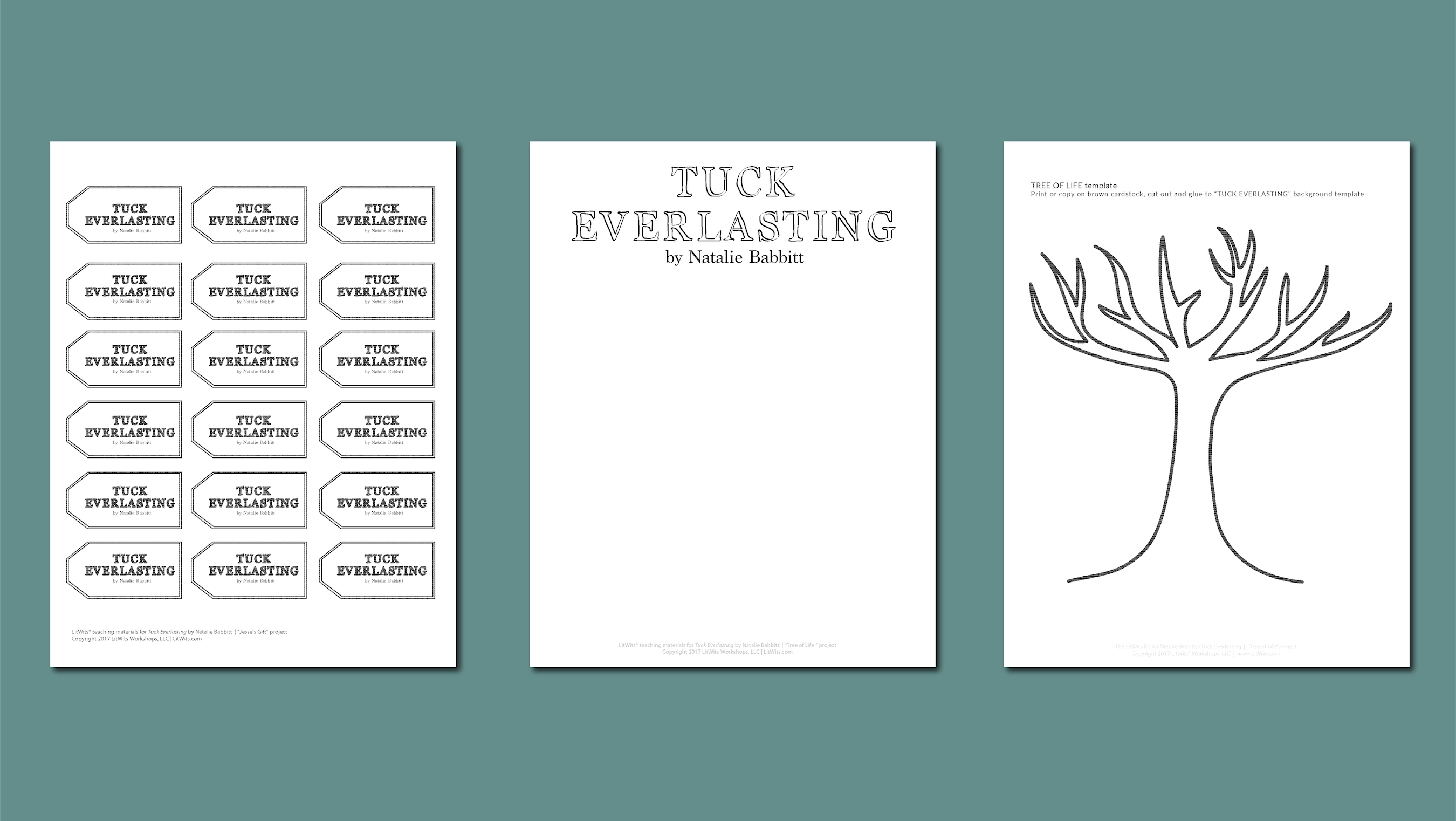
Have the kids cut out the tree and glue it to the background, then embellish it with watercolors. For leaves, have the kids use their fingerprints—for all kinds of reasons. Fingerprints are round, which remind us of wheels and cycles and seasons, so central (ha!) to the story.  And most kids love getting their fingers in the paint! You might ask them what color of leaves they’ll choose, and what “season” of life they might represent. 

A cluster of pebbles at the base of the tree hints that the spring is there, just below the surface. Some of our kids had fun “carving” messages and initials in the tree as well, which we hadn’t even thought of. We love it when our LitWitters out-LitWit us!

FOR DISCUSSION

While we worked, we read Angus’s Chapter 12 chat with Winnie, wherein he tells her “You can’t have living without dying.” Obviously you CAN, if you know about the Treegap juice—the question is, SHOULD you? 

We pondered this question aloud as a class, perused our Learning Links on immortality, and talked about the pros and cons of never dying. Just a fluffy little existential subject, nothing grade-schoolers can’t handle.

BookBites: A Good Supper

A LitWits activity from the story's Rising Action

BookBites is the part of our literary experience when we get to “taste the story.”  We choose a food right out of the book, and it has to meet at least one criterion:

  • it’s important to a plot point
  • it has thematic significance
  • it’s unfamiliar for reasons of culture, era, or location

During the meal Winnie shares with the Tucks in their home, we learn quite a bit about the Tucks. We also learn what Winnie thinks of them and their way of life. As she sits silently “chewing with strangers in a strange place,” she considers that perhaps they are crazy, or criminals. She’s discomfited, and declares she wants to go home. It’s an important point in the story, because Winnie is about to hear why she’s been “kidnapped” and why she must never tell anyone about the spring. So we took our BookBites choice from this sentence:

“It was a good supper.  Flapjacks, bacon, bread and applesauce…”

We also saw it as an irresistible academic opportunity to eat flapjacks with plenty of maple syrup, which of course we all licked off our fingers. We didn’t bother with bacon (we try to stay vegetarian as much as possible) or bread (too many carbs!), but applesauce was a healthy choice that was easy to serve. The kids loved the fruity-flapjack combo! 

FlapjacksHere’s the Food Network's version of flapjacks. We weren’t as gourmet as that. We used the “add water” pancake mix from the grocery store, but told the kids it was Ma Tuck’s time (lots of time)- tested recipe.

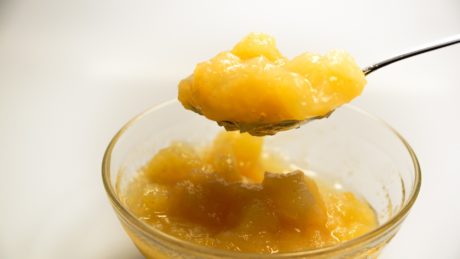
ApplesauceSingle-serve containers of applesauce were easy to share with the kids. But if you want a greener alternative, or feel like adding cooking to your lesson, here’s our mom’s recipe, straight off the apple farm and out of our childhood!

Mom’s Applesauce

  1. Golden Delicious, Pippin and/or Bellflower apples quartered, cored, and cut into ¾” pieces, enough to fill the pan.  
  2. Add ¼ – ½ cups of water. Bring to boil and reduce immediately to simmer ‘til apples are tender (15-20 min.).  
  3. Add sugar to taste (start with ½ cup per 6 qt. kettle). Stir and mash. 
  4. Serve warm with cinnamon and cream, or chilled; use as dessert or as accompaniment for meal; spread on raisin toast or sprinkle with granola – yum!

Jesse's Gift

A LitWits activity from the story's Rising Action

Wow, that Jesse knows where to get an awesome gift, doesn’t he—why give a girl diamonds when you can give her IMMORTALITY? Because diamonds aren't really  forever... but that spring water is!

Then again, is it generous or selfish of him to give a nonreturnable gift, with irreversible effects, to an impressionable little girl? That’s a big question, but it didn’t stop us from sending sixty little girls and boys home with their own bottles of magical spring water, and some points to ponder about the ethics of eternal life.

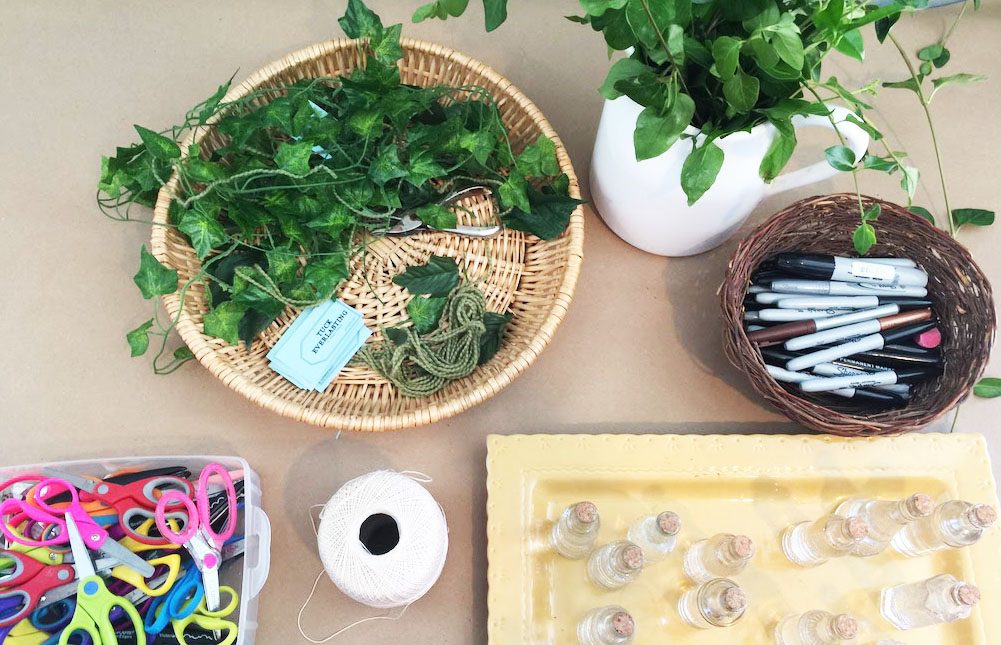
Fortunately, the project itself was simple: each student filled a little glass bottle from our container of “spring water,” then used twine or ribbon to tie on a tag and leaves.  

We left it up to the kids to decide whether to drink the water, save it for a later age, or pour it on an unsuspecting pet. Of course we told them they couldn’t drink it until they’d talked things over with their parents, as we didn’t want to be responsible for any unnatural longevity that may result.
SUPPLIES


FOR DISCUSSION

The word dilemma comes from the Greek dilémma, a compound formed from di- ‘two’ and lémma ‘proposition, premise.’ In the legendary story of Odysseus, a sea captain faced a dilemma when he had to choose between battling one of two terrifying monsters, a scene that led to the phrase “between Scylla and Charybdis.” Other expressions might be more familiar to your kids: “on the horns of a dilemma,”(horns come in pairs, and they’re sharp!), “between a rock and a hard place,” or maybe even “between the devil and the deep blue sea.

Tell the kids that a dilemma is a situation in which a difficult decision has to be made between two options, usually both undesirable ones. We face a dilemma when there’s a tough choice to be made, and both outcomes have their downsides.

For example, if you’re thinking about whether to have potato chips or pretzels with your sandwich, that’s just a decision. But if you have to choose between studying for a test (and miss miniature golfing) or go miniature golfing (and possibly fail your test), well, that’s a dilemma.

  • Ask your kids to identify as many dilemmas from the story as they can, and talk about what makes them such hard choices. 
  • Brainstorm together a “pros and cons” list for one or more of them, then identify the “deciding factor” that tipped the scales in favor of one particular choice.  (For instance, when Winnie is deciding whether or not to run away, she ultimately realizes she’s too afraid to go out on her own, alone. Her fear is stronger than her desire to change her circumstances. And though she heard many arguments for drinking or not drinking the magical water, in the end, she decided not to drink it.)
  • What are some real-life dilemmas your kids can think of, and what are the pros and cons that could tip the scales in one way or the other?

Around and Around

A LitWits discussion activity

A main theme of this book is that people shouldn’t live forever—an idea that circles around again and again and again in images of . . .  circles.  Circles, spheres, discs, curves, and arcs, from the Ferris wheel to the word “rolling” at the end.  And of course, whenever similar things or ideas show up over and over, there’s a message there.  

Have the kids work in groups to go through the story and come up with lists of “roundish” things, or things that cycle, or circle, or have spherical properties.  Give them a fixed amount of time to do this. Once the time is up and they have their lists, they should look for connections. Here are some conversation-starter questions:

  • What are the broad ideas within each word or phrase?
  • What do you think all these roundish things tell us in Tuck?  For instance, what comes to mind when you think of a Ferris wheel?  (Yep, “getting stuck at the top” comes to everyone’s mind . . . but also phrases like amusement park, going in circles, and view from above.)
  • What might those phrases have to do with the down side of immortality? 
  • In life, could any one situation be amusing FOREVER? 
  • How many circles can you go in before you get bored and frustrated? 
  • Do you only ever want to see the world from “above and beyond” everyone else?  

Writing to Reassure

Great books are born from all kinds of moments and motives, but some of the greatest have been inspired by a child’s question or need. In fact, Natalie Babbitt wrote Tuck Everlasting to address her little girl’s fears of dying. “I wrote Tuck to help Lucy understand what life is all about—that we all get born and we all have to die.," she said. "It’s a subject I never thought I’d write about, but there it was. I wanted to be sure Lucy would not grow up scared.” 
 
As a thoughtful creative writing assignment, you might want to ask your kids if they know a younger child with a fear (of dogs or the dark, for instance). As your kids come up with ideas as a class or in groups, note the fears on the board. Then have each student choose a fear and write a reassuring, interesting story that helps calm that fear.

Activated Adjectives

A LitWits activity 

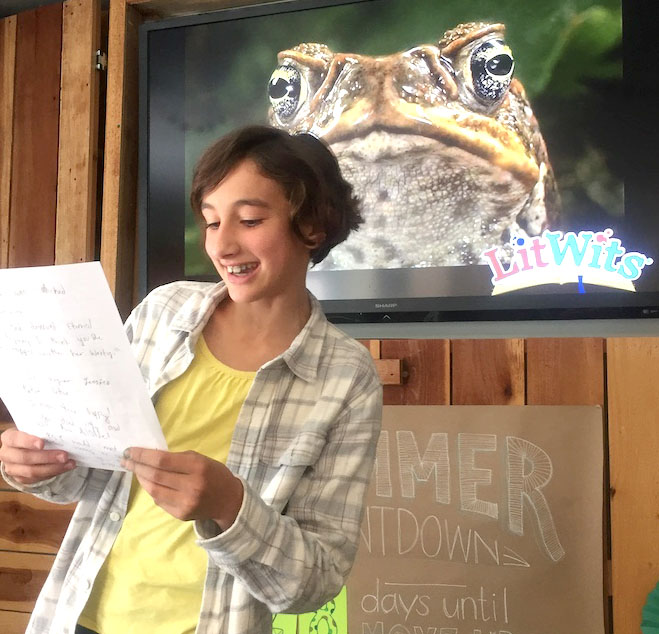
As a tie-in to our vocabulary worksheet, we had volunteers act out the adjectives that the author pairs with nouns. This had great appeal to the extroverts in our group, and inspired a few introverts to join in—but it was just as much fun for the spectators.  It’s easier to “get it” when you see someone really GET hysterical, melancholy, exhausted, and apologetic! 

Once our volunteers showed us “what that looks like,” it was easy to imagine how their adjectival actions might apply to Ms. Babbitt’s paired noun.

In Winnie's Words

A LitWits activity from the story's Falling Action

What was Winnie thinking, not drinking that magical water?  Didn’t she have a huge crush on adorable Jesse?  Doesn’t every woman want to stay young and beautiful forever?  Why do you think she decided not to drink it?
 
For this creative writing activity, you'll give your kids a scenario that asks Winnie to write to Jesse from beyond the grave.  You can make up your own details, or use our worksheet.

Printables Previews

The worksheets and printables used for our activities are sold as a complete set.

Common Core State Standards Alignment for the comprehensive use of our teaching ideas and materials is also included for grades 3, 4, 5 and 6. 

The LitWits Kit

Pack up for the field trip!

A LitWits Kit is a bag or box of supplies you pack up and give to each child right before you begin your "field trip" through the story.  You might be doing one-off projects as you read through the book together, or you might do everything in this guide from top to bottom after the book has been read. However you explore this book in LitWitty ways, kids love the anticipation of opening their kit.

If you'd like to build LitWits Kits for your kids, you could easily arrange the items in a bag, basket, or story-relevant container.  Honestly, it's just as much fun to create a kit as it is to open one!

To make it all the more fun, our printables for many books include special "story packaging" for certain activity supplies, including BookBites. Click the button below for a specific list of contents for this book. 

Takeaway Topics

Why we chose this book for a "field trip"
Tuck Everlasting is one of those stories that makes you wonder if you really want what you think you want after all--it's sort of like The Picture of Dorian Gray  for kids. It was recommended to us as a thought-provoking novel about the beauty of aging, the meaning of life, and the necessity of death. Nothing too heavy there, right?  How could we resist a beach read like that?  When we read the book, we found it just as thought-provoking and fascinating as promised, so we chose it for one of our experiential workshops. And it's packed with great takeaway topics, which we're sharing below.

In our workshops, we did our best to make these teaching points tangible, meaningful, and memorable in the kids' hands. It's amazing how much kids can learn while they're "just" having fun! 

Happy teaching!
Becky and Jenny

Takeaway 1

Dilemmas

From the moment Winnie considers running away to the evening she decides what to do with Jesse’s gift, Tuck Everlasting is full of dilemmas. And not just for Winnie, either.  What about Miles' decision not to give The Water to his wife and kids? And so on. This story raises big questions about making choices, and gives us opportunities for thoughtful conversations that consider both sides of each dilemma.

Hands-on connections in this guide:  props – the bottle of water, the spring; “Jesse’s Gift” project; “Tree of Life” project; creative writing worksheet 

Takeaway 2

Endless Cycles

A main theme of this book is that people shouldn’t live forever—that humans need to move on, to grow and progress.  If our position, path, and view were always the same, and there were no risks, we'd have nothing to lose--and therefore, nothing to gain . We’d just be stuck.  And if you look closely at that word, you’ll find the word Tuck stuck in there.

Hands-on connections in this guide: props acting as symbols or “sources” of immortality or time, “Tree of Life” project, “Jesse’s Gift” project, creative writing worksheet “In Winnie’s Words,” "Around and Around" discussion activity

Takeaway 3

Natalie Babbitt

Natalie Zane Babbitt was born in Ohio on July 28, 1932 and died on Hallowe’en Day in 2016. But like Jesse Tuck, she’ll live forever—through her books, especially Tuck Everlasting.

She didn’t always want to be a writer, though. Her mother loved the arts, and made sure Natalie and her sister Diane were exposed to music and literature. Natalie was inspired to be an illustrator, at nine, by John Tenniel’s Alice in Wonderland illustrations.  She went to art college, where she met her husband, and they moved to Connecticut and had three children in the 1950s.  She illustrated a children’s book her husband wrote, but she didn’t try writing herself until the 1960s, when she began writing and illustrating picture books and novels for kids.  In the 1970s the Babbitts bought a small vacation home in the Adirondacks of upstate New York. That setting inspired that of Tuck Everlasting, the author’s best-loved book.  [Source:  Publisher’s Weekly]

Here's a reading by the author herself:

Hands-on connections in this guide:   all props as thematic/symbolic elements of the story; all projects and activities as expressions of the author’s work, especially "Writing to Reassure" actvity; music and audiovisuals about the author’s life; setting, narrative arc, creative writing, and vocabulary worksheets, 
Tuck Everlasting is full of other fascinating topics to explore, too--from corporal punishment to mythological objects of immortality to the proverbial Fountain of Youth.  Scroll down to see our curated Learning Links for more tangential teaching opportunities, and to see how we brought this book and its ideas to life.

Learning Links

Explore these links to supplement your reading experience, research points of interest, and prompt tangential learning opportunities.


About the Book & Author


Story Supplements

Video – How to identify an ash tree
Video – A not-croaking toad
Video – Moth(ra)>
Video – Blacksmithing
Video – Woodcarving
Kingfisher
Thrush
Blackbird
Dragonflies
Snapping turtle
Goldenrod
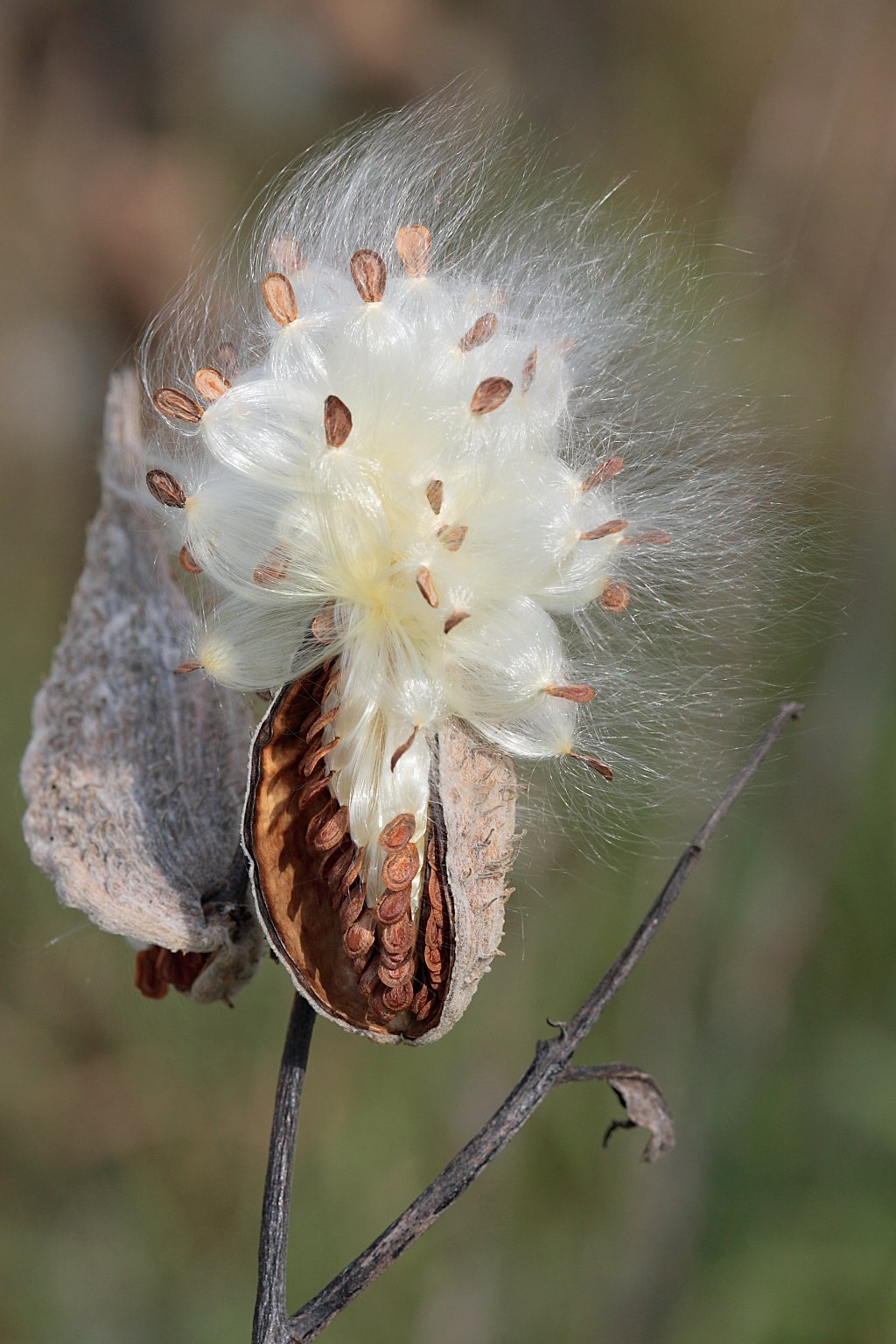
Milkweed (Chapter 25)
1939 convertible Hudson
“Stone walls do not a prison make . . .” by Richard Lovelace (Bartleby)
Six Pros and Cons of Immortality (Longevity Advice)
Is Immortality Unethical? (DebateWise)
Will Humans Ever be Immortal? (Live Science)
Want to Live Longer? Consider the Ethics (The Conversation)
Toward Immortality: The Social Burden of Longer Lives (Live Science)
Video 2:45 - The Search for the Fountain of Youth (History)
Video 11:00 - The Strange Story of St. Augustine's Fountain of Youth (ChadGallivanter)
Video 14:14m - The Tragic History of the Search for the Fountain of Youth
The Elusive Fountain of Youth -(Legends of America)
Ponce de Leon and the Fountain of Youth in Florida (Look and Learn)


Beyond the Book

Prop Ideas

When choosing props for our live workshops, we always try to focus on two important categories: props that are unique to the setting, because they help kids understand “what that was like,” and props that are symbolic of themes, because they make big ideas visual and tangible. Both kinds of props generate those wide-eyed, “aha!” moments. You could easily have your kids contribute items to a table over time, as the book is being read. 

Sometimes we create a printable prop; click the button to see the list for this book.

Stuck rock

People who live forever are like rocks left beside the road that never move on and never change.

Magic water

The bottle of spring water Jesse gave to Winnie. Would YOU drink it?

Music box

A music box painted with roses - just like Mae Tuck’s: “No one who owned a thing like this could ever be disagreeable.” Ours is from a thrift store; here's a similar one on Amazon.

Queen Anne's Lace

.. Queen Anne’s lace lay dusty on the surface of the meadows like foam on a painted sea.  This grows in our area, but you can get the Eternal species from Amazon's fields.

Immortal toad

This toad may not live forever - but he’ll outlast any toads we know! You can order one of his buddies from the Great Amazon Pond.

Wheel

The wheel of life and of seasons and of change. Tuck says that because of the water, he and Mae have dropped off the wheel. We found ours in an antique store, but this too can be found on Amazon!

Clock

A circular clock represents the idea of perpetual time and endless cycles. This one was a gift, but here's another cute one one we'd also put to everyday use.

Magic spring

An electric pump hidden in a dish made a bubbling fountain that delighted our kids.

Yellow daisies

The bright yellow daisies from Mae and Tuck’s homely and cluttered cottage. The Forever Yours variety is available here. :)

Great Quotes

“Don't be afraid of death; be afraid of an unlived life. You don't have to live forever, you just have to live.”

“Life's got to be lived, no matter how long or short. You got to take what comes.”

“You can't have living without dying. So you can't call it living, what we got. We just are, we just be, like rocks beside the road.”

“Everything's a wheel, turning and turning, never stopping. The frogs is part of it, and the bugs, and the fish, and the wood thrush, too. And people. But never the same ones. Always coming in new, always growing and changing, and always moving on. That's the way it's supposed to be. That's the way it is.”

The ownership of land is an odd thing when you come to think of it. How deep, after all, can it go? If a person owns a piece of land, does he own it all the way down, in ever narrowing dimensions, till it meets all other pieces at the center of the earth? Or does ownership consist only of a thin crust under which the friendly worms have never heard of trespassing?

“But dying's part of the wheel, right there next to being born. You can't pick out the pieces you like and leave the rest. Being part of the whole thing, that's the blessing.”

Closing the gate on her oldest fears as she had closed the gate of her own fenced yard, she discovered the wings she'd always wished she had.

“Still-there's no use trying to figure why things fall the way they do. Things just are, and fussing don't bring changes.”

“The way I see it," Miles went on, "it's no good hiding yourself away, like Pa and lots of other people. And it's no good just thinking of your own pleasure, either. People got to do something useful if they're going to take up space in the world.”

"But this rowboat now, it’s stuck. If we didn’t move it out ourself, it would stay here forever, trying to get loose, but stuck. That’s what us Tucks are, Winnie. Stuck so’s we can’t move on. We ain’t part of the wheel no more. Dropped off, Winnie. Left behind."

We're glad you're here!

You're literally on our page about inspiring kids to love great books.  YAY! We're eager to share our passion for LitWitting and the work we've done for over a decade.

We're also eager to keep doing it! :)  So if you found this guide-page inspiring and useful,* please share it with your social world. And if you buy our printables for this book, thank you. We appreciate you helping us keep the lights on at LitWits! 

Happy teaching,
Becky and Jenny
Sisters, best friends, and partners
*We hope  we've inspired you!  If you're feeling a little overwhelmed (we hear that sometimes), remember, you're LitWitting whether you do a lot or a little. You can't go wrong!  The learning is happening, trust us. Just take the pressure off and do what works for your kids, time, and budget.  It's all about inspiring kids to read for fun, so they want to read more—because kids who read more great books learn more great things.

Now get ready for a bunch of wide-eyed kids having “aha!” moments . . . and you, grinning ear to ear because your kids are happily engaged with a great book.

Terms of Use

The Becky & Jenny version:  Feel free to print pages for teaching use, and make copies of printables for your students. Please don’t use our name, ideas, or materials commercially or share our printables, though we'd love for you to share these free pages with your fellow educators.

The blah legal version: You are granted exclusive use of our products in download or print version as follows: You have the right of reproduction that is limited to your use only in whatever quantity is necessary to meet your needs and those of your student participants. This right is unlimited and extends for as long as you need the materials during which time they cannot be given to or shared with any other person(s) through any means of delivery, materially or digitally via the Internet. As such you have the right to store the product(s) on the hard drive of your computer or as hard copy in your resource file.  Any misuse of these rights is in violation of copyright law.

LitWits® is a registered trademark of LitWits Workshops, LLC.

LitWits teaching ideas and materials for Tuck Everlasting  by Natalie Babbitt
Copyright 2017 by LitWits Workshops, LLC.  All Rights Reserved.

Want ideas for more great books?