Creative Teaching Resources for
by Meindert DeJong (1956)
Plus: Takeaway Topics, Learning Links, and Prop Ideas
This is a survival tale of two heroes from different cultures who help each other, and it’s also a family tale. Tien Pao is a young Chinese boy who, after being separated from his family by an air raid, is lost in the Hunan mountains during the Japanese invasion. Scared and starving, he meets a downed American pilot who leads him to the caring “sixty fathers” at his base.
Meindert DeJong’s thoughtful, life-changing story of war is told with grace and without graphic or gratuitous violence. (Read our blog post about this here.)
LitWits makes a small commission on anything you buy through our Amazon affiliate links.

Start your experience of this story by introducing the kids to the author, so kids can asee the connections between his lived story and his written story.
Below is our kid-friendly biography of the brilliant Meindert DeJong—an author who won just about every possible major award for children's books, yet remains largely unknown. Our short video is a great discussion starter, and we've got a worksheet for author note-taking, too.
Set includes all worksheets and activity printables
A LitWits activity from the Exposition
The story is set in the mountains of China near Hengyang, a real city in Hunan Province that was badly damaged during the 1944 Battle of Hengyang. Hengyang lies on both sides of the Xiang River, a branch of the Yangtze River.
Our setting worksheet helps kids get their bearings before you set out to follow in Tien Pao's footsteps.
Set includes all worksheets and activity printables
About the place
If you have a few minutes to soak up the ambiance of the Hunan mountains, you and your kids will appreciate this overview. Though the story takes place south of this park, the mountains here match the descriptions of those in the story.
About the context
This book is set in the aftermath of Japan's 1937 attack on China, and the Sino-Japanese War that ensued and overlapped with World War II.
Here's a succint US State Dept. overview of how those events were linked. For links to additional resources, scroll down to "Beyond the Book" in the Learning Links section.
A LitWits activity that spans the whole narrative arc
The House of Sixty Fathers is a powerful, poignant story, one we wants kids to remember forever. This activity enbeds its in their minds through sensory connections.
Kids love guessing what's coming next, and they'll end up with a work of art that tells a rich, condensed, three-dimensional version of the story’s trajectory. They'll also learn that “sticking to the arc” can make a good story great! They’ll recognize arc points in the stories they read, and begin to include them in their own writing.
For each section of the narrative arc, you'll reach into the story and pull out the some of the sensory elements — the sights, textures, even smells — of critical scenes. The kids literally place those elements on the narrative arc as you talk about those scenes, and how each event keeps readers turning pages,
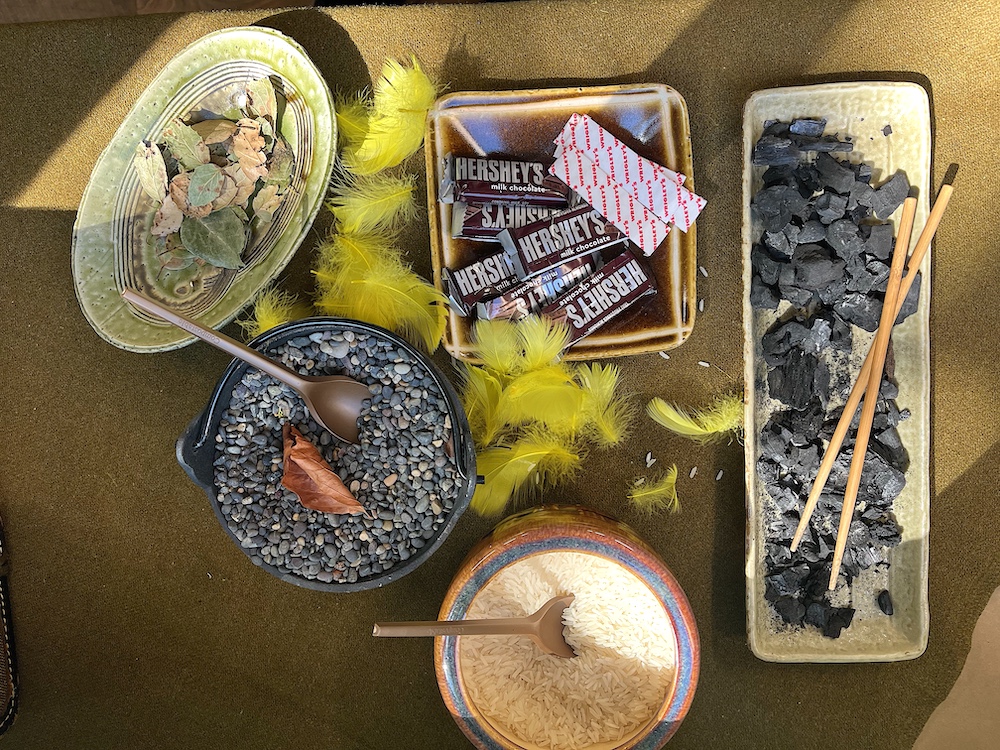
SUPPLIES for each child
watercolor set or a flat-sided blue crystal, to represent water
a couple of yellow feathers (white will work, eg from a pillow)
about a tablespoon of uncooked rice
a dry leaf
a snack-size chocolate bar (also used for BookBites*)
a small piece of charcoal (eg from the fireplace or a campfire)
a stick of gum (preferablly a vintage brand, but anything works (also used for BookBites*)
a pinch of gravel/tiny rocks
one piece 9x12 black construction paper
the narrative arc template (in our printables)
You can set these up buffet style, as shown, and have kids collect them all at once, or you can distribute sets to each child, or to pairs to share.Feel free to add any other elements you’d like to add to represent more Rising Action scenes — for instance loose tea or Chinese coins.
*Instead of enjoying BookBites separately and saving the wrappers, you might integrate that experience into the narrative arc project, stopping to eat rice, taste chocolate, and chew gum at each relevant plot point.
Set includes all worksheets and activity printables
DIRECTIONS
Begin by distributing the narrative arc worksheet (if you’re using it) and explaining the concept of the arc as written there.
Explain that we’re going to walk through the book’s storyline and create a piece of art at the same time. Assure them (and yourself) that this will make more sense as we go along. This is where it gets fun!

EXPOSITION
What element is everywhere at the beginning of this book? What’s pouring down on top of them, what’s underneath their sampan?
Yes, water! Add a crystal or splash of watercolor to the beginning of the arc.

CONFLICT
How can we symbolize separation on the narrative arc? What else does he separate from, by choice, as soon as he gets to shore?
The ducklings! Put a little blob of glue on the line where it begins to curve up on the collage arc, then stick a few feathers into the glue.

RISING ACTION
What happens next that shows us what kind of person Tien Pao is? Which scene lets us know Tien Pao is unselfish and compassionate?
When he gave his rice to the boy who was eating dirt! Put another blob of glue on your arc beside the feathers and cover it with uncooked rice.

RISING ACTION, cont.
Which scene shows us how resourceful Tien Pao is, and how determined he is to survive?
When he ate those old wet leaves! Put a hefty blob of glue on the arc before the top, and set some leaves in it.

RISING ACTION, cont.
When did we learn just how brave Tien Pao really was, when his own life was in greatest danger?
When he rescued the fallen airman! Remember how the airman shared his candy? Plop another hefty blob of glue on the arc right before the top, and add a piece of chocolate bar wrapper.

CLIMAX
How can we represent the destruction of Hengyang by fire?
Charcoal! Put a blob of glue at the very top of the arc, and place your piece of charcoal there.
RESOLUTION
How can we represent the care of the soldiers? What did they give Tien Pao as a treat?
Gum! Add glue where the arc begins to fall and put pieces of your wrappers on the line. (If you have bits of uniform, you can use those also or instead).

FALLING ACTION
We’ll symbolize Tien Pao's brilliant idea by representing his parents’ location. What surface represents the airfield, and the work he found his mother doing?
Gravel! Add more glue to the very end of the line, and sprinkle it with gravel.
A LitWits activity that spans the Conflict and Rising Action
Glory-of-the-Republic isn't just a sideckick in this book, though he does provide the only thing close to comic relief. Meindert DeJong makes sure we know that at every crisis, the pig inadvertently saves the day. And this activity ensures that everyone gets . . . a little glory.
When he realizes he's adrift, the first thing Tien Pao does is grab the boat rope and tie the pig to his wrist. "We have to stay together," he earnestly whispered—and looking out for that bulky, squealy, awkward friend is what keeps Tien Pao going against all odds. So in that indirect way, Glory saves his life.
Give each of your kids "a little Glory" (It's fun to hide them under leaves and make (or play) some pig noises before "finding" them), Have the kids tie him by the front leg to their wrist with twine, and take care of him for the day. Talk about the importance of the buddy system, or togetherness, throughout this story, and how Tien Pao cares for his pig no matter what. Point out that the pig proves heroic, and that as you come across scenes where Glory saves the day, they'll put a medal on his uniform.
What uniform, you ask? Well, you can't pin a star on a naked pig, can you? So have the kids use a little camo tape to make him a "shirt," as shown here, and pass out some gold stars.
Your kids might snap him a salute and say "Thank you for your service SIR!" as they attach the star.
Here are some medal-worthy actions by Glory-of-the-Republic:
Ch. 3: Glory finds them both shelter!
Ch. 3: Glory finds food! (Inspires Tien Pao to try leaves, which sustain him for weeks.)
Ch. 3: Glory comes up with the perfect camouflage! (Wallowing in mud.)
Ch. 4: Glory saves his buddy's life! (The pig bursts through the leaves as the airman is choking Tien Pao, thinking he's the enemy; when he sees Glory, he puts two-and-two together and releases him just in time.)
Ch. 5: Glory saves the airman's life! (Keeps him awake so he won't talk in his sleep and attract the enemy.)
Ch. 5: Glory helps capture an enemy soldier! (Though neither he nor Tien Pao would have volunteered him to be the bait.)
This activity emphasizes the truth that even the smallest of us can be of service—and that sticking together pays off.
Set includes all worksheets and activity printables
A LitWits activity from the Rising Action
To tell any story, you have to choose a point of view – a way of seeing and thinking about the things that happen. Meindert DeJong has chosen to tell The House of Sixty Fathers from Tien Pao’s point of view. This means we see the events through Tien Pao’s eyes; we know his thoughts and feelings.
Our creative writing worksheet helps kids imagine and perhaps even understand another character's very different perspective—which is excellent practice for life..
Set includes all worksheets and activity printables
A LitWits activity from the Rising Action
When Tien Pao discovers the injured American in the mountains, he and Hamsun have to communicate to survive. Even though they don’t know each other’s language, they’re able to understand each other through miming.
In this activity, kids pantomime a single sentence to a partner, or to the whole group, without using words, noises, or props—and discover that the heart does understand without words!
Even if you're only trying to ask someone if they'd like to go to Disneyland, or read Charlotte's Web, or other situations and questions we've provided in our printables.
Set includes all worksheets and activity printables
BookBites
A LitWits activity from the Rising Action
BookBites is a “taste of the story.” We choose a food right out of the book, and it has to be important to a plot point or theme, and/or unfamiliar for reasons of era, culture, or location. The House of Sixty Fathers doesn’t give us many food choices, but it does give us a new appreciation for every bite we take.
Before serving any of the three BookBites below, talk about Tien Pao's drastic decision, inspired by his pig's example, to eat leaves. After setting the tone of thoughtfulness, have the kids hold and smell some damp, dead leaves, and try to imagine the kind of hunger that drove that decision, while you read the passage in which the starving boy takes his first bite:
He sat listening almost wistfully to the little pig gobbling leaves. Suddenly he pulled a handful out of the little wall. He sniffed at the wet handful. Maybe leaves tasted better than grass. He closed his eyes and shoved some into his mouth. He smacked his lips loudly to make himself believe the soggy, musty mess tasted good. He swallowed them. They were bitter as gall, but at once they helped. For a moment his fierce hunger left him. He opened his eyes. His eyes had cleared! The spots were gone—the ballooning, lilting spots had gone away. Tien Pao grabbed another handful of leaves.
—Ch. 3
Of course, you won't ask them to eat leaves! The three BookBites below symbolize Tien Pao's hunger by his immense appreciation of them. They can be served all at once, as you discuss the circumstances of each one in the story, or you can serve each as you go through the Sensorized Arc activity (which makes use of rice grains and both candy wrappers).
RICE
The bowl of rice (actually two) prepared for Tien Pao by the "old crone" symbolizes her kindness and his too, with his parting words to her. It can be prepared the night before and served cold, the way Tien Pao ate it most of the time, when he had it at all. However, if you have a way to cook or heat it while you’re teaching, the aroma of hot rice adds another wonderful sensory element, and evokes the rice cooking in Chapter 5. Either way, it can be presented in a bamboo steamer or iron pot, and served with chopsticks in simple wooden bowls.
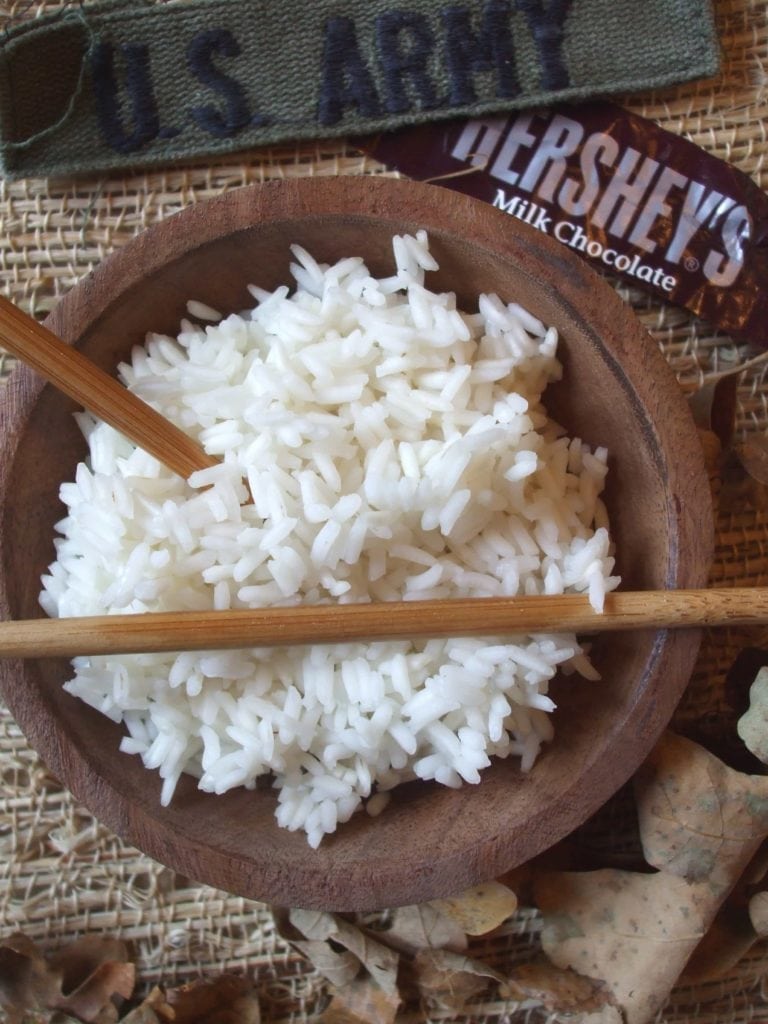
While the kids eat, play Chinese folk music.
CHOCOLATE
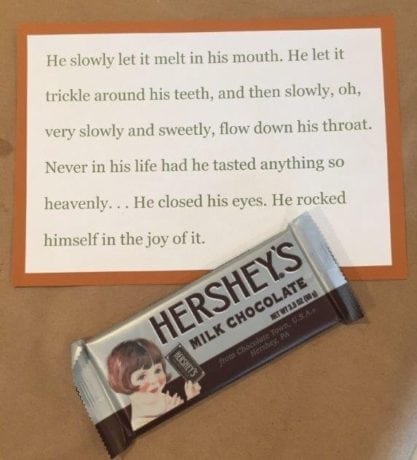
Have the kids very slowly nibble and savor miniature chocolate bars, while you read aloud from Chapter 4, where Tien Pao’s first experience of chocolate is so vividly described. They too may rock themselves in the joy of it, but you might want to tell them they're lucky the author made it sweet, because the real Army chocolate tasted terrible.
GUM
Tien Pao's first introduction to (two of) the "sixty fathers" they give him a piece of gum, which is new to him. Give each child a stick of gum and read about Tien Pao’s first, confusing experience with it in Chapter 7. Listen to a vintage radio ad for chewing gum. and World War II big band instrumentals.
Set includes all worksheets and activity rintables
A LitWits discussion about a theme
"Sticking together" is a big theme in this book, and its importance is often emphasized by signs of its negative, or opposite: signs of separation. These touch our hearts and help us feel how hard separation is—and how very important togetherness is.
From the backstory on, there's a focus on flight that shows up in objects, creatures, and actions. (This includes the idea of taking flight from danger—Tien Pao’s village didn’t stand a chance of fighting against the Japanese bombers, so they had to take flight, and become separated from home, loved ones, pets, land, and belongings.)
Have the kids guess these three symbols of flight by their sounds: the ducklings, the cuckoo, and airplanes (here the P40, flown by the Flying Tigers)
Ask the kids why Tien Pao’s ducklings can’t fly to safety. They have the potential to fly, but are too young and inexperienced — just like Tien Pao.
Tell them that in Chinese lore, the cuckoo bird represents spring and hope. It also represents abandoned children, because it abandons its own to be raised by other birds! How is the sound of the cuckoo helpful to Tien Pao? It gives him comfort and hope while he is separated from his family. He can’t see it, but he can hear it; he’s separated from it, but knows it’s there, just like he knows his family is out there somewhere, too.
The book opens with a “bad plane” and ends with a “good plane” — two sure signs that planes are a strong theme clue. Ask the kids how airplanes might symbolize both togetherness and separation — two sides of the same theme. The Japanese planes separate Tien Pao from his home, and the Beechcraft helps reunite Tien Pao with his family.
Photo: Fourteenth Air Force, B-24 Liberators. Our uncle, Norman Bruce Clendenen, captain of a Liberator, was killed when he and his crew were shot down in the waters of Formosa (now Taiwan).
Set includes all worksheets and activity printables
A LitWits activity from outside the narrative arc
If Tien Pao attended school in his village, he would have learned how to write the common words “house” and “fathers,” and numbers as well. Writing the book’s title in traditional Chinese calligraphy on traditional rice paper lets kids share in Chinese culture and Tien Pao’s story — if only “in title.”
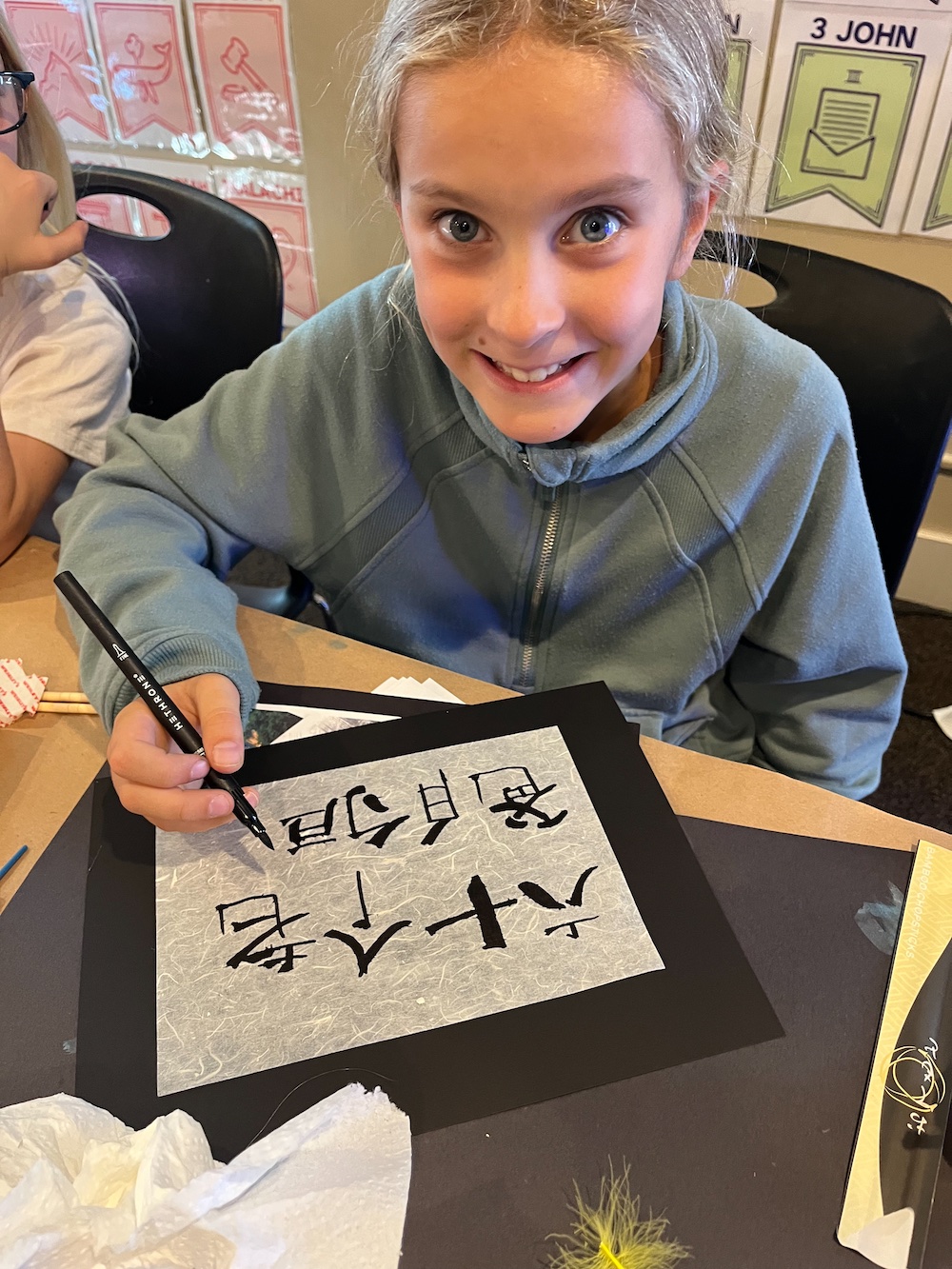
SUPPLIES
glue stick
a piece of rice paper trimmed to 6x9
a piece of black cardstock, for matting (or a pocket folder for storing worksheets)
copies of the calligraphy model in our printables (the dialect of Hunan Province is Xiang; here the translation is traditional Chinese)
Set includes all worksheets and activity printables
PREVIEWS BELOW
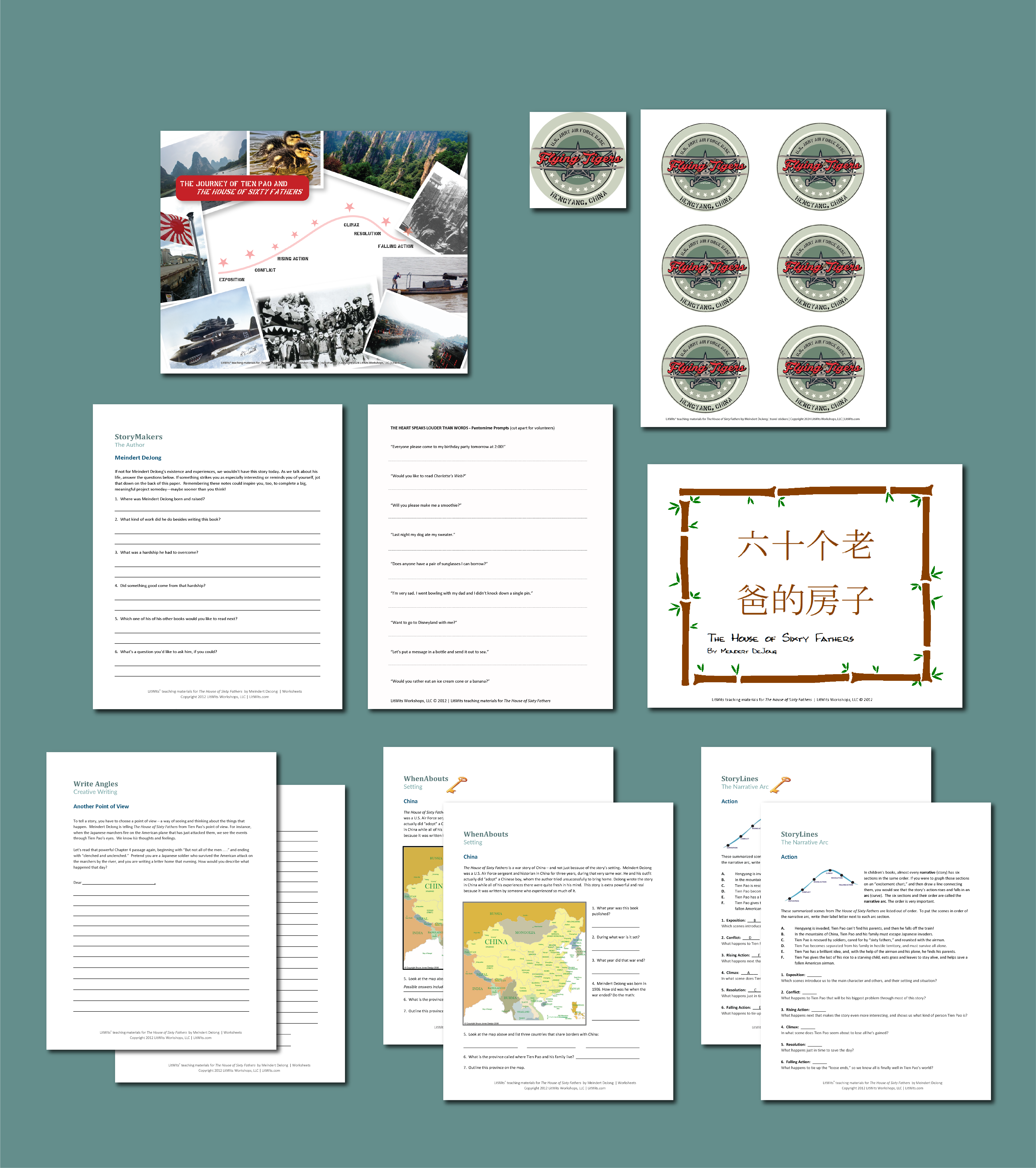
Throughout our workshops, we weave in worksheets that help kids process ideas in written form. For The House of Sixty Fathers, your kids can use these four worksheets to:
take notes about the author while watching our video bio
find the setting on a map and learn some significant dates
follow the narrative arc and see how this story conforms to it
practice writing about another character's point of view
These worksheets and all our activity printables are included in our printables set—click the red button for previews and details.
Set includes all worksheets and activity printables
A LitWits souvenir
Here's a travel sticker to prove kids have taken a trip through this great book, LitWits style, and have met some great people and learned some great things on the way!
Set includes all worksheets and activity printables
The worksheets and printables used for our activities are sold as a complete set.
Common Core State Standards Alignment for the comprehensive use of our teaching ideas and materials is also included for grades 3, 4, 5 and 6.
We hadn't read this book as kids—in fact, we'd never heard of it, or of any of Meindert DeJong's books. It was recommended by a wise friend, so we read it, and we've never been the same. It is profoundly moving, and a non-preachy reminder that we are all connected by the astounding, indefatiguable power of love.
At first, DeJong's writing seems highly simplistic, even repetitive—and then the effect sinks in, and you feel it deeply in your heart, and you realize what he's doing (we've written more about that here, from the heart).. We've gone on to read and teach The Wheel on the School and Along Came a Dog, more of his many award winners which we also highly recommend.
This book is packed with great takeaway topics, which we're sharing below. In our workshops, we did our best to make these teaching points tangible, meaningful, and memorable in the kids' hands. It's amazing how much kids can learn while they're "just" having fun!


TakeawaY 1
Meindert DeJong (pronounced De-Young) is worth getting to know, not just as an author but as a human being — one who has lived a great deal of what he has written. During World War II he was official historian for the Chinese-American Composite Wing, which was part of Chennault’s famous Fourteenth Air Force. A young Chinese war orphan (the Tien Pao of this story), was adopted by DeJong’s outfit at Peishiyi The boy chose DeJong as his special “father” and the two were devoted to one another. DeJong wanted to bring the boy back to the United States with him, but because of legal complications he was unable to do so.
The other soldiers left the youngster well provided for when they returned to America, but the Communists then took over that section of China, and Meindert DeJong never heard what happened to the boy. The dedication in the beginning of the book is “To Wally in memory of the compound in Peishiyi, China, and of little, lost Panza” — in fact, he wrote this book while he was still in China in the 1940s.
Source: Adapted from HarperCollins and the Clark Historical Library (CMU).
Takeaway 2
Togetherness, or unity, is a major theme in The House of Sixty Fathers. We see more than one thing joining together in this story, starting with Tien Pao in the runaway sampan, seeing the river widening to join another one. The name of his village is “The-Corner-of-the-Mountains-Where-the-Rivers-Meet.” Two countries join to help each other, Tien Pao and the airman join together in the forest, the airman rejoins his outfit, Tien Pao joins all of them, and finally he rejoins his family.
It's a theme emphasized by acts of separation that touch our hearts and make us all the happier for Tien Pao by the very end.

Takeaway 3
The House of Sixty Fathers is set near and in Hengyang, a real city in Hunan Province that was badly damaged by warfare during World War II. (Hengyang lies on both sides of the Xiang River, which is a branch of the Yangtze River.) In the book, Hamsun was part of the Flying Tigers, a group that became famous for their daring missions in China.
Things to talk about with the kids:
Why did the Japanese invade China back in the 1930s and 1940s? Explain that Japan had an “imperialist policy” — which means their government acted as if their country were superior to others and could take what it wanted.
What might an island country want from an enormous mainland country? In what ways is an island at a disadvantage?
Tell the kids that at first America helped China fight back by giving them money, or “economic aid.” Why did America suddenly decided to join the war and send soldiers overseas?
How many have heard of Pearl Harbor, in Hawaii? Tell the kids Japanese planes bombed American military ships there in 1941, and that made Americans realize that their own country was in danger, too. Many young American men offered to be soldiers and help the Chinese and other countries fight off invaders.
Point out that there were two giant wars going on at the same time, one against Japan and one against Germany – it seemed most of the world fighting on one side or the other. What do we call them both together? Explain that the Great War had ended in 1918, so this one was called World War II. Millions of people died during these wars. Germany surrendered in May of 1945, but World War II wasn’t over until Japan surrendered in August of that year.
Ask how our countries can be such good friends now, after such a terrible fight. Why do we make up with anyone?
The House of Sixty Fathers is chock-full o topics to explore, from Chinese culture to Japanese military tactics to American politics. Scroll down to see our curated Learning Links for more tangential teaching opportunities, and to see how we brought this book and its ideas to life.
Explore these links to supplement your reading experience, research points of interest, and prompt tangential learning opportunities.
About the Book & Author
Alternative book cover, 1972
Chinese book cover
Illustration from the book
Goodreads community reviews
Sonlight reviews
A very thoughtful essay on important themes in the book
Interview notes revealing DeJong's character (Calvin College)
Biography (New Netherland Institute)
Autobiographical article about DeJong’s Dutch origins (Calvin College, pg 35-44)
Chinese-American Composite Wing (CACW) where DeJong served - Wikipedia
Peishiyi (airfield where DeJong served - Wikipedia
Finding aid for the Meindert DeJong papers – Clarke Historical Library
Overview from “100 Books Every Child Should Read Before Growing Up”
Photo and basic facts (Wikipedia)
Short bio with Newbery acceptance speech quote (Bookology Magazine)
Bio (HarperCollins)
Obituary (NY Times)
Story Supplements
Photo of Japanese sampan and women, dated before 1886
Photo of Hunan mountains – as seen in the movie Avatar
Map of Hengyang within Hunan Province within Asia, showing length of Xiang River
Map of Japanese path of invasion
“World War II: From the Chinese perspective” (Tom Clifford, George Washington Univ)
Image of flag of Japanese Imperial Army
Photo of Japanese soldiers in China, 1931
Information and images of the Flying Tigers
William Norman Reed, ace upon whom DeJong may have based Lt. Hamsum - Wikipedia
Photo of US fighter jets (Flying Tigers) over China in WW2
Image of Flying Tigers crew c. 1940
Audio of bomb explosions, fighter jets – listen to sample or purchase
Classical Chinese Folk Music
Chinese Folk Songs(instrumental) - Musical Moments East on YouTube
Beech-nut gum vintage radio ad
Photo of WWII Beechcraft AT-7 airplane
The great airfield at Leijiang and its revetments, revisited and described - J-Aircraft.com, Robert Anderson
Beyond the Book
First Sino-Japanese War - Britannica
Events that linked the Sino-Japanese war (Nanking invasion) with World War II and US involvement - US State Dept Archives
Video (<3m,non-graphic) about the Pearl Harbor attack - Smithsonian
"How the US and Japan Went From Enemies to Allies after WW II" - History.com
Video (15m) "Sampan Family" all about sampans (1949)
Article "No Sweet Treat for GIs" about the rations recipe for chocolate - Butler Eagle
Because DeJong as a child was bullied for being an immigrant, and because this story is about refugees, here’s a great collection of resources on bullying, including of immigrants
When choosing props for our live workshops, we always try to focus on two important categories: props that are unique to the setting, because they help kids understand “what that was like,” and props that are symbolic of themes, because they make big ideas visual and tangible. Both kinds of props generate those wide-eyed, “aha!” moments. You could easily have your kids contribute items to a table over time, as the book is being read.
Sometimes we create a printable prop; click the button to see what's included for this book.
Set includes all worksheets and activity printables
Chinese money represents Tien Pao's earnest desire to earn money for his family by rowing the "river god." It also represents a key plot point the life-saving bribe paid in Chapter 6.
An image of The Flying Tigers and a scrap of a U.S. soldier's uniform.
Musty leaves moistened to give them that foresty smell. In Chapter 3 when Tien Pao is lost and starving he first begins to eat leaves to survive. d
Chinese writing - oddly enough we found this blowing through the woods the day of our workshop and when we had it translated by a friend we learned that it includes characters for missing left out coming down falling and nighttime. How appropriate!
Rice (also used for arc project). Rice is featured throughout the story but most memorably in Chapter 3 when Tien Pao sets a bowl of his last few grains beside the starving boy.
Loose tea - we chose jasmine for its wonderful aroma.
Three "ducklings" in a vintage dishpan.
A "hamper-like" basket, like the one in which Tien Pao hides Glory-of-the-Republic in Chapter 6.
WW2 army blanket (this one was our dad's)
You're literally on our page about inspiring kids to love great books. YAY! We're eager to share our passion for LitWitting and the work we've done for over a decade.
We're also eager to keep doing it! :) So if you find this guide-page inspiring* and useful, please share it with your social world. And if you buy our printables for this book, thank you. We appreciate you helping us keep the lights on at LitWits!
Happy teaching,
Becky and Jenny
Sisters, best friends, and partners